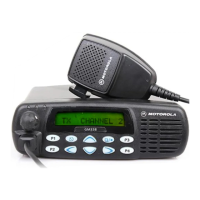
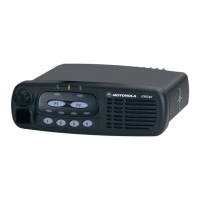
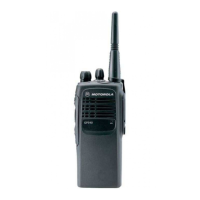
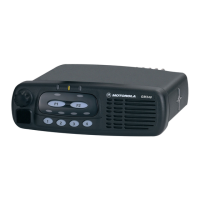
This document describes the Motorola Professional Radio GP Series, focusing on its power distribution and controller circuits. The radio is designed for professional use, likely in environments requiring robust and reliable communication.
Function Description
The Motorola Professional Radio GP Series is a communication device that utilizes a sophisticated controller system to manage its operations, including power distribution, digital processing, audio/signaling, and real-time clock functions. The core of the radio's intelligence resides on the Main Board, which houses the microcontroller and various supporting circuits.
Power Distribution: The radio's power system is designed for efficiency and reliability, drawing power from a 7.5V battery. An electronic on/off control system manages power distribution, initiating a momentary-on path when the mechanical on/off/volume control is activated. This triggers the distribution of power (SWB+) across the board. A 3.3V Vdda regulator then supplies the microprocessor, which, within 12ms, takes over the momentary-on path. The SWB+ supply continues to power the entire board until the radio is turned off. The system also incorporates a low battery detection mechanism, which prompts the microprocessor to save personality data to EEPROM before shutting down, ensuring data integrity.
Controller Circuits: The controller board acts as the central interface, integrating various radio subsystems. It is divided into MCU digital and audio/signaling architectures.
- MCU Digital Architecture: This section comprises a microcontroller, along with associated EEPROM, RAM, and ROM memories. This architecture is versatile, supporting both low-tier and high-tier products, including conventional and trunking portable radios. Different memory sizes (RAM: 8KB, 32KB; ROM: 128KB, 256KB, 512KB) are available to accommodate various application software requirements.
- Real Time Clock (RTC): Radios equipped with displays feature an RTC module within the microcontroller. This module is crucial for message time stamping and maintaining accurate time. It operates using a 38.4kHz crystal oscillator, which is divided down to 1 Hz by the processor. A Lithium-Ion battery provides backup power to the RTC when the primary battery is removed, ensuring continuous timekeeping. A MOSFET (Q416) switches in the Lithium-Ion supply when Vdd is absent and provides isolation during radio program flashing. The 3.3V regulator is responsible for charging the Lithium battery.
- Audio/Signaling Architecture: This architecture is built around the audio/signaling/filter/companding IC (ASFIC_CMP) and an audio power amplifier. It receives a 16.8 MHz clock from the synthesizer, recovered audio, squelch signals, MCU control signals, and input from internal or external microphones. Its outputs include a microprocessor clock, a modulator output to the synthesizer, and amplified audio signals directed to either an internal or external speaker.
Usage Features
The Motorola Professional Radio GP Series offers several features that enhance its usability in professional settings:
- Reliable Power Management: The radio's power distribution system is designed for stable operation, with an automatic shutdown sequence upon low battery detection that prioritizes saving user data. This prevents data loss and ensures a smooth user experience even in critical power situations.
- Flexible Memory Configurations: The availability of different RAM and ROM sizes allows for customization to suit various application software needs, making the radio adaptable to different operational requirements, from conventional to trunking systems.
- Real-Time Clock for Enhanced Operations: The integrated Real-Time Clock is particularly useful for applications requiring precise timekeeping, such as message time stamping. This feature is invaluable for logging events and ensuring accurate record-keeping in professional environments. The RTC's backup battery ensures that time is maintained even when the main battery is removed, providing continuous functionality.
- Comprehensive Audio and Signaling: The advanced audio/signaling architecture supports clear communication through both internal and external microphones and speakers. The inclusion of a modulator output to the synthesizer and a microprocessor clock indicates its capability for complex signaling and control, essential for professional radio communication.
- External Connectivity: The radio supports external accessories through a 20-pin connector, allowing for integration with keypads, option boards, and expansion boards. This expandability enhances the radio's versatility and allows it to be tailored to specific user needs.
- User-Friendly On/Off Control: The mechanical on/off/volume control initiates the power-up sequence, making it intuitive for users to operate. The electronic control then takes over, ensuring efficient power management.
Maintenance Features
The design of the Motorola Professional Radio GP Series incorporates features that facilitate troubleshooting and maintenance:
- Detailed Troubleshooting Charts: The manual provides extensive troubleshooting charts specifically for UHF/UHF2/800MHz controllers. These charts guide technicians through a systematic process to diagnose issues related to PTT, audio, speaker functionality, power-up alerts, and various voltage checks. This structured approach helps in quickly identifying the root cause of problems, reducing downtime.
- Component-Level Diagnostics: The troubleshooting process involves checking specific components and signals, such as the red LED, PTT U409 pin 53, Q502-2 voltage, U409 EXTAL frequency, U201 pin 19, and various voltage levels at U247/U248. This level of detail allows for precise fault isolation.
- Reprogramming Capability: For issues related to radio data or programming, the charts suggest reprogramming the correct data, indicating that the radio's software can be updated or restored. This is a critical maintenance feature for correcting software-related malfunctions.
- Modular Design for Replacement: The troubleshooting charts often recommend replacing specific components or modules (e.g., speaker, faulty component, U247/U248, U404, U420 Audio PA, MCU) once a fault is isolated. This modular approach simplifies repairs, allowing for the replacement of defective parts rather than the entire unit.
- Clear Schematic Allocation: The manual provides a clear allocation of schematics and circuit boards, categorizing them by PCB numbers and radio types (UHF, UHF2, UHF GP1280, 800 MHz). This organization helps technicians quickly locate the relevant diagrams for specific radio models, aiding in accurate diagnosis and repair.
- Test Points: The presence of test points (e.g., TP405 TEST_POINT) on the circuits indicates that the design supports easy measurement of critical signals, which is essential for verifying circuit operation and troubleshooting.
- Isolation for Programming: The MOSFET (Q416) in the RTC circuit provides isolation from the BOOT_CTRL function during radio program flashing, protecting the circuit and ensuring stable programming operations. This is a crucial design consideration for maintenance and software updates.


 To Next Page



 General