
 Need help?
Do you have a question about the MPH PYTHON III and is the answer not in the manual?
Explains how the PYTHON III radar can be used in various operational modes, including moving and stationary.
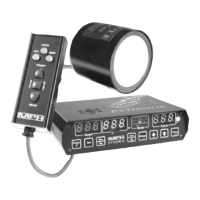
Describes the mode section of the display, indicating radar status like standby or transmission.
Details the three LED speed display windows: Target, Auxiliary, and Patrol.
Explains the photocell for automatic brightness adjustment and the infrared remote sensor.
Controls the power for the PYTHON III radar and remembers user settings.
Initiates a self-test of the radar, checking displays and operation at various speeds.
Toggles the radar between moving and stationary operating modes.
Adjusts audio volume and squelch settings for the radar.
Adjusts the radar's sensitivity setting, ranging from 1 to 9.
Sets patrol speed range to highway values or increments settings.
Sets patrol speed range to city values or decrements settings.
Controls City/Highway mode and patrol blanking, allowing adjustment of settings.
Explains the speaker for Doppler audio and tone beeps, aiding target identification.
Describes the red buttons for antenna control (Front, Rear, Standby) and the blue Lock button.
Explains the extra buttons (S/O, FAST) on the FS remote for advanced modes.
Details the Fastest mode, allowing viewing of the fastest target alongside the strongest.
Explains the Same Direction mode, tracking targets moving in the same direction as the patrol vehicle.
Describes the initial self-test sequence and software version display upon powering on the radar.
Explains the standard test procedure using tuning forks to verify radar accuracy.
Details how to perform a tuning fork test for the radar in stationary mode.
Explains how to perform tuning fork tests for moving radar modes, simulating patrol and target speeds.
Explains harmonic detection circuitry that prevents false readings from strong reflections.
Discusses factors affecting radar range and optimal placement within the vehicle.
Discusses traditional power sources and recommendations for optimal performance.
Provides instructions for replacing the fuse in the cigarette lighter plug.
Provides a historical perspective on the development of traffic radar technology.
Explains the Doppler principle and its application in velocity measurement.
Details how the Doppler principle is used for measuring speed.
Explains how the Doppler principle is practically applied in MPH traffic radar.
Explains the theory behind moving traffic radar operation, including signal processing.
Explains the Fastest mode, its purpose, and limitations for target identification.
Details how to operate and use the Fastest mode on the radar unit.
Describes the Same Direction mode and its operational requirements.
Explains how to operate the Same Direction moving mode and the role of the FAST button.
Discusses natural factors like rain, terrain, and strong reflectors that can affect radar operation.
Covers man-made influences like electronic signals, power lines, and vehicle noise causing interference.
Legal encyclopedia reference on radar evidence admissibility in traffic cases.
Legal publication on cases proving speed violations using radar devices.
Landmark case establishing radar accuracy and operator qualification sufficiency.
Case law establishing radar measurement accuracy and operator competency requirements.
Details certification services for the radar and tuning forks, including recertification.
Describes the available durable carrying case for storing the radar and accessories.
Lists various mounting brackets available for different vehicles and motorcycles.
Information on obtaining the comprehensive service manual for authorized personnel.
Details how owners and agencies can order additional copies of the operation manual.
Information on ordering replacement certified tuning forks.
Explains the speedometer interface module for comparing radar speed to vehicle speed.
Outlines the rigorous quality control measures and testing procedures for the PYTHON III radar.
Details the process for warranty repairs, requiring authorization and factory service.
Recommends MPH's service center for out-of-warranty repairs due to expertise.
Lists system specifications including power, voltage, current draw, and speed ranges.
Details the display specifications: speed display windows, LED indicators, control buttons, and connectors.
Provides physical specifications for the remote control, including button types and dimensions.
Lists specifications for the antenna unit, including operating frequency, power, and beam width.
Details the specifications for the mixer diode, including type and burnout rating.
Provides typical range and factors affecting it for different radar bands.

 To Next Page
 General