Care and Use of MSA Helmets ; Frequently Asked Questions and Answers
It is important that you read and carefully follow all of the instructions and warnings accompanying your helmet.
Failure to follow the instructions listed on the bag provided with your helmet may result in serious injury or death.
For questions concerning the care and use of your MSA helmet, contact your MSA Sales Associate or MSA Customer Service at 800-MSA-2222.
QUESTION ANSWER
What is the service life of an
MSA industrial helmet?
MSA helmets are designed with high-quality, wear-resistant materials but do not last forever. The helmet’s protective properties will degrade by exposure to many
common work environments, such as extreme temperatures, chemical exposure, sunlight, and normal daily wear. MSA recommends the following replacement schedule:
• Suspension (replace every 12 months)
• Helmet (replace every 5 years)
To ensure that a helmet shell or suspension has not reached the end of its service life, MSA recommends the following procedure before and after each use:
• Visually inspect the shell for breakage, cracks, crazing, discoloration, chalky appearance, or any other unusual condition. Also, inspect the shell for brittleness
by exing the brim (do not compress the shell sides). These conditions can indicate a loss of impact, penetration, and/or electrical resistance and the helmet
must be replaced immediately.
• The suspension should be checked for loss of exibility. Check for cracks, breaks, frayed straps, or damaged stitching. If any of these conditions exist,
the suspension must be replaced immediately.
NOTE: These are recommended useful service life guidelines. Wear or damage noticed during a regular inspection may determine that an earlier replacement of the
entire helmet is necessary. ALWAYS replace the helmet after it has withstood impact or penetration. The life of a Skullgard Helmet tends to exceed our suggested service
life due to the increased rigidity of the helmet’s materials and areas of use. However, as with other personal protective equipment, a Skullgard Helmet’s life should
ultimately be determined by routine daily inspection before and after use.
Why don’t MSA industrial helmets
have a UV indicator?
While there may be benefits to a UV indicator, we feel that this only tells part of the story. Other factors, such as the appearance of cracks or crazing, frayed suspension
straps, or other anomalies dictate that - regardless of a UV indicator - users should perform daily inspections before and after each use. Keep in mind, too, that all MSA
helmets have UV inhibitor molded into the material as it's being manufactured.
What does the date code on an
MSA industrial helmet represent?
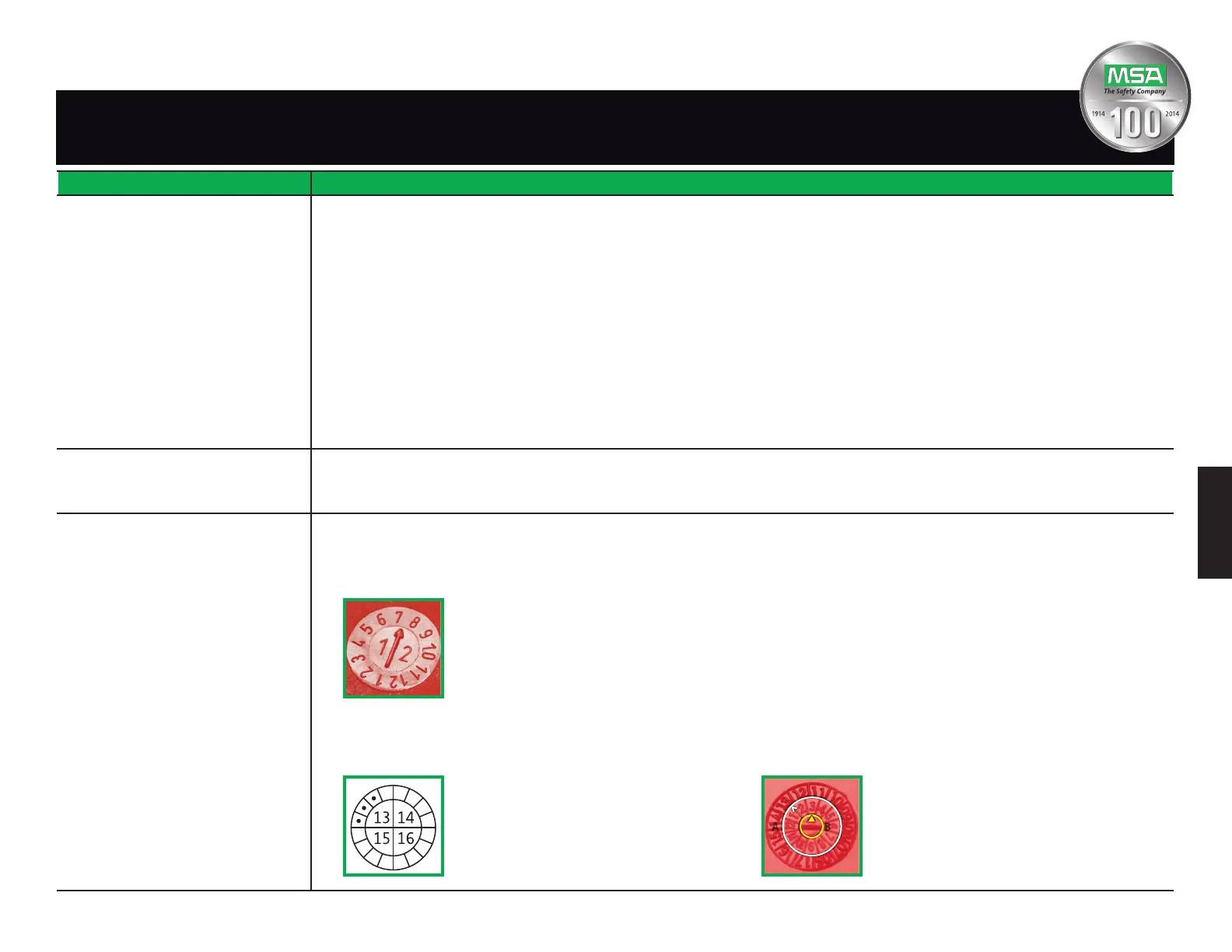
vThe date code indicates when the shell was molded. Date codes are molded into the underside of the shell’s brim with the year and month in which that specific
shell was molded. This date does not indicate a helmet’s service life; the service life begins when it is placed into service (see "What is the service life of an MSA
industrial helmet?" above).
The following date code refers to these MSA Protective Caps/Hats:
• V-Gard Cap and Hat • Topgard Cap and Hat
• V-Gard 500 Vented and Non-Vented Cap • Super-V Cap
• V-Gard GREEN Cap • Vanguard Cap
• SmoothDome Cap • Comfo Cap
The large number inside the circle indicates the year. The arrow inside the circle points to the outer ring of numbers that represents the month.
Therefore, this specific example reads July (7th month) of 2012 (12 in center).
MSA Skullgard Cap and Hat
Four years are noted in the center, and each year
is surrounded by four medallions. As each quarter
of each year passes, the medallions are “dotted.”
This process is continuous and read in a clockwise
direction. Therefore, this specific example reads
3rd quarter (July-September) of 2013.
Two rings are noted around the center circle:
(A) the outer ring indicates the year, and (B) the inner
ring indicates the month. The smaller arrow between
both rings points to the year (A), and the arrow inside
the center circle points to the month (B). Therefore,
this specific example reads March (3rd month) of 2013
(13 on outer ring).
MSA Bump Cap
2
A B


 To Next Page
 Loading...