The MSA Cairns® 1836 Fire Helmet is a protective ensemble element designed for structural firefighting activities, offering limited head protection. It is compliant with NFPA 1500, Standard on Fire Department Occupational Safety and Health Program, CFR Title 29, Part 1910, Subpart I, Personal Protective Equipment, and NFPA 1971, Standard on Protective Ensembles for Structural and Proximity Fire Fighting, as applicable, depending on the chosen configuration.
Function Description:
The primary function of the MSA Cairns® 1836 Fire Helmet is to provide limited protection to the head during structural firefighting operations. It is designed to be worn comfortably and safely with most Self-Contained Breathing Apparatus (SCBA) facepieces, featuring an exclusive interface that allows the helmet to rest in the proper position for a secure fit of both the helmet and facepiece. The helmet is equipped with various components for adjustment, eye/face protection, and secure fit, including a headband assembly, ratchet system, chinstrap, and options for external goggles, internal Defender Visor, or Bourke lenses.
Important Technical Specifications:
- Headband Adjustment: The headband assembly has three location settings (front and two rear-side) for adjustment, ensuring a proper fit.
- Ratchet System: The ratchet knob adjusts in 1/8 inch (0.3 cm) increments, and the pivoting nape rotates 20 degrees for a comfortable and snug fit. The headband adjustment size accommodates hat sizes 5 - 3/8 to 8 - 1/2.
- Eye/Face Protection:
- External Goggles: Designed to fit comfortably without gaps, adjustable via straps and slide buckles.
- Defender Visor (Internal): Stays locked inside the helmet until needed, lowered by grasping handles and pulling down/back, raised by pushing up until locked. The lens can be articulated.
- Bourke Lenses: Traditional Bourke lenses are for cosmetic purposes only and do not provide eye or face protection, not certified to ANSI or NFPA standards. NFPA-compliant Bourke lenses are marked with certification information.
- Detergent Compatibility: For routine cleaning, a mild detergent with a pH range of 6.0 to 10.5 is recommended. For SCBA washing machines, only Pro-Blend SCBA detergent (P/N PB0010967AA) is approved, with a calibrated concentration of 0.6%.
- Water Temperature for Cleaning: Water temperature for cleaning should not exceed 105°F (40°C).
- Material Compatibility (Cleaning): Do not use abrasives, solvents, paint removers, acetone, paint or lacquer thinner, or chlorinated organic solvents on the fire helmet shell.
Usage Features:
- Donning: The manual provides detailed steps for donning the helmet, including adjusting the headband, ratchet, and chinstrap. Specific instructions are given for integrating the helmet with SCBA facepieces and adjusting various eye/face protection options.
- Doffing: Simple steps are outlined for doffing the helmet, involving loosening the chinstrap and ratchet, then removing the helmet.
- SCBA Facepiece Interface: The helmet's design allows for a secure and comfortable fit with most SCBA facepieces, with adjustable headband features to prevent gaps or upward pushing by the facepiece.
- Eye Protection Recommendations: MSA recommends wearing approved eye protection (e.g., safety glasses complying with ANSI/ISEA Z87.1 and CSA Z94.3) in conjunction with faceshields and NFPA Bourke lenses, as the helmet's integrated eye/face protection provides limited coverage.
- RFID Tap to Pairing: Instructions for RFID functionality are available online.
Maintenance Features:
- Routine Cleaning:
- Helmets should be cleaned after each use to prevent contamination from toxins.
- Use a solution of water (no higher than 105°F/40°C) and a mild detergent (pH 6.0-10.5).
- Soft Goods (ear cover, ratchet cover, liner, chinstrap) and goggles should be removed and washed separately, preferably machine-washed with a mild liquid detergent.
- The fire helmet shell, impact cap, and Defender visor can be wiped with a soft sponge or cloth dampened with warm water and mild detergent.
- Do not use cleaning solvents, oils, varnishes, or polishes other than those recommended.
- Air dry all components completely; do not use forced hot air, direct/indirect sunlight, fluorescent light, or UV light. Do not dry in a cabinet air dryer.
- Advanced Cleaning:
- Required at least every six months, or whenever a routine inspection removes the ensemble from service.
- Must be performed by a manufacturer-trained organization, verified organization, or verified Independent Service Provider (ISP).
- Involves removing all detachable components and accessories, immersing the entire helmet and accessories in a solution of water and mild detergent (pH 6.0-10.5, max 105°F/40°C), scrubbing with a soft brush, rinsing thoroughly, wiping with a clean cloth, and air-drying.
- The Foam Impact Cap should NOT be removed from the Plastic Liner during advanced cleaning.
- Routine Inspection:
- Perform after EACH use to check for damage from impact and thermal exposure.
- Inspect the fire helmet shell for stress cracks, cracks through the shell, cracks >1 inch, misaligned surfaces, exposed fibers, crazing, dents, abrasions, exposed glass fibers, bubbling, soft spots, warping, discoloration, or dull/chalky finish.
- Inspect the impact cap for cracks, depressions/dents, punctures, blisters, discoloration, or burnt/charred areas.
- Inspect suspension for missing, cut, fraying, broken stitching, tears, abrasions, brittleness, discoloration, or damaged attachment clips.
- Inspect ear cover, ratchet cover, and liner for missing, cut, broken stitching, tears, discoloration, charring, perforation, or searing.
- Inspect headband for brittleness, tears, cracks, breaks, punctures, holes, or inability to open ratchet by tugging on nape arms.
- Inspect chinstrap for fraying, missing/broken parts, missing/cut/frayed/broken stitching, clogged/worn-out hook-and-loop fastener, brittleness, broken/missing quick-release button, loose Postman's Slide, broken/cracked attachment points, or loose snap fasteners.
- Inspect goggles/mounting hardware for damage to ventilation/filtration areas, lens, frame, straps, or adjustment assembly.
- Inspect faceshield/hardware for blistering, bubbling, cracking, charring, damage, or missing E-ring retainer.
- Inspect Bourke lenses/mounting hardware for blistering, bubbling, cracking, charring, or damage.
- Inspect Defender visor/attachment clips for blistering, bubbling, cracking, charring, or if the lens won't stay stowed or adjust.
- Inspect edge trim for broken/exposed aluminum core or if it's pulled away from the helmet hanger.
- Inspect reflective trim for charring, partial detachment, non-reflectivity, or missing sections.
- Inspect anchor release and accountability brackets for any damage.
- Any damaged part must be replaced, or the entire helmet ensemble if shell damage is found.
- Advanced Inspection:
- Includes all routine inspection items plus additional checks.
- Requires disassembly of the helmet components, as illustrated in the manual, to inspect each part thoroughly.
- For replacement and warranty purposes, the manufacturing date is based on the oldest original part shipped with the complete compliant helmet ensemble.
- Storage:
- Store in a clean, dry area away from heat, cold, direct/indirect sunlight, fluorescent light, or UV light.
- Keep leather products away from direct sunlight, open windows, hot ovens, and radiators.
- Do not store with the lining ratchet face down or with the ratchet fully extended to prevent distortion.
- When not in use, store with the ratchet suspension set to its smallest size.
- Do not store unauthorized equipment on or in the helmet, as it can change protective capacity.

 Need help?
 General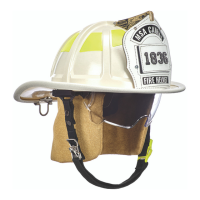

 To Next Page