3 Doffing
US MSA Cairns® 1836 9
3 Doffing
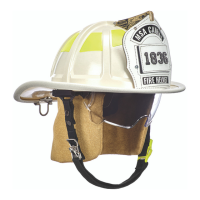
1. Loosen and release the chinstrap.
2. While holding the fire helmet, turn the ratchet knob counter-clockwise to loosen the headband.
3. Remove the fire helmet.
4 Maintenance
WARNING!
Component repair, alteration, or replacement of any MSA Cairns Fire Helmet must be performed by in by an MSA-
authorized repair facility unless otherwise stated. Unauthorized component repair, alteration, or replacement of any MSA
Cairns Helmet will void the factory warranty and may adversely affect the performance of the helmet. Carefully obey all of
the procedures for cleaning, inspecting, repairing, and storing the fire helmet.
Failure to follow this warning can result in serious personal injury or death.
For additional guidance, refer to the current edition of NFPA 1851, which specifies the minimum selection, care, and
maintenance requirements for structural firefighting protective ensembles and the individual ensemble elements, including
fire helmets and interface components that are compliant with NFPA 1971, Standard on Protective Ensembles for
Structural Fire Fighting Fire Fighting.
4.1 Routine Cleaning
WARNING!
Helmets that are dirty or soiled from any firefighting, rescue, or related activities may be contaminated with toxins that are
poisonous, pathogenic, toxic or carcinogenic. Failure to properly clean the helmet after each use per the recommended
cleaning procedures may result in injury, illness, disease and/or death. Helmets should be properly cleaned consistent with
NFPA 1851 under the supervision of the authority having jurisdiction and standard operating procedures.
• Do not use cleaning solvents, oils, varnishes, or polishes other than those recommended in this manual to clean or
decontaminate fire helmets or fire helmet components.
• Consult the Cairns Helmet Washing Instructions (P/N 3600-118-MC) for recommended cleaning procedures,
including instances of approved tumbling or agitation methods for washing or drying complete fire helmets.
• Do not use forced hot air or put the fire helmet directly on a heat source to dry it.
Failure to follow these warnings can result in serious personal injury or death.
• To prevent contamination after firefighting activities, clean the fire helmet after each use, before inspection.
• Remove any fire helmet that has been exposed to chemical or biological contaminants from service and clean it
using the procedures in 4.2 Advanced Cleaning.
• For routine cleaning, use a solution of water at a temperature no higher than 105°F (40°C) and a mild detergent with
a pH range of not less than 6.0 pH and not greater than 10.5 pH undiluted as indicated on the product safety data
sheet (SDS) or original product container.
• Do not use a fire helmet that is wet from use or cleaning. Allow all parts to dry completely before use.
• Do not dry helmet or components in direct or indirect sunlight, under fluorescent light, or under UV light.


 To Next Page