Need help?
Do you have a question about the MSI Oculux Series and is the answer not in the manual?
Legal notice regarding product branding and intellectual property rights.
Contact details and resources for product assistance and troubleshooting.
Critical guidelines for safe operation, handling, and maintenance of the monitor.
Information on green product attributes and the manufacturer's environmental policy.
Declarations of conformity with European (CE) and US (FCC) regulations.
Details on WEEE, chemical substances, and RoHS compliance across various regions.
Lists all items included in the monitor packaging for initial setup.
Step-by-step instructions for attaching the monitor stand to the display.
Guidance on optimizing the monitor's position for viewing comfort and ergonomics.
Identification of monitor ports, buttons, and key features for setup and use.
Procedures for physically connecting the monitor to a computer system.
Explains how to use the Navi Key to navigate the OSD menu.
Outlines default Navi Key functions and basic OSD menu interactions.
Covers OSD adjustments for gaming, dark boost, response time, and image profiles.
Details settings for brightness, contrast, color temperature, and eye saver.
Options for selecting input signals and personalizing Navi Key shortcuts.
Configuration for language, sleep modes, transparency, and factory reset.
Technical details, dimensions, power requirements, and environmental operating conditions.
Supported display resolutions and refresh rates via HDMI and DisplayPort.
Solutions for power, image, connectivity, and display quality problems.
This document serves as the user manual for the Oculux Series LCD Monitor, specifically covering models NXG251R (3EA35 / 3EA37). It provides comprehensive guidance on setting up, operating, and maintaining the monitor, ensuring users can maximize its features and performance.
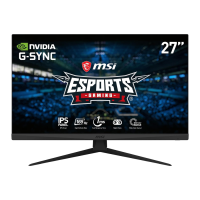
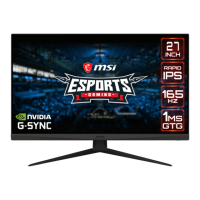
The Oculux Series LCD Monitor is a high-performance display designed to provide an immersive visual experience. It functions as a primary output device for computers, rendering graphics and text with clarity and precision. The monitor is equipped with multiple input interfaces, including HDMI and DisplayPort, allowing for versatile connectivity with various computing devices. It also features USB Type B Upstream and USB Type A Downstream ports, enabling the monitor to act as a USB hub, expanding the connectivity options for peripherals. A dedicated headphone jack is integrated for audio output, providing a convenient solution for private listening. The monitor is designed with a focus on gaming, offering features like high refresh rates and fast response times to deliver smooth and responsive gameplay. Its On-Screen Display (OSD) menu, accessible via a multi-directional Navi Key, provides extensive customization options for image settings, gaming modes, and other display parameters.
The Oculux Series monitor is designed for user comfort and convenience. Its adjustable stand allows for tilt and height adjustments, enabling users to position the screen ergonomically to suit their viewing preferences and reduce strain. The monitor can also be wall-mounted using a VESA-compatible kit, offering flexibility in setup.
Setting up the monitor involves a straightforward process: connecting the stand, attaching the base, and then connecting the monitor to a PC using either an HDMI or DisplayPort cable. The power adapter and cord are then connected to the monitor and an electrical outlet, respectively. Once powered on, users can select their desired input source through the OSD menu.
The OSD menu is the central control panel for the monitor's features. It is navigated using the Navi Key, a multi-directional joystick-like control located on the monitor. Pressing the middle button of the Navi Key launches the OSD main menu, from which users can access various sub-menus. The Up, Down, Left, and Right movements of the Navi Key are used to navigate through menus, select items, and adjust values. The Navi Key also supports "Hot Key" functions when the OSD menu is off, allowing for quick access to frequently used settings.
Key OSD features include:
The monitor also supports "Refresh Rate" display, which can be shown on the screen at a user-defined location. An "Alarm Clock" feature can also be set and displayed on the screen, providing a convenient timer.
The manual emphasizes several safety and maintenance guidelines to ensure the longevity and proper functioning of the monitor:
 General
| Aspect Ratio | 16:9 |
|---|---|
| Viewing Angle | 178°(H) / 178°(V) |
| VESA Mount | 100 x 100 mm |
| Refresh Rate | 165Hz |
| Screen Size | 27 inches |
| Curvature | Flat |
| Connectivity | DisplayPort, HDMI, USB |
| Contrast Ratio | 1000:1 |
| Panel Type | IPS |
| Resolution | 2560 x 1440 (QHD) |
| Response Time | 1ms (MPRT) |
| Color Gamut | sRGB 100% |


 To Next Page