EasyManua.ls Logo

MSI Optix AG32C - User Manual

MSI Optix AG32C
28 pages
Print Icon
To Next Page IconTo Next Page
Loading...
Optix Series
LCD Monitor
Optix AG32CV (3KA0)
Optix AG32C (3KA0)

Other manuals for MSI Optix AG32C

Question and Answer IconNeed help?

Do you have a question about the MSI Optix AG32C and is the answer not in the manual?

Summary

Preface

Copyright and Trademarks Notice

Legal notice regarding copyright and trademarks of the product.

Revision Information

Details about the document's revision history and date.

Technical Support

Information on how to obtain technical assistance for the product.

Safety Instructions

Green Product Features

Environmental Policy

Details the product's design for reuse, recycling, and proper disposal.

Regulatory Compliance

CE Conformity

Statement of compliance with EU directives on EMC and safety standards.

FCC-B Radio Frequency Interference Statement

FCC compliance statement for Class B digital devices regarding radio frequency interference.

WEEE Statement

Compliance with EU directive on waste electrical and electronic equipment disposal.

Chemical Substances and RoHS Compliance

Information on chemical substances and RoHS compliance across different regions.

Getting Started

Introduction and Safety Notes

Overview of hardware setup procedures and important handling precautions.

Package Contents

Lists all items included in the monitor package.

Installing the Monitor Stand

Step-by-step guide for attaching the monitor stand.

Adjusting the Monitor

Instructions on how to adjust the monitor for comfortable viewing.

Monitor Overview

Identifies external buttons, indicators, and ports on the monitor.

Connecting the Monitor to PC

Detailed steps for connecting the monitor to a computer.

OSD Setup

Introduction and Important Notes

Information and important notes regarding the On-Screen Display setup.

OSD Key Identification

Explains the purpose of the OSD keys on the monitor.

OSD Setup Menu Operations

Describes how to use OSD keys to navigate and operate the OSD menu.

Appendix

Appendix Introduction

Important note regarding information changes in the appendix.

Specifications

Detailed technical specifications of the monitor.

Preset Display Modes

Lists available display modes and their resolutions.

Troubleshooting

Common issues and solutions for monitor problems.

Overview

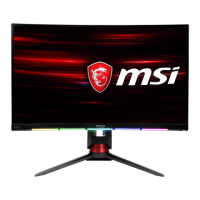
The MSI Optix Series LCD Monitor, available in models AG32CV (3KA0) and AG32C (3KA0), is designed to provide an immersive visual experience with user-friendly setup and adjustment capabilities. This monitor is primarily an LCD display unit, functioning to present visual information from a connected computer.

Function Description

The Optix Series monitor serves as a high-performance display for various applications, including gaming, professional work, and general media consumption. It supports multiple input sources such as DVI-D, HDMI, and DisplayPort, allowing for flexible connectivity with different devices. The monitor features an On-Screen Display (OSD) menu, which provides extensive control over display settings, enabling users to customize their viewing experience. Key functions accessible via the OSD include Game Mode, Screen Assistance, Input Source selection, and various image adjustments.

Usage Features

Getting Started:

The monitor's setup process is straightforward, beginning with the installation of the monitor stand. Users are instructed to fit the stand to the monitor, secure the base with a screw, and then place a protection cover. It is crucial to place the monitor on a soft, protected surface during assembly to prevent scratching the display panel.

Adjusting the Monitor:

The Optix Series monitor is designed for ergonomic comfort, offering tilt adjustment capabilities. Users can adjust the monitor's tilt from -5° to 10° to find their optimal viewing angle. It is important to avoid touching the display panel directly when making these adjustments.

Monitor Overview and OSD Key:

The monitor features a set of OSD keys located on the bottom right side, along with a power button and LED indicator. These keys provide quick access to various settings:

  • Menu Key (M): Launches the OSD main menu and exits the current menu.
  • Select Keys (◀ and ▶): Used for selecting function menus and items, and for adjusting function values (upward/downward).
  • Enter Key (E): Enters submenus and confirms selections or settings.
  • Power Button: Turns the monitor on or off.
  • LED Indicator: Displays blue when the monitor is on and blinks blue when in standby mode.

Hot Keys (Without Entering OSD Menu):

The OSD keys also function as hot keys for quick settings:

  • ◀ (Left Select Key): Accesses Game Mode, allowing users to quickly switch between User, FPS, and Racing modes.
  • ▶ (Right Select Key): Activates Screen Assistance, which can display a crosshair or other visual aids for gaming.
  • E (Enter Key): Selects the Input Source, enabling users to switch between DVI, HDMI, and DisplayPort inputs.

OSD Setup Menu:

The OSD menu is comprehensive, offering detailed control over various aspects of the monitor's performance and appearance.

  • Gaming:

    • Game Mode: Offers preset modes like User, FPS, Racing, RTS, and RPG, each optimized for specific game genres.
    • Night Vision: Enhances background brightness, particularly useful for FPS games, with options like OFF, Normal, Strong, Strongest, and A.I.
    • Response Time: Allows users to adjust the pixel response time (Normal, Fast, Fastest) to reduce motion blur.
    • Zero Latency: Can be adjusted (OFF/ON) in any mode, input source, resolution, and refresh rate. When FreeSync is enabled, Zero Latency is automatically set to ON.
    • Refresh Rate: Users can adjust the refresh rate and its display location (Left Top, Right Top, Left Bottom, Right Bottom, Customize).
  • Professional:

    • Pro Mode: Includes User, Reader, Cinema, and Designer modes, each with adjustable settings. When Pro Mode is set to Reader, Eye Saver is automatically enabled.
    • Eye Saver: Protects eyes by reducing blue light, adjusting screen color temperature to a warmer, yellow glow. It can be turned OFF or ON.
    • HDCR (High Dynamic Contrast Ratio): Enhances image quality by increasing contrast. When ON, Brightness is grayed out.
    • Image Enhancement: Improves the sharpness and detail of image edges with options like OFF, Weak, Medium, Strong, and Strongest.
  • Image:

    • Brightness: Adjustable from 0-100 in User, RTS, RPG, and Reader modes.
    • Contrast: Adjustable from 0-100 in any mode.
    • Sharpness: Adjustable from 0-5 in any mode, improving clarity and detail.
    • Color Temperature: Offers Cool, Normal, Warm presets, and a Customization mode for fine-tuning R, G, and B values (0-100).
    • Screen Size: Allows adjustment to Auto, 4:3, or 16:9 in any mode, resolution, and refresh rate.
  • Input Source:

    • Enables manual selection of DVI, HDMI, or DisplayPort inputs.
  • Hot Key:

    • Allows customization of the functions assigned to the Left, Right, and Enter buttons as hot keys, including Brightness, Game Mode, Screen Assistance, Alarm Clock, Input Source, Refresh Rate, and Information on Screen.
  • Setting:

    • Language: Supports multiple languages, with English as the factory default. Language settings are independent and override factory defaults upon reset.
    • Transparency: Adjusts the transparency of the OSD menu (0-5).
    • OSD Time Out: Sets how long the OSD menu remains visible (5-30 seconds).
    • LED: Controls the power LED indicator (ON/OFF).
    • Power Button: Configures the monitor's behavior when powered off. Pressing the power button for over 5 seconds turns the monitor off. Users can choose between OFF (monitor completely off) or Standby (panel and backlight off, but can be activated by OS detection).
    • Information on Screen: Displays monitor status information on the right side of the screen (OFF/ON).
    • Reset: Restores all OSD settings to their original factory defaults, except for the Language setting.

Connecting the Monitor to PC:

The connection process involves:

  1. Turning off the computer.
  2. Connecting the DVI-D, HDMI, or DisplayPort cable from the monitor to the computer.
  3. Assembling the monitor power adapter and power cord.
  4. Connecting the power cord to the monitor power jack.
  5. Plugging the power cord into an electrical outlet.
  6. Turning on the monitor.
  7. Powering on the computer, after which the monitor will automatically detect the signal source.

Maintenance Features

Safety Instructions:

The manual emphasizes several safety instructions to ensure proper and safe operation of the monitor:

  • Read and thoroughly understand all safety instructions, cautions, and warnings.
  • Refer servicing to qualified personnel only.
  • Keep the User's Guide for future reference.
  • Protect the device from humidity and high temperatures to prevent fire or shock hazards.
  • Place the device on a reliable flat surface.
  • Ensure the power voltage is within the 100-240V safety range and properly adjusted.
  • Do not disable the protective earth pin from the plug; the device must be connected to an earthed mains socket-outlet.
  • Disconnect the power cord or switch off the wall socket if the device is unused for an extended period to save energy.
  • Do not cover the ventilator, as it is crucial for air convection and preventing overheating.
  • Avoid leaving the device in unconditioned environments with storage temperatures outside -20°C to 60°C. The maximum operating temperature is around 40°C.
  • When cleaning, always remove the power plug. Use a soft cloth and avoid industrial chemicals or pouring liquids into openings to prevent damage or electric shock.
  • Route the power cord to prevent people from stepping on it.
  • Keep strong magnetic or electrical objects away from the device.
  • Seek service personnel if the power cord/plug is damaged, liquid has penetrated, the device has been exposed to moisture, it malfunctions, has been dropped, or shows signs of breakage.

Green Product Features:

MSI promotes environmental responsibility through its product design:

  • Reduced energy consumption during use and standby.
  • Limited use of harmful substances.
  • Easily dismantled and recycled.
  • Reduced use of natural resources.
  • Extended product lifetime through easy upgrades.
  • Reduced solid waste production through a take-back policy.

Environmental Policy:

The product is designed for proper reuse and recycling. Users are encouraged to contact local authorized collection points for end-of-life product disposal and recycling. MSI's website and gpcontdev@msi.com provide further information on recycling and disassembly.

Eye Health Recommendations:

The manual includes a warning about overuse of screens affecting eyesight and provides recommendations:

  • Take a 10-minute break for every 30 minutes of screen time.
  • Children under 2 years should have no screen time; for children aged 2 and over, screen time should be limited to less than one hour per day.

Troubleshooting:

The manual provides solutions for common issues:

  • Power LED is off: Check power button and cable connection.
  • No image: Verify graphics card installation, power connections, signal cable, and check if the computer is in Standby mode.
  • Screen image not properly sized or centered: Refer to Preset Display Modes for suitable settings.
  • No Plug & Play: Check power and signal cable connections, and ensure computer/graphics card are Plug & Play compatible.
  • Fuzzy/blurry icons, font, or screen, or color problems: Avoid video extension cables, adjust brightness/contrast/RGB color/color temperature, check signal cable connection, and inspect for bent pins.
  • Monitor flickering or showing waves: Change refresh rate to match monitor capabilities, update graphics card drivers, and keep the monitor away from sources of electromagnetic interference (EMI).

MSI Optix AG32C Specifications

General IconGeneral
3DNo
Pixel pitch0.36375 x 0.36375 mm
Display diagonal31.5 \
Display technologyLCD
Native aspect ratio16:9
Contrast ratio (dynamic)100000000:1
Contrast ratio (typical)3000:1
Display number of colors-
Display brightness (typical)250 cd/m²
Supported graphics resolutions1920 x 1080 (HD 1080)
On/off switchYes
Feet colorBlack/Red
Product colorBlack
Market positioningGaming
DVI-D ports quantity1
VGA (D-Sub) ports quantity0
Cable lock slot typeKensington
Power consumption (standby)0.5 W
Power consumption (typical)48 W
Package weight8940 g
Weight and Dimensions IconWeight and Dimensions
Depth (without stand)209 mm
Width (without stand)723 mm
Height (without stand)512 mm
Weight (without stand)6630 g

Related product manuals