6 MTX.COM
INSTALLATION
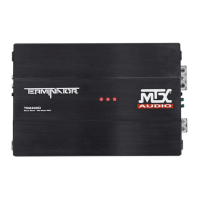
MTX recommends your new TERMINATOR Series
amplifier be installed by an Authorized MTX
Dealer. Any deviation from specified installation
instructions can cause serious damage to the
amplifier, speakers and / or vehicle’s electrical
system. Damage caused from improper installation
is NOT covered under warranty. Please verify all
connections prior to system turn on!
1. Disconnect the vehicle’s negative battery cable.
2. Determine the mounting place for your amplifier.
Keep in mind there should be sufficient air
flow for proper cooling. Mark the mounting
holes using the amplifier as a template. Before
drilling or installing mounting screws, make
sure all vehicle wires, gas lines, brake lines, and
gas tank are clear and will not interfere with the
amplifier installation. Drill mounting holes
(where applicable) and install the amplifier using
supplied mounting screws.
3. Install a positive (+) power cable from the
vehicle’s battery through the firewall using a
grommet or firewall bushing to avoid cable
damage from sharp edges of the firewall. Run
the cable through the interior of the vehicle and
connect it to the amplifier’s (+12V) terminal. Do
not connect to the battery at this time.
4. Install a circuit breaker or fuse holder on
the power cable within 18" of the battery. This
effectively lowers the risk of severe damage
to you or your vehicle in case of a short circuit
or accident. Make sure the circuit breaker is
switched off or the fuse is taken out of the fuse
holder until all connections are made. Now
connect the positive power cable to the positive
battery terminal.
Note: Use equivalent gauge wire for both
power and ground connections.
5. Grounding - Locate a proper ground point on the
vehicle’s chassis and remove all paint, dirt or
debris to reveal a bare metal surface. Attach
the ground wire to that contact point. Connect
the opposite end of the ground wire to the
amplifier’s (GND) terminal.
6. Connect a Remote Turn-on wire from the source
unit to the amplifier’s (REM) terminal. If the
source unit does not have a dedicated Remote
Turn-on lead, you may connect to the vehicle’s
accessory wire.
7. Connect the signal cables from the source unit
to the amplifier RCA inputs.
• When using a source unit with low-level
(RCA) outputs, use high quality RCA cable(s)
to connect directly to the amplifier RCA
inputs.
• When using a source unit with high level
(speaker) outputs, use an RCA to speaker
level adapter, or splice speaker wires directly
to RCA cable(s) and connect to the amplifier
RCA inputs.
• For source units with high level output
greater than 6V, a separate high to low level
converter is required.
8. Connect your speakers to your amplifier’s
speaker terminals using the appropriate gauge
speaker wire. See Wiring Diagrams on page 7
for minimum speaker impedance requirements
per model.
9. Double check all previous installation steps,
in particular, wiring and component connections.
Once verified, reconnect the vehicle’s negative
battery cable, turn the circuit breaker on or place
the fuse in the fuse holder.
10. Gain Adjustment
A. Turn the gain control on the amplifier all the
way down (counter clockwise).
B. Turn up the volume control on the source
unit to approximately 3/4 of maximum.
C. Adjust the gain control on the amplifier until
audible distortion occurs.
D. Adjust the gain control down until audible
distortion disappears.
E. The amplifier is now calibrated to the output
of the source unit.



 To Next Page
 Loading...