1
1. INTRODUCTION
1.1 MOTOR PROTECTION REQUIREMENTS
Three phase AC motors have become the workhorse of mod-
ern industry. Although motors are generally reliable devices,
many different causes ranging from abnormal conditions to op-
erator abuse can result in premature failure. Newer motors also
tend to be designed much closer to the normal operation limits
allowing less margin for abuse.
Sophisticated electronic relays are now normally used on large
high voltage motors to protect against a wide range of possible
fault conditions. High cost has precluded the use of these re-
lays on less expensive motors. In these applications, a simple
thermal overload is usually used. While inexpensive, these de-
vices only give limited protection under one type of fault condi-
tion — overloads.
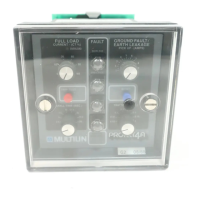
The PROTECT 4A relay is designed to provide protection
against the four main causes of motor failure: overloads, single
phasing, ground faults (earth leakage) and overheating (ther-
mistor sensing). The Protect 4A relay is economical enough in
price that it can be used with low and medium voltage motors,
bridging the gap between expensive, sophisticated relays and
economical thermal overloads which are of limited effectiveness.
While no relay can prevent normal wear on the motor, the Pro-
tect 4A has been optimized to give maximum motor life without
unnecessary production shutdown from overprotection. Controls
are simple and self explanatory for ease of use.
Current sensing is achieved through the use of separate phase
and ground fault CTs connected directly to the PROTECT 4A
relay. Three 5 amp or 1 amp secondary CTs are used to sense
motor phase currents. The three phase current wires pass
through the window of a 2000:1 CT for ground fault sensing.


 To Next Page