Need help?
Do you have a question about the Multilin SR469 and is the answer not in the manual?
Provides an overview of the SR469 Motor Management Relay, its features, and typical applications.
Details the SR469 order code, including options for phase CT secondaries, control power, and analog output range.
Lists detailed technical specifications for the SR469 relay, including power supply, current inputs, voltage inputs, and output relays.
Covers the mechanical aspects of the SR469 installation, including dimensions, product identification, and unit handling.
Details the electrical connections and wiring diagrams for the SR469 relay, covering various inputs, outputs, and communication ports.
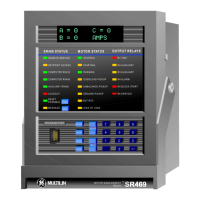
Describes the SR469's front panel layout, including status indicators, motor status indicators, and output relay indicators.
Explains the SR469's vacuum fluorescent display and how messages are presented to the user.
Details the SR469 status, motor status, and output relay LEDs, explaining their meaning and behavior.
Describes the RS232 program port for PC connection, used for setpoint programming, local interrogation, and firmware upgrades.
Explains the SR469 keypad layout and the function of each key for navigating messages and setpoints.
Provides instructions on how to enter custom text messages for the SR469, such as in the Message Scratchpad.
Explains the method for entering negative numbers or signs using the SR469 keypad.
Details the procedure for accessing and changing SR469 setpoints, including passcode and access jumper requirements.
Defines the three basic categories of protection elements: Trips, Alarms, and Blocks, and how they are assigned to output relays.
Provides guidelines and practices for assigning features to output relays (R1-R6) to avoid conflicts and ensure proper operation.
Illustrates the organization of SR469 setpoint messages, showing the logical grouping and navigation paths.
Covers setpoints related to SR469 system setup, including passcode, preferences, serial ports, and data management.
Details setpoints for system configuration, including current sensing, voltage sensing, power system, and communication settings.
Explains the configuration of SR469 digital inputs, including pre-assigned functions and assignable input functions.
Covers setpoints for output relay configuration, including reset modes and force operation of relays.
Details the SR469 thermal model setpoints for motor protection, including overload curves, unbalance bias, and cooling constants.
Covers SR469 setpoints for current-based protection elements like short circuit, overload, mechanical jam, and undercurrent.
Details SR469 setpoints related to motor starting, including acceleration timer, start inhibit, and jogging block features.
Explains SR469 setpoints for RTD temperature monitoring, including RTD types, alarm, and trip configurations.
Covers SR469 setpoints for voltage-related protection elements like undervoltage, overvoltage, and phase reversal.
Details SR469 setpoints for power measurement and protection, including power factor, reactive power, and underpower.
Covers SR469 setpoints for monitoring functions, including trip counters, starter failure, and demand metering.
Explains SR469 setpoints for analog input and output configuration, including parameters and differential inputs.
Details SR469 setpoints for testing and simulation modes, including simulation, pre-fault, fault, and output relay tests.
Covers SR469 setpoints specific to two-speed motors, including O/L setup, undercurrent, and acceleration timers for each speed.
Describes how to access measured values, maintenance, and fault analysis information via the SR469.
Provides access to motor status, last trip data, alarm status, start blocks, digital inputs, and real-time clock information.
Displays actual metering data for current, temperature, voltage, speed, power, torque, demand, analog inputs, and phasors.
Shows learned motor starting data, average motor load, and maximum RTD values, providing insights into motor performance.
Provides access to maintenance data, including trip counters, general counters, and timers for motor operation tracking.
Allows viewing of the SR469 Event Recorder, which stores motor and system information for troubleshooting purposes.
Provides SR469 model information, including order code, serial number, revisions, and calibration dates.
Offers diagnostic messages for operators, including last trip data, active alarms, start blocks, and flash messages.
Details the hardware and electrical interface for SR469 communications, including RS485 and RS232 ports.
Explains the Modbus RTU serial communication protocol supported by the SR469, including data frame format and rates.
Describes the structure of Modbus data packets, including slave address, function code, data, and CRC.
Details the CRC-16 error checking algorithm used in Modbus RTU transmissions for data integrity.
Explains the timing constraints that maintain data packet synchronization in SR469 communications.
Lists the Modbus function codes supported by the SR469 for communication and control.
Describes the SR469's error responses, including illegal function, illegal data address, and illegal data value.
Provides information about the SR469 memory map, including setpoints, actual values, and user-definable areas.
Details the data format codes used in the SR469 memory map, explaining the type and definition for each format.
Describes the purpose and procedures for performing functional tests on the SR469 hardware and firmware.
Covers functional tests for SR469 hardware components, including phase current accuracy, voltage input accuracy, and differential/ground current accuracy.
Details advanced functional tests for SR469 features like overload curve timing, power measurement, unbalance, and phase reversal.
Provides instructions for installing and upgrading the 469PC program software on a computer system.
Explains how to configure the 469PC program to establish communication with the SR469 relay.
Details the procedure for upgrading the SR469 relay firmware using the 469PC program.
Guides users on how to create new setpoint files using the 469PC program for SR469 configuration.
Explains how to edit existing setpoint files for the SR469 relay using the 469PC program.
Provides instructions for downloading a preprogrammed setpoint file from a PC to the SR469 relay.
Details how to upgrade the revision code of a saved setpoint file to match new SR469 firmware revisions.
Explains how to print SR469 relay setpoints and actual values using the 469PC program.
Covers the trending and graphing capabilities of the SR469 via the 469PC program for analyzing parameters over time.
Describes how to use the 469PC program to capture and analyze waveforms from the SR469 at the instant of a trip.
Explains how to view the phasor diagram of three-phase currents and voltages for the SR469 using the 469PC program.
Details how to use the 469PC program to view the SR469 Event Recorder for motor and system information.
Provides procedures for troubleshooting common issues encountered with the 469PC program within the Windows environment.
Commissioning summary for SR469 setup setpoints including Passcode, Preferences, Serial Ports, Message Scratchpad.
Commissioning summary for system setup setpoints covering Current Sensing, Voltage Sensing, Power System, and Communication Control.
Commissioning summary for digital input setpoints, detailing starter status and various alarm/trip functions.
Commissioning summary for output relay setpoints, including reset modes and force output relay options.
Commissioning summary for protection setpoints, focusing on Thermal Model and Current Elements.
Commissioning summary for current elements setpoints, covering short circuit, overload, mechanical jam, undercurrent, and unbalance.
Commissioning summary for motor starting setpoints, including acceleration timer, start inhibit, jogging block, and restart block.
Commissioning summary for RTD temperature setpoints, detailing RTD types, alarms, and trip configurations for each RTD.
Commissioning summary for voltage elements setpoints, covering undervoltage, overvoltage, phase reversal, and frequency.
Commissioning summary for power elements setpoints, including power factor, reactive power, underpower, and reverse power.
Commissioning summary for monitoring setpoints, covering trip counter, starter failure, and demand metering.
Commissioning summary for analog I/O setpoints, including analog outputs and inputs, and differential inputs.
Commissioning summary for two-speed motor setpoints, covering O/L setup, undercurrent, and acceleration for Speed 2.
Illustrates the use of two CTs for sensing three-phase currents, covering proper configuration and polarity considerations.
Provides guidance on selecting appropriate cooling time constants for the SR469 thermal model based on motor characteristics.
Details the specifications and dimensions for Ground Fault CTs designed for low leakage current detection.
Describes 5A secondary CTs for low resistance or solidly grounded systems, including available sizes and primary amp ratings.
Provides information on Phase CTs available in common ratios for motor protection relays, including dimensions and voltage class.
 General
| Frequency | 50/60 Hz |
|---|---|
| Mounting | Panel Mount |
| Display | LCD |
| Outputs | Relay Outputs, Analog Outputs |
| Current Rating | 5 A |
| Communication Protocols | Modbus RTU, Modbus TCP/IP |
| Protection Functions | Overcurrent, Overload, Ground Fault |
| Inputs | Analog Inputs, Digital Inputs |
| Enclosure Rating | IP54 |

 To Next Page