13
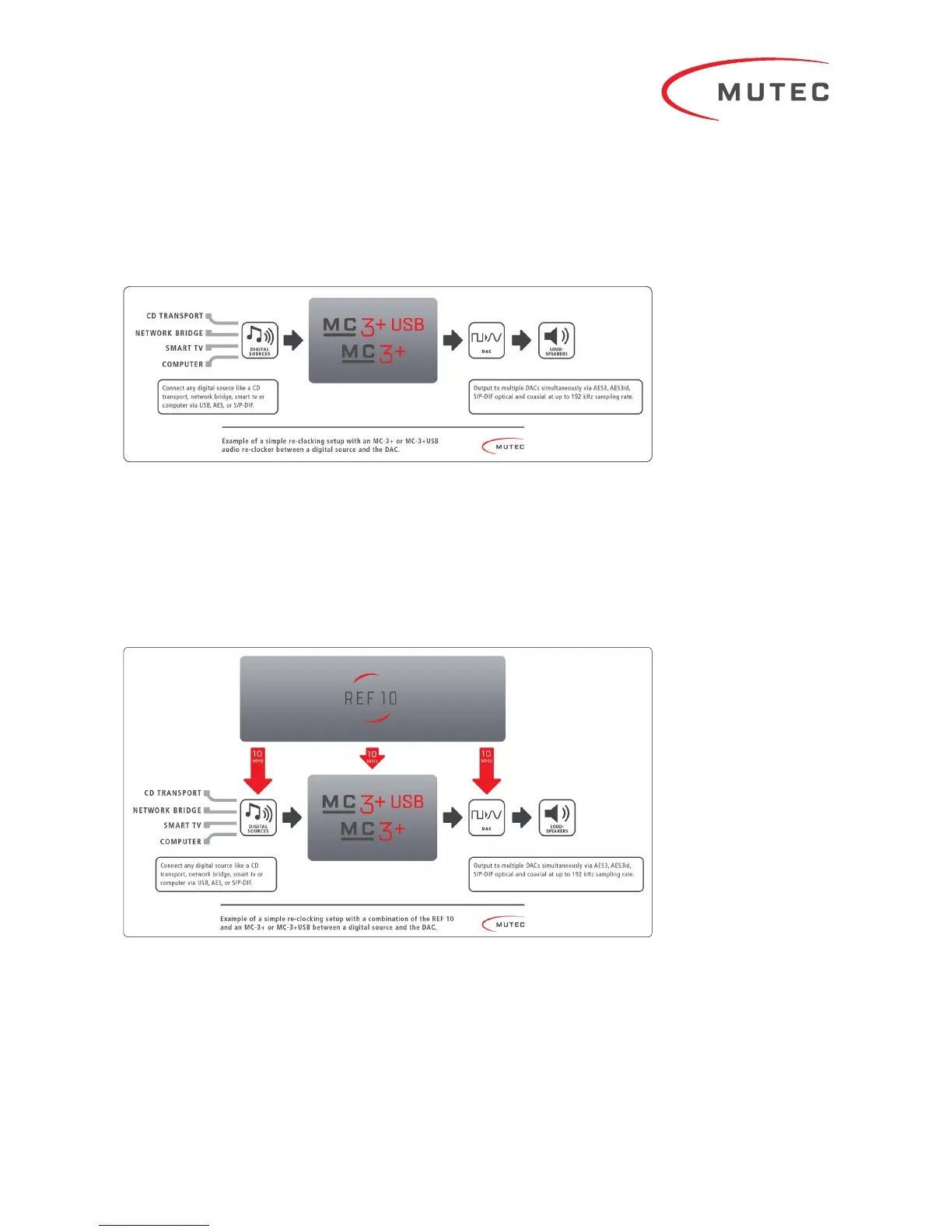
In this application example we have several digital sources on the left that are used to play back music via several digital in-
terfaces (e.g. AES3, S/P-DIF or USB). The MUTEC MC-3+ or MC-3+USB act as audio re-clockers to enhance the music signal and
remove jitter before passing the signal on to the DAC (d/a converter) and the loudspeakers. This is a simple closed system in which
the audio clock rate is determined by the music source. All other devices following in the chain (audio re-clocker and DAC) will
adapt to the sampling rate set by the source.
This particular system can be enhanced by the REF 10 in up to three places, depending on how many of the digital devices offer a
10 MHz compatible input. In the best possible case, all of the digital sources (e.g. BlueRay player, streamer, network bridge), the
audio re-clocker, and the DAC can receive their own 10 MHz clock supply from the REF 10.
It is helpful to understand that the hierarchy with respect to the audio clock (i.e. the sampling rate) of the system remains un-
changed. The 10 MHz signal from the REF 10 is strictly used to enhance the performance of the connected devices and does not
make changes to the audio clock of the system. The sampling rate of the system is still determined by the music source, which is
important to know when playing back playlists with mixed sampling rates.
Of course this application example is also conceivable without using an audio re-clocker between the digital sources and the
DAC. In this case, the REF 10 can still yield a significant improvement in sound quality, as long as at least one of the other devices
is equipped with a 10 MHz compatible clock input.
To help you getting started in the “10 MHz” universe we have put together a comprehensive list of currently available 10 MHz
compatible devices.


 To Next Page