EasyManua.ls Logo

MXL V67g - Recording Amplified Guitar; Amplifier Microphone Positioning

MXL V67g
10 pages
Print Icon
To Next Page IconTo Next Page
To Previous Page IconTo Previous Page
Loading...
Recording
Amplified
(Electric)
Guita
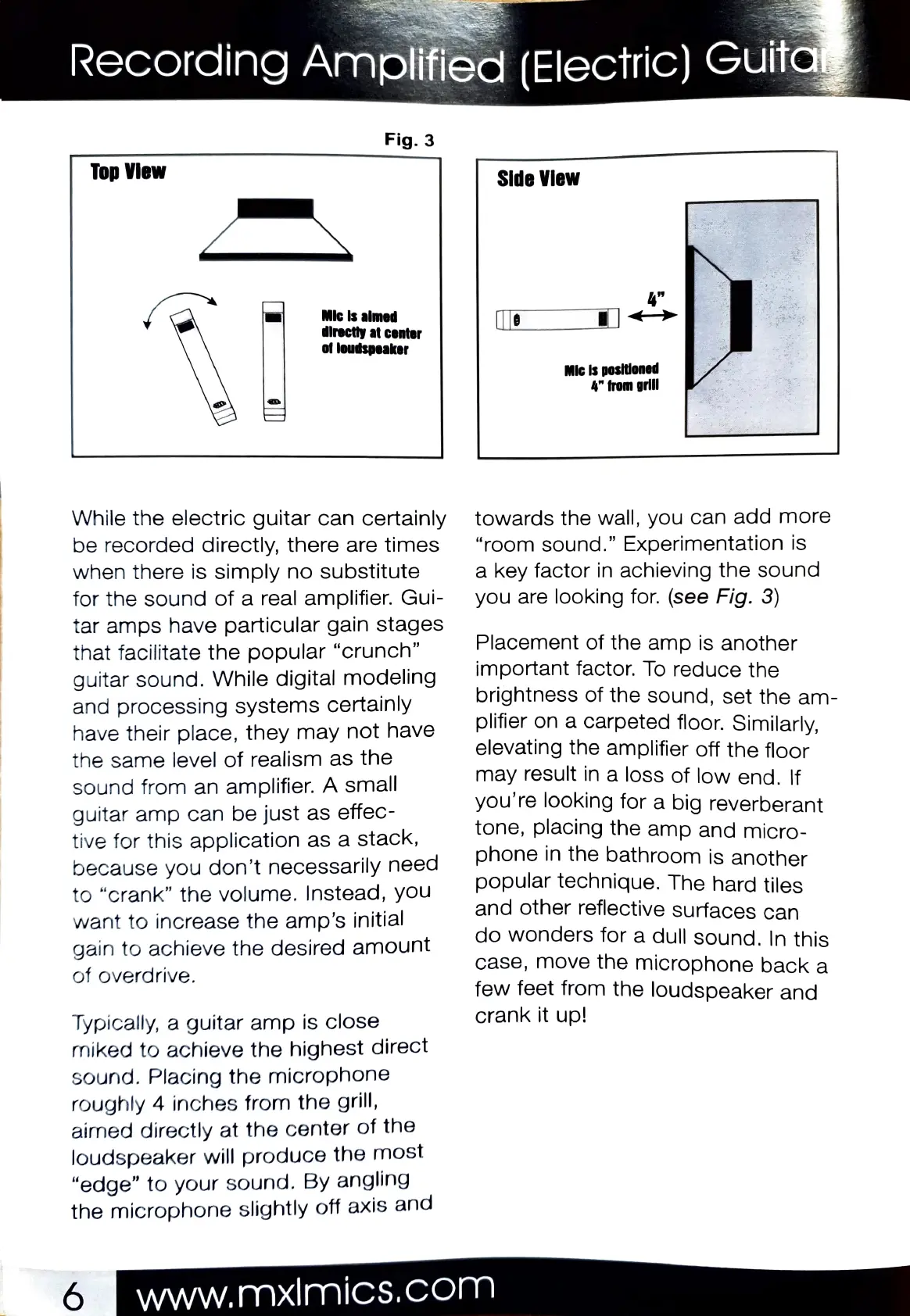
Fig.
3
Top
View
Slde
Vlew
Mic
Is
almed
directy
at
center
of
loudspeaker
Mic
Is
postloned
4
from
gr
While
the
electric
guitar
can
certainly
towards
the
wall,
you
can
add
more
be
recorded
directly,
there
are
times
when
there
is
simply
no
substitute
for
the
sound
of
a
real
amplifier.
Gui-
tar
amps
have
particular
gain
stages
that
facilitate
the
popular
"crunch"
guitar
sound.
While digital
modeling
and
processing
systems
certainly
have
their
place,
they
may
not
have
the
same
level
of
realism
a
sOund
from
an
amplifier.
A
small
guitar
amp
can
be
just
as
efec
tive
for
this
application
as
a
stack,
because
you
don't
necessarily
need
phone
in
the
bathroom
is
another
to
"crank"
the
volume.
Instead,
you
want
to
increase
the
amp's
initial
gain
to
achieve
the
desired
amount
of
overdrive.
"room
sound."
Experimentation
is
a
key
factor
in
achieving
the
sound
you
are
looking
for.
(see
Fig.
3)
Placement
of
the
armp is
another
important
factor.
To
reduce
the
brightness
of
the
sound,
set
the
am-
plifier
on
a
carpeted
floor. Similarly,
elevating
the
amplifier
off
the
floor
may
result
in
a
loss
of
low
end.
If
you're
looking for a big
reverberant
tone,
placing
the
amp
and
micro-
the
popular technique. The hard tiles
and
other
reflective
surfaces
can
do
wonders
for a dull
sound.
In
this
case,
move
the
microphone
back
a
few
feet
from
the
loudspeaker
and
crank
it
up!
Typically,
a
guitar
amp
is
close
miked
to
achieve
the
highest
direct
SOund.
Placing
the
microphone
roughly
4
inches
from
the
grill,
aimed
directly
at
the
center
of
the
loudspeaker
will
produce
the
most
"edge"
to
your
sound.
By
angling
the
microphone
slightly
off
axis
and
6
www.mxlmics.com

Other manuals for MXL V67g

Related product manuals