Need help?
Do you have a question about the Myenergi ZAPPI-2H07UB and is the answer not in the manual?
Overview of physical controls and visual indicators on the zappi unit.
Detailed explanation of the graphical LCD display and its elements.
Explains the meaning of various icons shown on the zappi display.
Describes different status messages displayed by the zappi during operation.
Explains the different charging modes: FAST, ECO, ECO+.
How to manually boost EV charging using the zappi.
How to program zappi for scheduled charging based on energy needs.
Setting up timed charging sessions for boosted charging.
Security feature to prevent unauthorized operation of the zappi.
Overview of the main menu structure and its options.
Accessing device information, serial numbers, firmware, and status.
Settings related to charging modes, limits, and delays.
General settings like time, date, and format.
Settings for screen brightness, contrast, and sound alerts.
Configuring the PIN lock and timeout settings.
Access to advanced configuration options (requires passcode).
General overview of configurable settings.
Passcode-protected settings for detailed configuration.
Settings for supply grid phase and device limits.
Settings for grid connection limits, battery integration, and net phases.
Configuration of Current Transformer (CT) inputs for monitoring.
Settings for vehicle preconditioning using charging power.
Using the eSense input for charging control or economy tariff activation.
Connecting zappi with other myenergi devices wirelessly or via Ethernet.
Viewing status and information of connected devices.
Information on wireless communication between myenergi devices.
Using Ethernet for device communication and network connection.
General instructions for installing the zappi unit.
Details on wiring, supply, and earthing requirements.
Specific wiring diagrams for single and three-phase connections.
How to connect and use the eSense input.
Guide to installing Current Transformer (CT) sensors.
Steps for reassembling the zappi unit after installation.
Options like load balancing and three-phase system setup.
Integrating zappi with AC or DC coupled battery systems.
Overview of safety features integrated into the zappi.
Protection against excessive current draw from the EV.
Procedure for powering up the zappi after installation.
Checks to perform before leaving the installation site.
General guide to diagnosing and resolving issues.
Explains specific fault messages and their actions.
Information on product warranty and how to claim.
Instructions for registering the device.
Key performance metrics of the zappi charger.
Electrical ratings, voltage, current, and consumption.
Physical dimensions, material, and weight.
Details on WiFi and radio frequency interfaces.
Information on the online portal for device management.
Details about the mobile application for control and monitoring.
Summarizes the operational charging modes.
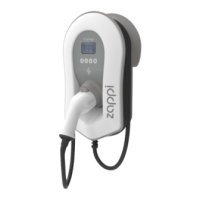
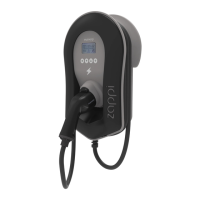
Lists different zappi models based on rating, connector, and color.
Statement of compliance with EU directives.
 General
| Model | ZAPPI-2H07UB |
|---|---|
| Category | Battery Charger |
| Type | EV Charger |
| Input Voltage | 230V AC |
| Rated Power | 7.4 kW |
| Output Current | 32A |
| Maximum Output Current | 32A |
| Output Voltage | 230V AC |
| Phases | Single Phase |
| Connector Type | Type 2 |
| Connectivity | Wi-Fi, Ethernet |
| Compatibility | All EVs with Type 2 connector |
| IP Rating | IP65 |
| Warranty | 3 years |
| Weight | 4.5 kg |
| Charging Modes | Eco, Fast |
| Protection Features | Overcurrent, Overvoltage |

 To Next Page