EXAMPLE
Of
AN"TENNA
GROUNDING
AS
PER
NATIONAL
ELECTRICAL
CODE
ELECTRIC
SERVICE
EOU1Pl.l[Nl
__
NEC
-
NATlON.AL
EL£CTRIC"L
CODE
ANTENNA
LEAD
IN
WIRE
ANTENNA
DISCHARGE UNlT
(NEC SECTION
810-20)
Q
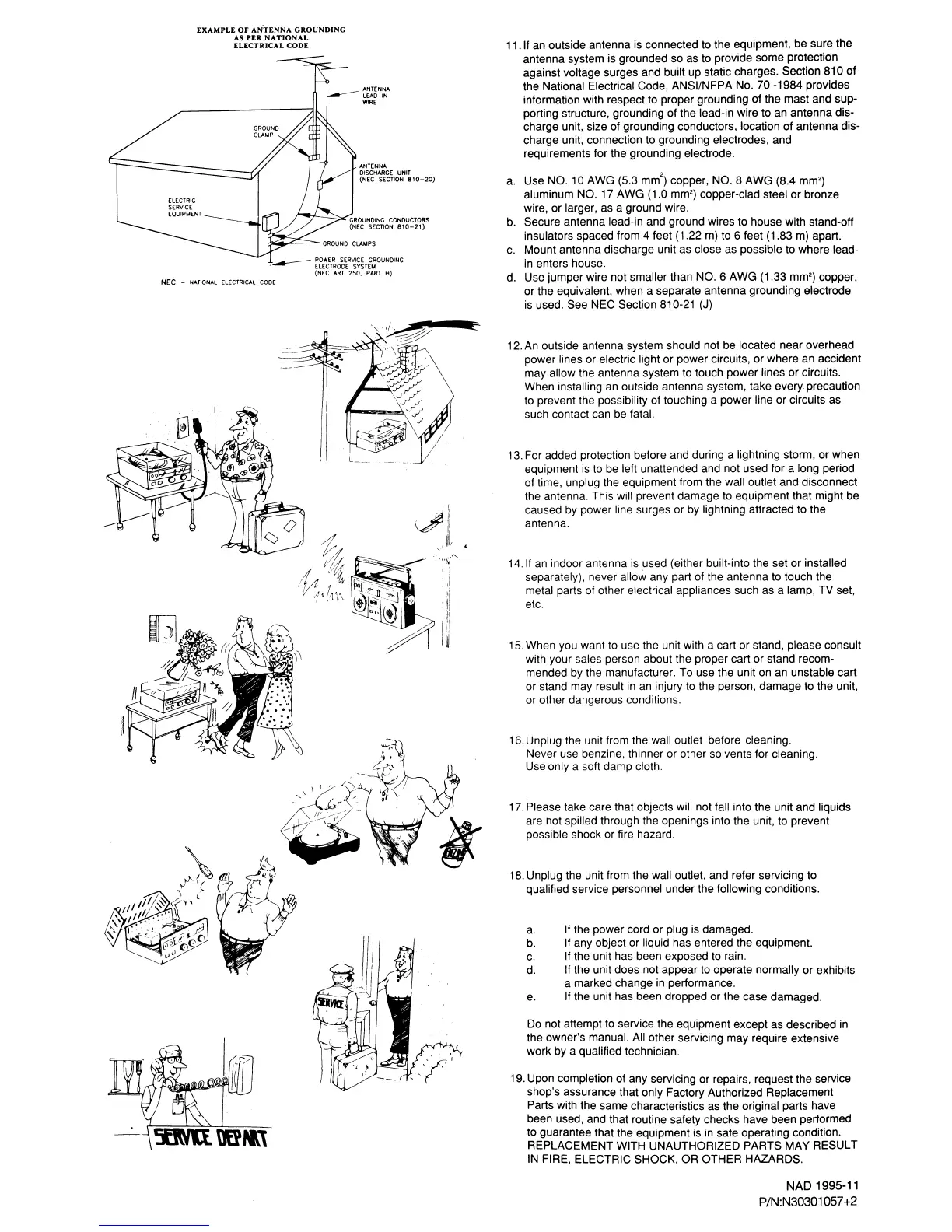
11.lf
an outside antenna is connected to the equipment, be sure the
antenna system is grounded so as to provide some protection
against voltage surges and built up static charges. Section 810 of
the National Electrical Code, ANSI/NFPA No. 70 -1984 provides
information with respect to proper grounding of the mast and sup-
porting structure, grounding of the lead-in wire to an antenna dis-
charge unit, size of grounding conductors, location of antenna dis-
charge unit, connection to grounding electrodes, and
requirements for the grounding electrode.
a.
Use NO. 10 AWG (5.3 mm') copper,
NO.8
AWG (8.4 mm')
aluminum NO.
17
AWG (1.0 mm') copper-clad steel or bronze
wire, or larger, as a ground wire.
b.
Secure antenna lead-in and ground wires to house with stand-off
insulators spaced from 4 feet (1.22
m)
to 6 feet (1.83 m) apart.
c.
Mount antenna discharge unit as close as possible to where lead-
in
enters house.
d. Use jumper wire not smaller than
NO.6
AWG (1.33 mm') copper,
or the equivalent, when a separate antenna grounding electrode
is used. See NEC Section 810-21
(J)
12.
An
outside antenna system should not be located near overhead
power lines or electric light or power circuits, or where an accident
may allow the antenna system
to
touch power lines or circuits.
When installing an outside antenna system, take every. precaution
to prevent the possibility of touching a power line or circuits as
such contact can be fatal.
13. For added protection before and during a lightning storm, or when
equipment
is
to
be left unattended and not used for a long period
of time, unplug the equipment from the wall outlet and disconnect
the antenna. This will prevent damage to equipment that might be
caused
by
power line surges or
by
lightning attracted to the
antenna.
14.lf
an
indoor antenna
is
used (either built-into the set or installed
separately). never allow any part of the antenna to touch the
metal parts of other electrical appliances such as a lamp, TV set,
etc.
15. When you want to use the unit with a cart or stand, please consult
with your sales person about the proper cart or stand recom-
mended by the manufacturer.
To
use the unit on
an
unstable cart
or stand may result
in
an
injury
to
the person, damage to the unit,
or other dangerous conditions.
16.
Unplug the unit from the wall outlet before cleaning.
Never use benzine. thinner or other solvents for cleaning.
Use only a soft damp cloth.
17. Please take care that objects will not fall into the unit and liquids
are not spilled through the openings into the unit, to prevent
possible shock or fire hazard.
18. Unplug the unit from the wall outlet, and refer servicing
to
qualified service personnel under the following conditions.
a.
If
the power cord or plug
is
damaged.
b.
If
any object or liquid has entered the equipment.
c.
If
the unit has been exposed
to
rain.
d.
If
the unit does not appear to operate normally or exhibits
a marked change
in
performance.
e.
If
the unit has been dropped or the case damaged.
Do not attempt
to
service the equipment except as described in
the owner's manual. All other servicing may require extensive
work by a qualified technician.
19. Upon completion of any servicing or repairs, request the service
shop's assurance that only Factory Authorized Replacement
Parts with the same characteristics as the original parts have
been used, and that routine safety checks have been performed
to guarantee that the equipment
is
in
safe operating condition.
REPLACEMENT WITH UNAUTHORIZED PARTS MAY RESULT
IN
FIRE, ELECTRIC SHOCK, OR OTHER HAZARDS.
NAD
1995-11
PIN:N30301
057+2


 To Next Page