67
S08 MAINTENANCE
DRAINING THE COOLANT CIRCUIT
1. Stop the engine and remove the key from the panel.
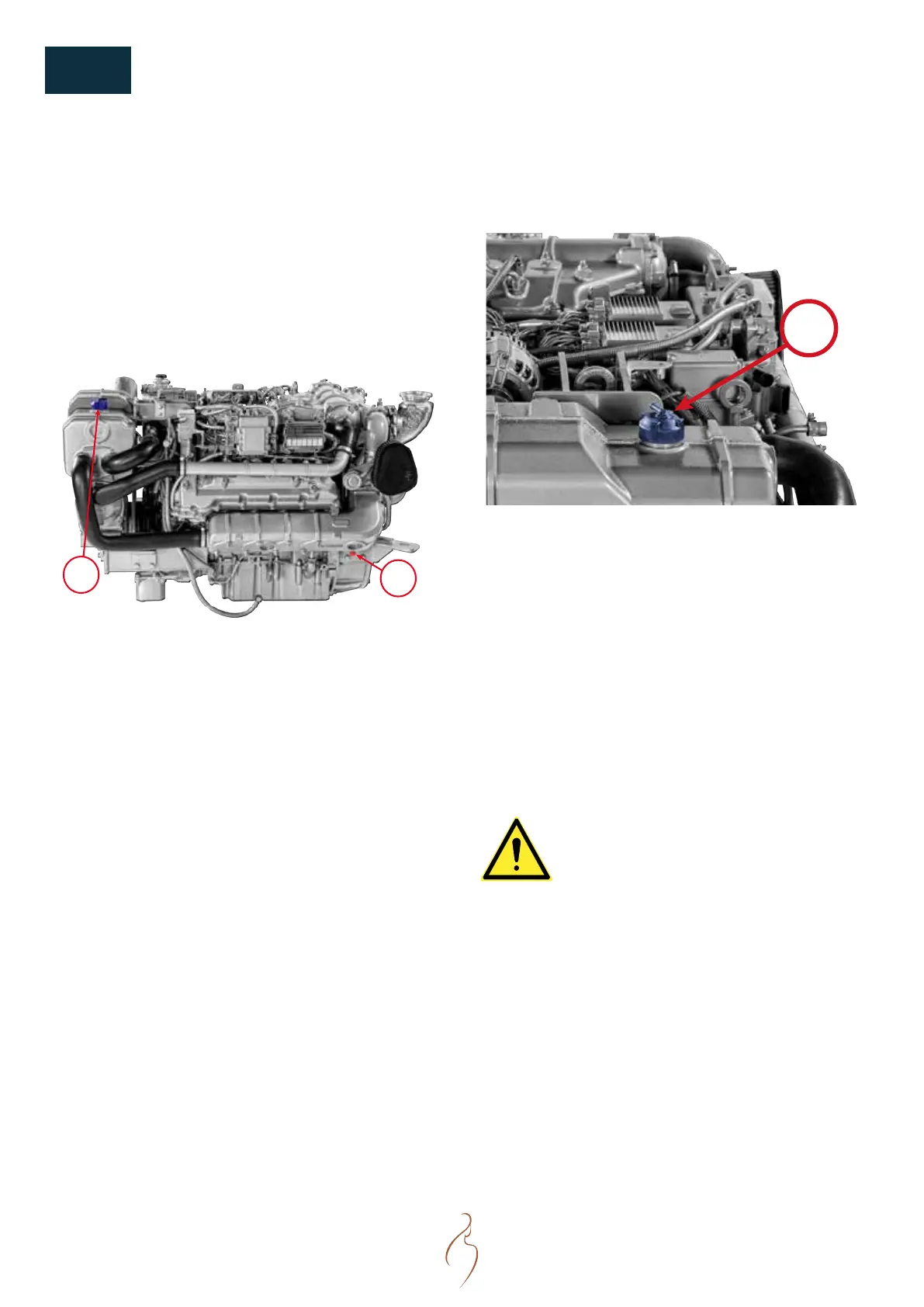
2. Put a container under the two drain plugs (B) on
both sides of the engine to collect coolant. Unscrew
the plugs and remove the ller cap (A) on top.
B
A
3. Drain off all coolant. Empty the recovery container
as well as the hoses.
4. Insert a hose into the heat exchanger ller port.
Rinse with fresh water until water which flows from
the drain port is clean.
5. Reinstall the drain plug, secure it and ll with new
coolant as explained on next paragraph..
COOLANT - FILLING
Mix the anti-freeze with water in a clean container
before lling the heat exchanger. The coolant must be
totally free from dust. Fill the exchanger slowly not to
introduce air into the coolant system.
Refer to the chapter TECHNICAL DATA to know the
coolant capacity of the heat exchanger. For Keel
Cooling system or when using a water boiler, the
coolant capacity must be adapted according to the
pipes length and the tank capacity.
TO FILL THE COOLANT SYSTEM:
A
1. Check that the two drain plugs (B) on both sides of
the engine are properly tightened.
2. Add coolant through the heat exchanger ller port
on top (A). Stop lling when coolant is reaching the
bottom of the ller cap lip.
3. Close and secure cap.
4. Start the engine and let it operate few minutes at
idle. Stop the engine, wait few minutes and check
the coolant level in the heat exchanger and in the
expansion tank. Top up if necessary.
CAUTION !
If a boiler is connected to the engine, follow the lling
procedure given by the manufacturer of the boiler. If
the boiler is above the engine in the boat, rst ll the
heat exchanger, the boiler, and top up with coolant the
recovery tank located above the boiler.
Make sure not to overll the heat exchanger when lling
with coolant. If too much coolant has been added, drain
part of the coolant.



 To Next Page