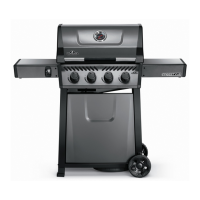
This document is the owner's manual for the Napoleon Freestyle Series grills, specifically models F365 and F425. It provides comprehensive information on the grill's features, safe operation, maintenance, and troubleshooting.
Function Description:
The Napoleon Freestyle Series grills are outdoor gas grilling appliances designed for cooking food. They feature main burners for direct and indirect grilling, and some models include a range side burner for versatile cooking options like preparing sauces or soups. The grills are equipped with an ACCU-PROBE™ temperature gauge for precise temperature monitoring and a JETFIRE™ ignition system for quick and easy start-up. A rotisserie kit is available as an optional accessory for roasting.
Important Technical Specifications:
The manual specifies gas connection requirements, including the use of a 20 lb (9.1 kg) propane cylinder (for propane models) or a natural gas supply line. The propane regulator must supply a pressure of 11 inches water column (0.39 psi) and have a QCC1 type fitting. Natural gas plumbing must supply a pressure of 7 inches water column. The BTU/h specified on the rating plate should be considered for gas pipe sizing.
For the FREESTYLE 425 model, the main tube burner has a #64 propane orifice or a 1.27mm natural gas orifice, with a 0.500" air shutter for both, providing 9500 Heat Input. The flame side burner uses a #65 propane orifice or a 1.25mm natural gas orifice, with an open air shutter for both, providing 9000 Heat Input.
For the FREESTYLE 365 model, the main tube burner has a #62 propane orifice or a #54 natural gas orifice, with a 0.500" propane air shutter and a 0.375" natural gas air shutter, providing 11000 Heat Input. The flame side burner uses a #65 propane orifice or a 1.25mm natural gas orifice, with an open air shutter for both, providing 9000 Heat Input.
The maximum pot or pan diameter for the flame side burner is 10" (25 cm).
Proper clearance to combustibles is 24" (610mm) to the rear and 7" (178mm) to the sides, with an additional 24" (610mm) recommended near vinyl siding or glass panes.
Usage Features:
The grills are designed for outdoor use in a well-ventilated space and should not be operated in a building, garage, shed, or any enclosed area.
- Lighting: Main burners are lit by pushing and slowly turning the knob counter-clockwise to HIGH until the pilot lights, then continuing to push down until the burner ignites. If the pilot doesn't light within 5 seconds, the knob should be turned to OFF, and the process repeated or a match used. The side burner lighting follows a similar procedure.
- Burn-off: Before first use, the warming rack should be removed, and main burners run on high for 30 minutes to burn off internal paints and lubricants.
- Grilling: The grill should be preheated for approximately 10 minutes with the lid closed for searing. Food cooked for a short time can be grilled with the lid open. Grilling with the lid closed ensures higher, consistent temperatures and more even cooking. Cooking grids can be oiled before preheating to prevent sticking. Indirect grilling is recommended for larger cuts of meat or foods prone to flare-ups, by lighting burners opposite the food.
- Rotisserie (optional): The rotisserie motor is installed on the side bracket. The spit rod, with forks, is threaded through the meat, and the pointed end inserted into the motor, with the opposite end resting on hangers. A stop bushing secures the spit rod. A metal dish should be placed underneath to collect drippings. Wings should be tied or skewered to the body of chickens when cooking multiple birds.
- Grilling Experience Checklist: This checklist encourages users to read the manual, clean the grease tray, check the hose, preheat and clean grids, prepare the cooking area, avoid excessive lid opening, leave space between food, and use a thermometer for proper cooking.
- Cast Iron Grid Seasoning: This procedure, to be done before first use and every 3-4 uses, involves washing and drying the grids, applying fat/oil evenly, preheating the grill to 350°F - 400°F (176°C - 204°C), and cooking the grids for 30 minutes, repeating the fat/oil application and cooking for another 30 minutes. Rust on cast iron grids can be removed with a scouring pad or brass brush before re-seasoning.
Maintenance Features:
Annual inspection and servicing by a qualified service person are recommended.
- Cleaning:
- First Time Use: Wash grids by hand with mild dish soap, rinse thoroughly, and dry completely.
- Cast Iron Grids: Season regularly to prevent corrosion.
- Stainless Steel Grids: Clean by preheating the grill and using a wire brush. Discoloration from high temperatures is normal.
- Inside of the Grill: Remove cooking grids, use a brass wire brush to clean debris from sides and under the lid, scrape sear plates with a putty knife or scraper, brush debris from burners, and sweep debris into the drip pan.
- Porcelain Enamel: Avoid chipping or scratching; use plastic putty knives or scrapers.
- Drip Pan: Accessible through doors or openings. Grease and drippings collect in the drip pan and disposable grease tray. Use Napoleon-approved liners. Clean frequently (every 4-5 uses) to prevent grease build-up. Cleaning steps involve sliding out the drip pan, scraping it, and replacing the disposable tray every 2-4 weeks.
- Control Panel: Clean with warm soapy water only to preserve printed text.
- Aluminum Castings: Clean with warm soapy water. Oxidization (white spots) from high temperatures and weathering is normal.
- Outside Grill Surface: Use non-abrasive cleaners and wipe in the direction of the grain. Handle porcelain enamel components with care. Discoloration of stainless steel parts over time is normal.
- Insect Screen and Burner Ports: Spiders and insects can build nests, causing flame issues. Burners have insect screens on air shutters to reduce this. Cleaning involves removing the burner, using a flexible venturi tube brush to clean the inside, shaking out debris, checking ports and orifices for blockages, and using a paper clip or supplied port maintenance bit/drill bit to clear them. Ensure the insect screen is clean and tight before reinstallation.
- Combustion Air Adjustment: The air shutter is factory-set but may require adjustment in extreme field conditions. Correct flames are dark blue, tipped with light blue, and occasionally yellow. Too little airflow causes soot and lazy yellow flames; too much causes erratic, lifting flames. Adjustment involves removing grids and sear plates, accessing the air shutter screw, loosening it, lighting burners on high to visually inspect flames, then turning burners off, tightening screws, and replacing parts.
- Stainless in Harsh Environments: Stainless steel can oxidize or stain in coastal, humid, or pool areas due to chlorides and sulfides. Regular washing with warm soapy water (every 3-4 weeks) is recommended.
- Clearance Ventilation: Hot air must escape the grill for proper burner function. Covering more than 75% of the cooking surface with solid metal is not recommended.
Safety Warnings:
The manual emphasizes numerous safety warnings, including:
- Immediately shutting off gas and calling the supplier if gas is smelled.
- Not attempting to light the appliance without reading instructions.
- Not storing or using flammable liquids near the appliance.
- Not storing an unconnected LP cylinder near the appliance.
- Alerting adults and children about hot surfaces and supervising young children.
- Leaving instructions with the grill owner for future reference.
- Installing the grill according to local codes (CSA B149.1 in Canada or ANSI Z223.1/NFPA 54 in the US).
- Electrically grounding a rotisserie motor according to local codes.
- Assembling the grill exactly as instructed and performing a leak test before operation.
- Not modifying the grill or using non-QCC1 cylinders.
- Using only Napoleon-supplied or recommended pressure regulator and hose assembly.
- Not smoking or using open flames during a leak test.
- Not routing the hose under the drip pan or allowing it to contact hot surfaces.
- Not lighting burners with the lid closed or deep frying on the side burner.
- Not operating the appliance under combustible construction.
- Maintaining proper clearance to combustibles.
- Turning off gas at the source after use and storing propane cylinders outdoors in a well-ventilated space.
- California Proposition 65 warning regarding chemicals known to cause cancer and reproductive harm.

 Need help?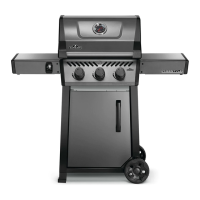




 To Next Page
 General