Need help?
Do you have a question about the Nat NPX136D and is the answer not in the manual?
Defines the target audience for the training, requiring familiarity with VHF FM radio and P25 concepts.
Details the agenda and timings for the training, including presentation, demonstration, and hands-on operation.
Illustrates simplex and duplex communication paths for the radio within an aircraft context.
Shows the NPX136D transceiver's connections to audio panels, headsets, and antennas.
Identifies the primary keys used for navigating the NPX136D menus, including Menu, Enter, and arrow keys.
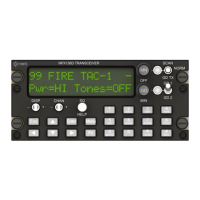
The NAT NPX136D is a panel-mount VHF P25 transceiver designed for aircraft, offering a stand-alone radio solution for a single mission user. It provides comprehensive features for communications within the VHF high band, supporting both analog and digital modes. The radio is lightweight and compact, making it suitable for space and weight-restricted cockpits of helicopters and light fixed-wing aircraft. It has been tested and accepted by NIFC/USFS as a 'fire approved' radio, indicating its suitability for critical operations.
The NPX136D serves as a primary communication device, enabling pilots and crew to transmit and receive voice communications. It supports a variety of channel types, including Analog FM 25 kHz, 12.5 kHz, and digital C4FM 12.5 kHz channels. This versatility allows it to operate within different communication environments and standards. The radio incorporates a two-channel synthesized guard receiver, which enhances safety and operational awareness by allowing monitoring of additional frequencies.
The device's core function revolves around its ability to manage and operate multiple communication channels. Users can select and switch between channels, adjust frequencies, and manage squelch settings. The radio's design emphasizes ease of use, with a clear display and intuitive controls that are similar to other products from Northern Airborne Technology (NAT). This familiarity helps reduce training time and improves operational efficiency for existing NAT product users.
The NPX136D also supports various operational modes, including Analog Simplex/Semi-Duplex and Digital P25. This allows for flexible deployment in different communication networks, whether direct aircraft-to-aircraft, aircraft-to-ground, or through repeaters. Its agile operation capability means it can quickly adapt to changing frequency requirements, which is crucial in dynamic operational environments like firefighting or search and rescue missions.
The NPX136D features a user-friendly interface with a clear display and tactile controls. To power on the radio, the main (MN) knob is rotated clockwise past the OFF detent. The display provides essential information at a glance, including the channel number, channel name, modulation type, scan flag, display type, frequency, tone/squelch number, and TX power. This comprehensive display ensures that the operator has all relevant communication parameters readily available.
Changing channels is straightforward, utilizing the CHAN switch or dedicated arrow buttons. The radio's squelch disable feature allows operators to open the squelch to hear weak signals or monitor a channel without squelch filtering. For guard transmit operations, the radio provides specific controls, enabling transmission on a designated guard frequency, which is vital for emergency communications or specific operational protocols.
The menu system is accessed via the "Menu" button, offering a structured approach to configuring various settings. The main menu structure includes:
Navigation within the menus is facilitated by the "Enter" button and the arrow keys, allowing users to scroll through options and make selections. The "Help" function, accessible through the SQ button, provides on-screen text scrolls that offer guidance and explanations for various features and settings, enhancing user self-sufficiency.
The radio also supports multiple scan modes, allowing operators to monitor several channels simultaneously. This feature is particularly useful for keeping track of different operational groups or emergency frequencies without manually switching between them. Encryption capability is also integrated, providing secure communication when required, which is essential for sensitive operations. DTMF generation is another feature, enabling the transmission of dual-tone multi-frequency signals for various control or signaling purposes.
The NPX136D is designed with modular construction, which simplifies maintenance and repair. In the event of a component failure, individual modules can be replaced, reducing downtime and overall maintenance costs. This modularity also allows for easier upgrades and modifications to the radio system.
Programming and configuration of the NPX136D can be performed using a personal computer with an RS232 serial data connector system. The Northern Airborne Technology Universal Device Programmer (NUDP) application runs on a PC and allows users to enter, edit, upload, and download system and channel data to and from the NPX136D. This capability is crucial for customizing the radio's channel lineup, frequency settings, and other operational parameters to suit specific mission requirements. The ability to load configurations from a PC ensures consistency across multiple units and simplifies fleet management.
The radio's internal diagnostics and maintenance menu provide tools for troubleshooting and verifying the radio's operational status. These features help identify potential issues early, allowing for proactive maintenance and ensuring the radio remains in optimal working condition. The display illumination level can be adjusted from 1 to 20 through the settings menu, which is a minor but important maintenance feature for ensuring visibility in various lighting conditions.
The NPX136D's robust design and support for external programming tools contribute to its overall maintainability, making it a reliable communication solution for demanding airborne applications.
 General
| Reach | 10km |
|---|---|
| Wavelength | 1310nm |
| Connector Type | LC |
| Fiber Type | Single-mode |
| Voltage Range | 3.3V |

 To Next Page