
 Need help?
Do you have a question about the National Instruments NI 9237 and is the answer not in the manual?
Specifies the maximum safe voltage limits for various connections and conditions.
Outlines safety requirements for using the NI 9237 in hazardous environments.
Details specific certifications and conditions for hazardous location use globally.
Information on EMC compliance and preventing interference during operation.
Requirements for meeting EMC standards in marine environments.
Details the operating temperature, humidity, and altitude requirements.
Explains the purpose and function of each signal pin on the NI 9237.
Guides on connecting full, half, and quarter bridge sensor configurations.
Procedure for calibrating bridge sensors after installation or changes.
Instructions for connecting sensors with TEDS (Transducer Electronic Data Sheet).
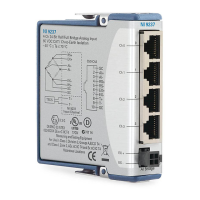
The NI 9237 is a C Series module designed for simultaneous bridge completion, offering four analog input channels. It is suitable for various measurement applications, including those involving full, half, and quarter bridges, and supports TEDS sensors.
The NI 9237 serves as a data acquisition module, specifically tailored for bridge-based measurements. It provides four analog input channels (AI+, AI-) that can be configured for full, half, or quarter bridge setups. The module includes connections for positive and negative remote sensing (RS+, RS-), which are crucial for maintaining measurement accuracy over long cable lengths by compensating for lead wire resistance. Sensor excitation is provided through dedicated positive and negative excitation connections (EX+, EX-). For smart sensor applications, the NI 9237 integrates TEDS (Transducer Electronic Data Sheet) data (T+) and return (T-) connections, allowing for automatic sensor identification and configuration. Additionally, it features a shunt calibration connection (SC) for verifying and adjusting the bridge balance.
The module is designed to connect to a chassis, which then interfaces with a computer for data acquisition and control. It is compatible with both RJ-50 and DSUB connectors, offering flexibility in wiring configurations. The simultaneous sampling capability across all four channels ensures that all measurements are taken at the same instant, which is critical for applications requiring precise synchronization between different sensor readings.
The NI 9237 is designed for ease of integration into various measurement systems. For full bridge connections, users can directly wire the bridge to the AI+, AI-, EX+, EX-, RS+, and RS- terminals. When connecting floating signals, it is recommended to connect the EX- signal to earth ground or a shield to improve noise rejection.
For half bridge configurations, the module also provides the necessary connections, with similar recommendations for floating signals. Quarter bridge connections can be achieved by adding an external resistor to create a half bridge, or by using specific NI Quarter Bridge Completion Accessories (NI 9944 or NI 9945) when using the RJ-50 connector variant.
The module supports TEDS sensors, which simplify setup by allowing the module to automatically read sensor information. Users should ensure that TEDS data (T+) and return (T-) signals are not tied in common to any analog input signals. The NI 9237 internally connects all T- signals. For the DSUB version, which has only three T- pins, two TEDS sensors can share a single T- pin if four sensors are used.
The NI 9237 is suitable for use in industrial locations and is designed to comply with electromagnetic compatibility (EMC) requirements. It is also approved for marine (shipboard) applications, provided it is installed in a shielded enclosure with filtered power and I/O ports, and appropriate precautions are taken with measurement probes and cables.
The device is intended for indoor use only and has specific environmental operating limits, including temperature, humidity, and altitude. It is important to operate the NI 9237 only as described in the documentation to ensure safety and proper functioning.
The NI 9237 is designed for reliable operation, but certain maintenance considerations are outlined in the manual. In the event of product damage, it should be returned to National Instruments for repair, as unauthorized repairs could compromise safety protection.
Bridge calibration is an important maintenance procedure, especially when inserting or removing new sensors. Slight changes in excitation voltages can lead to mismatches between internal half-bridge completion resistors and half-bridge sensors, causing measurement offsets. Therefore, it is recommended to perform bridge calibrations for quarter- or half-bridge sensors after connecting all sensors to the NI 9237 and after any sensor changes. Additional information on voltage offsets and calibration can be found on the NI website using a specific info code.
For hazardous locations, specific guidelines must be followed to ensure safety. This includes not disconnecting I/O-side wires or connectors, or removing modules, unless power has been switched off and the area is known to be nonhazardous. Substitution of components may impair suitability for hazardous environments. For Division 2 and Zone 2 applications, the system must be installed in an enclosure rated to at least IP54, and connected signals must be within specified capacitance and inductance limits. The enclosure itself must have a door or cover accessible only by a tool.
The manual also emphasizes the importance of adhering to the specified operating environment conditions, such as temperature, humidity, and pollution degree, to ensure the longevity and performance of the device. Regular checks of these environmental factors can help prevent issues.
For comprehensive specifications and troubleshooting, users are directed to the device datasheet and other online resources provided by National Instruments, including support websites for technical assistance, installation services, repairs, and extended warranty options. Product registration is also encouraged to receive important information updates.
 General
| Input Channels | 4 |
|---|---|
| Input Type | Differential |
| Connectivity | USB, Ethernet |
| Operating Temperature | -40 °C to 70 °C |
| Input Range | ±25 mV/V |
| Resolution | 24 bits |
| Excitation | 5 V |
| Sensor Compatibility | Strain gauges, load cells |
| Isolation | 250 Vrms |
| Measurement Type | Strain |
| Sampling Rate | 50 kS/s |





 To Next Page