
 Need help?
Do you have a question about the Neptun NCSP-E 75 and is the answer not in the manual?
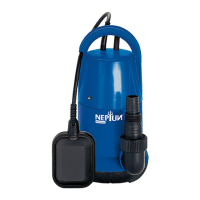
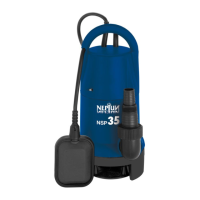
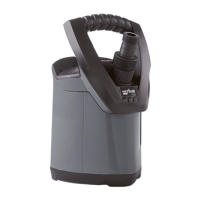
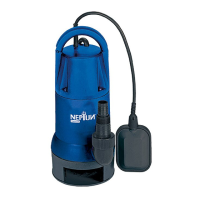
This document describes the NCSP-E 75 dirty water pump, a submersible pump designed for various water transfer applications.
The NCSP-E 75 is a dirty water pump primarily intended for pumping water with a maximum temperature of 35°C. It is suitable for use in households, gardens, and other applications where water needs to be transferred. The pump is not designed for continuous operation, such as a circulation pump in a pond, as this would significantly shorten its lifespan due to the continuous load it is not built for. The device should not be used for aggressive liquids, abrasive substances, motor fuels, cleaning agents, or other chemical products. It is also explicitly stated that the pump is not suitable for use in swimming pools or paddling pools of any kind, or any other body of water where people or animals may be present during operation. Operating the device in a danger zone with people or animals present is prohibited.
The pump operates with a floating switch that controls its on/off switching points. These points can be adjusted by shifting the floating switch within its notched holder. The floating switch must be positioned to allow easy and low-force activation and deactivation. A minimum distance of 10 cm between the floating switch head and the cable holder is crucial for proper function. Care must be taken to ensure the floating switch does not touch the bottom before the pump switches off, to prevent dry running.
The pump must be supplied via a residual current device (RCD) with a rated fault current of no more than 30 mA, in accordance with VDE 0100 Part 702 and 738. Before initial operation, a specialist should verify that the earthing, neutral conductor, or RCD circuit complies with safety regulations and functions correctly. Electrical plug connections must be protected from moisture. In case of flood risk, plug connections should be placed in a flood-safe area.
Before starting the pump, users must ensure that the data on the rating plate matches the mains data. The pump can be installed either stationary with a rigid pipe line or stationary with a flexible hose line. When using the universal hose connection, it should be shortened to the actually used connection to avoid unnecessary reduction of the pumping rate. Flexible hoses must be fastened with a hose clip (not included in the scope of supply).
During installation, the device must never be hung freely from the discharge line or power cable. It should be suspended by its designated handle or rest on the bottom of the shaft. To ensure proper function, the shaft bottom must always be free of sludge or other debris. If the water level is too low, sludge can dry out quickly and prevent the pump from starting, necessitating regular checks and trial start-ups. The pump shaft should be sufficiently large.
The device is equipped with an earthing-pin plug for connection to a 230 V ~ 50 Hz earthed socket outlet. The socket must be adequately fused (at least 6 A) and in good working order. Any electrical work must be performed by a specialist electrician or customer service to prevent hazards.
Regular maintenance is crucial for the pump's longevity and safe operation. Before any maintenance work, the power plug must be disconnected. For mobile applications, the pump should be cleaned with clear water after each use. For stationary installations, it is recommended to check the floating switch's function every three months. Lint and fibrous particles that may accumulate in the housing should be removed with a water jet. Every three months, the shaft bottom should be cleared of sludge, and the shaft walls should be cleaned. Deposits on the floating switch should also be removed with clear water.
If excessive deposits accumulate in the housing, the lower part of the device must be dismantled for cleaning. This involves disconnecting the intake cage from the housing and cleaning the paddle wheel with clear water. It is important not to rest or support the device on the paddle wheel during this process. Reassembly is performed in reverse order. The internal components of the device do not require additional maintenance.
In case of damage to the power cable, it must be replaced by the manufacturer, their customer service, or similarly qualified personnel to avoid hazards.
For ordering spare parts, specific information such as the machine type, article number, identification number, and the required spare part number should be provided. Current prices and information are available on the manufacturer's website.
The device and its packaging materials are not toys and should be kept out of reach of children. The equipment and accessories should be stored in a dark, dry, and frost-free place, inaccessible to children. The optimal storage temperature is between 5°C and 30°C. The electric tool should be stored in its original packaging.
The document also includes a troubleshooting guide for common issues such as the pump not starting, not pumping, not cutting out, insufficient pumping rate, or switching off after a short running time, along with their causes and remedies. For example, if the pump does not start, the cause could be a missing power supply or a non-triggering floating switch, with remedies being to check the power supply or raise the floating switch to a higher position. If the pump does not pump, it could be due to a clogged intake sieve or a kinked discharge hose, remedied by cleaning the sieve with a water jet or unkinking the hose.
The device is supplied in packaging to prevent transport damage, and this packaging material is recyclable. The device and its accessories are made of various materials, such as metal and plastic. Defective devices should not be disposed of with household waste but taken to a suitable collection center for proper disposal, in accordance with European Directive 2012/19/EC.
 General
| Brand | Neptun |
|---|---|
| Model | NCSP-E 75 |
| Category | Water Pump |
| Language | English |

 To Next Page