26 Evolution Series - XPAND NGP\00329 Rev. C 23-06-2006
4.4. Power supply and consumption
The equipment operates from a battery supply between -40.5 volt and -57 volt, nominally -48 volt DC
according to EN 300 132-2. The primary DC-power is supplied to the indoor unit through a filtering
function that includes input filter to attenuate the common mode noise.
The power to the outdoor unit is supplied from the indoor unit via the IFU-ODU coaxial cable.
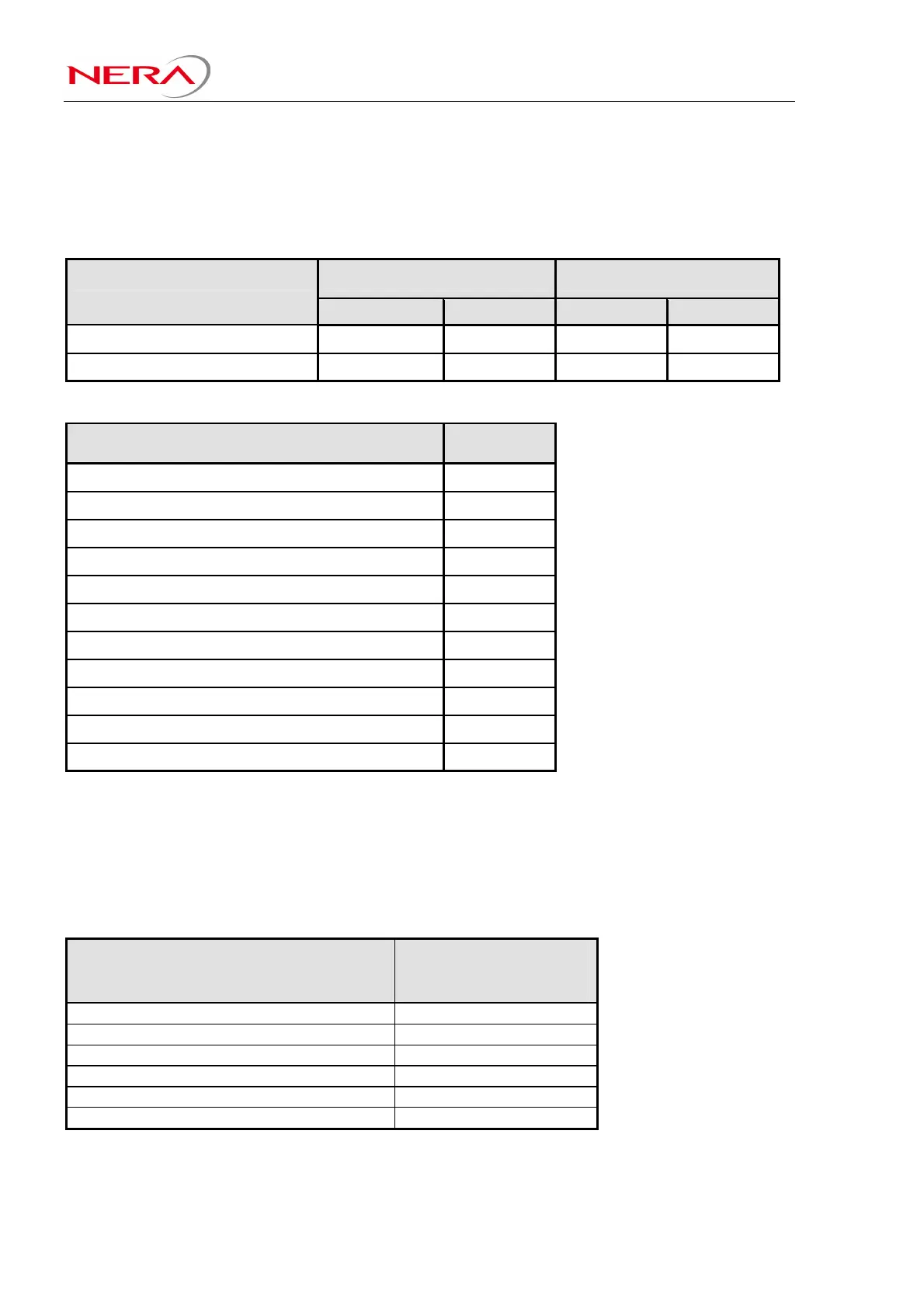
L6-11 GHz 13-38 GHz Terminal without interface
Average Maximum Average Maximum
1+0 Terminal 65 W 71 W 52 W 58 W
HSB/1+1/2+0 Terminal 117 W 128 W 91 W 102 W
Table 4-4 Power consumption terminal
Unit
ODU L6-11 GHz 48 W
ODU 13-38 GHz 35 W
Basic IFU, incl. SU and fans 13.5 W
Radio Interface Unit 9.3 W
3xE3/DS3 Interface Unit 3 W
25xE1and 16xT1 Interface Unit 4 W
Auxiliary Units, 64 kb, Wayside and Alarm Unit 2 W
Service channel Unit 2.5 W
Line Interface Unit, Electrical or S-1.1 optical 2.3 W
Line Interface unit, L-1.1 or L-1.2 optical 4 W
DXC Unit 5.5 W
Table 4-5 Maximum power consumption units
4.5. System Reliability
4.5.1. Mean Time Between Failures (MTBF)
The MTBF figures are predicted and calculated according to methods in MIL-HDBK-217E including
adjustment for experienced field data. MTBF for 1+0 Terminal with Line Interface Unit is about 30 years.
Unit name: MTBF,
25 °
°°
°C ambient temp:
[
[[
[Hours]
]]
]
Transceiver Unit (ODU) 400 000
Basic IFU incl. one RIU
1 000 000
RIU 3 200 000
Supervisory Unit 3 200 000
Interface units 5 000 000-1 600 000
DXC 2 600 000



 To Next Page