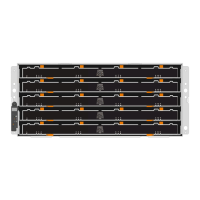
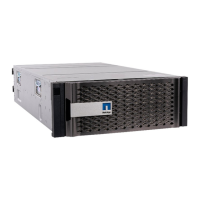
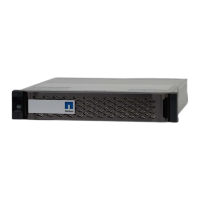
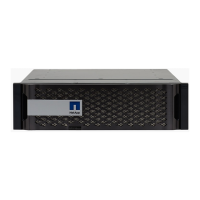
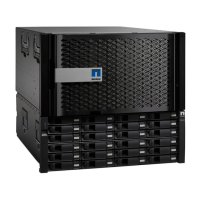
host ports. This addition increases the number of host ports in your storage array and
provides additional host protocols.
About this task
When you add HICs, you must power off the storage array, install the HIC, and reapply power.
Before you begin
• Review
Requirements for E5700 HIC replacement.
• Schedule a downtime maintenance window for this procedure. The power must be off when you install
HICs, so you cannot access data on the storage array until you have successfully completed this
procedure. (In a duplex configuration, both controllers must have the same HIC configuration when they
are powered on.)
What you’ll need
• One or two HICs, based on whether you have one or two controllers in your storage array. The HICs must
be compatible with your controllers.
• New host hardware installed for the new host ports, such as switches or host bus adapters (HBAs).
• All cables, transceivers, switches, and host bus adapters (HBAs) needed to connect the new host ports.
For information about compatible hardware, refer to the
NetApp Interoperability Matrix and the NetApp
Hardware Universe
.
• Labels to identify each cable that is connected to the controller canister.
• An ESD wristband, or you have taken other antistatic precautions.
• A #1 Phillips screwdriver.
• A management station with a browser that can access SANtricity System Manager for the controller. (To
open the System Manager interface, point the browser to the controller’s domain name or IP address.)
Step 1: Prepare to add HIC
Prepare to add a HIC by backing up the storage array’s configuration database, collecting support data, and
stopping host I/O operations. Then, you can power down the controller shelf.
Steps
1. From the Home page of SANtricity System Manager, ensure that the storage array has Optimal status.
If the status is not Optimal, use the Recovery Guru or contact technical support to resolve the problem. Do
not continue with this procedure.
2. Back up the storage array’s configuration database using SANtricity System Manager.
If a problem occurs during this procedure, you can use the saved file to restore your configuration. The
system will save the current state of the RAID configuration database, which includes all data for volume
groups and disk pools on the controller.
◦ From System Manager:
a.
Select Support
› Support Center › Diagnostics.
b. Select Collect Configuration Data.
c. Click Collect.
79



 To Next Page