This document is a Quick Operation Guide for the New Holland TH Telehandler, an agricultural machine designed for lifting, loading, and handling tasks.
Function Description
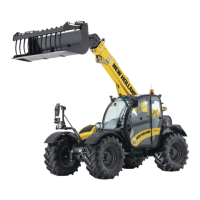
The New Holland TH Telehandler is a versatile agricultural machine primarily used for material handling, such as lifting and stacking hay bales, loading materials into trailers, and other tasks requiring extended reach and lifting capacity. It features a telescopic arm that can extend and retract, a quick coupler for attaching various implements, and different steering modes for maneuverability. The machine is equipped with a powershift transmission, offering multiple operational modes to suit different tasks and terrains.
Important Technical Specifications
Model Variants and Performance:
The TH Telehandler series includes several models with varying reach, lift capacity, and engine power:
- TH5.26: Reach 5.7 m, Lift capacity 2600 kg, Max engine power 73 hp.
- TH6.28: Reach 6.35 m, Lift capacity 2800 kg, Max engine power 107 hp.
- TH6.32: Reach 6.3 m, Lift capacity 3200 kg, Max engine power 133 hp. Available in S and Classic versions.
- TH6.36: Reach 6.3 m, Lift capacity 3600 kg, Max engine power 133 or 146 hp. Available in Plus and Elite versions.
- TH7.32: Reach 7.0 m, Lift capacity 3200 kg, Max engine power 133 hp. Available in S, Classic, and Plus versions.
- TH7.37: Reach 7.0 m, Lift capacity 3700 kg, Max engine power 133 or 146 hp. Available in Classic, Plus, and Elite versions.
- TH7.42: Reach 7.0 m, Lift capacity 4200 kg, Max engine power 133 or 146 hp. Available in Plus and Elite versions.
- TH9.35: Reach 9.1 m, Lift capacity 3500 kg, Max engine power 133 hp. Available in Classic and Plus versions.
Engine and Transmission:
- S version: 133hp engine, standard cooling fan, gear pump, 4x3 powershift transmission, open-differential rear axle, 128° dump angle.
- CLASSIC version: 133hp engine, reversible cooling fan, piston pump, 4x3 powershift transmission, 142° dump angle, limited-slip-differential rear axle.
- PLUS version: 133hp engine, reversible cooling fan, piston pump, 6x3 powershift transmission, limited-slip-differential rear axle, 142° dump angle.
- ELITE version: 146hp engine, reversible cooling fan, piston pump, 6x3 powershift transmission, limited-slip-differential rear axle, 142° dump angle, hydraulic pressure release.
Powershift Transmission Speeds (kph):
- S and Classic (4F x 3R):
- Forward: Gear 1 (6), Gear 2 (8), Gear 3 (18), Gear 4 (34)
- Reverse: Gear 1 (6), Gear 2 (13), Gear 3 (24)
- Plus (6F x 3R):
- Forward: Gear 1 (6), Gear 2 (8), Gear 3 (13), Gear 4 (18), Gear 5 (25), Gear 6 (34)
- Reverse: Gear 1 (6), Gear 2 (13), Gear 3 (24)
- Elite (6F x 3R):
- Forward: Gear 1 (7), Gear 2 (10), Gear 3 (15), Gear 4 (20), Gear 5 (28), Gear 6 (40)
- Reverse: Gear 1 (7), Gear 2 (15), Gear 3 (28)
Rear Hitch Load Capacities:
- Towable mass (trailer without brakes): 3000 kg (6614 lb) for all hitch types.
- Independently braked towable mass: 6000 kg (13228 lb) for all hitch types.
- Inertia-braked towable mass: 8000 kg (17637 lb) for all hitch types.
- Towable mass when fitted with hydraulic or pneumatic braking:
- Swivel hook: 20000 kg (44092 lb)
- Coupling Clevis Automatic: 14000 kg (30865 lb)
- Coupling Pick-up hitch: 10000 kg (22046 lb)
- Vertical load:
- Swivel hook: 1600 kg (3527 lb)
- Coupling Clevis Automatic: 2000 kg (4409 lb)
- Coupling Pick-up hitch: 2000 kg (4409 lb)
Usage Features
Cab Controls:
- Joystick:
- S, Classic, and Plus models: Controls boom lower/raise, loader/attachment rollback/dump, and gear up/down. A roller switch extends/retracts the boom, and a separate switch manages auxiliary hydraulic functions.
- Elite models: Feature a seat-mounted control and a different joystick design.
- Steering Wheel: Standard steering control.
- Foot Brake Pedal: For braking.
- Foot Throttle: For engine speed control.
- Machine Display: Provides operational information.
- Display Navigation Switch (enter/home, up/down arrow key): For menu navigation.
- Battery Isolator Switch: To disconnect the battery.
- Auxiliary Hydraulic Lock/Enable Switch: To control auxiliary hydraulics.
- "Road mode"/"Work mode" Switch: To select operating modes.
- De-clutch by Service Brake Enable Switch: Allows de-clutching with the service brake.
- Working Light Switches: For front, rear, and boom lights (optional).
- Rotating Beacon Switch: For the rotating beacon (optional).
- Roof Wiper Motor Switch: For the roof wiper.
- Steering Mode Selector: To choose between 2-wheel, 4-wheel, and crab steering.
- Radio: Optional.
- Transmission Mode Switch: To select transmission modes.
- Parking Brake Switch: Optional.
Transmission Modes:
- Plus models: Offer Manual and Semi-Auto shifting modes. Semi-Auto is suitable for road work.
- Elite models: Offer Manual, Semi-Auto (for short cycle jobs), and Full-Auto (for long cycle and road work) modes.
Shuttle Modes:
Three shuttle modes are available:
- Shuttling mode 1 (Comfort): Speed/ratio logic for smooth operation.
- Shuttling mode 2 (Silage / Heavy Duty): Optimized for demanding tasks.
- Shuttling mode 3 (Memory): Allows the operator to set preferred shuttle gears.
Changing modes involves navigating a "SETUP MENU" on the display using UP/DOWN buttons and selecting with the enter button.
Steering Mode Selection:
The telehandler offers three steering modes:
- 4-wheel steering (4WS): For maximum maneuverability in tight spaces (Left-hand side position A on the rotary switch).
- 2-wheel steering (2WS): For road driving (Central position B on the rotary switch). Always select this mode when driving on road.
- Crab steering: Allows the machine to move diagonally (Right-hand side position C on the rotary switch).
To select a mode, align the four wheels in the straight-ahead position, indicated by symbols (1) and (2) illuminating on the display.
Connecting Attachments:
- Ensure hydraulic locking pins are in the unlocked position.
- Lower the boom and position the machine parallel to the attachment.
- Rotate the headstock forward.
- Align with the attachment, lift the boom, and tilt back the headstock.
- Lock the locking pins via a button in the cab.
Automatic Lubrication System:
The telehandler can be equipped with two independent automatic lubrication systems:
- Main machine lubrication: A pump with an integrated control unit (1) greases various points on the machine. Lubrication duration can be time-dependent or based on pump motor revolutions.
- Boom kinematic lubrication: A separate pump (2) greases the boom's kinematic points. Lubrication is pressure-dependent, activating whenever the tilt cylinder starts working.
Rear Hitch:
Telehandlers can be equipped with a rear hitch with hydraulic and electric connections. UK models typically feature a pick-up hitch controlled from the cab. To release, a latch under the armrest must be released, then the third hydraulic function is used to lift/lower the hitch.
Load Cell Calibration:
A load cell calibration must be performed at least once per year to ensure safety and accuracy. The procedure involves:
- Key ON, push two specific switches within 5 seconds to enter calibration mode, then start the engine.
- With no load, fully raise the boom and retract the extension, then press enter.
- With a 2500-3000kg load, extend the boom parallel to the ground until the rear wheels lift, then press enter.
- Reduce total extension by 20% (from front wheels), then press enter.
- Reduce total extension by another 500mm, then press enter.
Maintenance Features
Easy and Quick Servicing:
- Full access engine bay: A large one-piece hood provides full access, with lower side panels also opening for enhanced access.
- Gas struts: Two gas struts reduce effort to open the hood and hold it open.
- Accessible daily checks: Engine oil, water coolant, air filter, and radiators are easy to check, fill, and clean. Radiators fold out for excellent cleaning access.
Less Maintenance, More Work:
- Extended service intervals: Class-leading 600-hour service intervals.
- Reduced downtime: Servicing is designed to be easier and less time-consuming, cutting downtime and costs.
Daily Fluid Checks (before starting):
- Engine oil
- Hydraulic reservoir oil
- Transmission oil
- Fuel
- Cooling liquid
- Brake oil
This guide is a quick reference and not a replacement for the full Operators Manual. For additional assistance, consult the Operators Manual or an authorized New Holland Dealer.

 Need help?
 General


 To Next Page