NEVER CONNECT AN UNREGULATED GAS
SUPPLY LINE TO THE APPLIANCE. USE THE
REGULATOR/HOSE ASSEMBLY SUPPLIED.
This is a liquid propane configured grill. Do not attempt to
use a natural gas supply.
Total gas consumption (per hour) of this gas grill with all
burners on “HIGH”:
Main Burner 4 x 10,000 BTU/hr.
Total 40,000 BTU/hr.
L.P. TANK REQUIREMENT
A dented or rusty L.P. tank may be hazardous and should be
checked by your L.P. supplier. Never use a cylinder with a
damaged valve. The L.P. gas cylinder must be constructed
and marked in accordance with the specifications for L.P.
gas cylinders of the U.S. Department of Transportation (DOT)
or the National Standard of Canada, CAN/CSA-B339,
Cylinders, Spheres and Tubes for Transportation of
Dangerous Goods; and Commission, as applicable.
Overfilling prevention device (OPD) shall be provided on
cylinder & QCC1 connection on the cylinder valve,
ANSI/CGA- V-1. The cylinder supply system must be
arrange for vapor withdrawal. The cylinder must include a
collar to protect the cylinder valve. The cylinder must be
provided with a shut off valve terminating in an L.P. gas
supply cylinder valve outlet specified, as applicable, for
connection type QCC1 in the standard for compressed gas
cylinder valve outlet and inlet connection ANSI/CGA-V-1.
Manifold pressure: 11”(27.94cm) water column (W.C.).
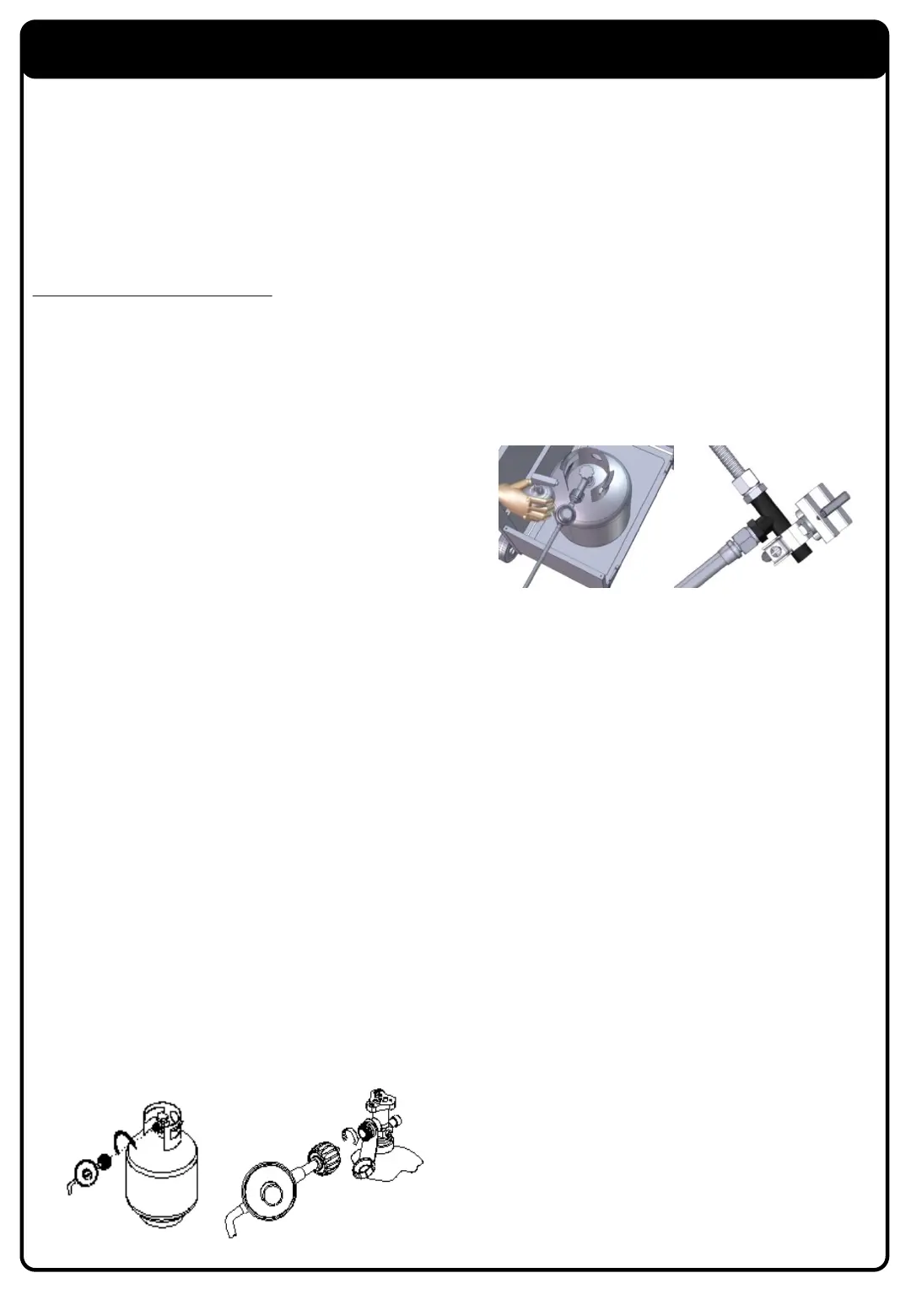
L.P. GAS HOOK-UP
Ensure that the black plastic grommets on the LP cylinder
valve are in place and that the hose does not come into
contact with the firebox of the grill.
CONNECTION
Your grill is equipped with gas supply orifices for use only
with liquid propane gas. It is also equipped with a high
capacity hose/regulator assembly for connection to a
standard 20lb. L.P. cylinder (18-1/4” (46.35cm) high, 12-
1/4”(31cm) diameter). To connect the L.P. gas supply
cylinder, please follow the steps below:
1. Make sure tank valve is in its full off position (turn
clockwise to stop)
2. Check tank valve to assure it has proper external
male threads (type 1 connection per ANSIZ21.81)
3. Make sure all burner valves are in their off position.
4. Inspect valve connections, port, and regulator
assembly. Look for any damage or debris. Remove
any debris. Inspect hose for damage. Never attempt to
use damaged or obstructed equipment. See your local
L.P. gas dealer for repair.
5. When connecting regulator assembly to the valve,
hand tighten the quick coupling nut clockwise to a
complete stop. Do not use a wrench to tighten. Use of
a wrench may damage the quick coupling nut and
result in a hazardous condition.
6. Slowly open the tank valve fully (counterclockwise).
Apply the soap solution with a clean brush to all gas
connections. See below. If growing bubbles appear in
the solution the connections are not properly sealed.
Check each fitting and tighten or repair as necessary.
7. If you have a gas connection leak you cannot repair,
turn gas OFF at supply tank, disconnect fuel line from
your grill and call 1-800-913-8999 or your gas supplier
for repair assistance.
8. Also apply soapy solution to the tank seams. See
below. If growing bubbles appear, shut tank OFF and
do not use or move it! Contact an LP gas supplier or
your fire department for assistance.
To disconnect L.P. gas cylinder:
1. Turn the burner valves off.
2. Turn the tank valve off fully (turn clockwise to stop).
3. Detach the regulator assembly from the tank valve by
turning the quick coupling nut counterclockwise.
Gas Hookup
7


 To Next Page