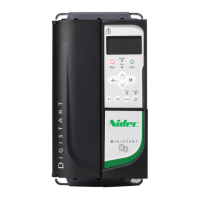
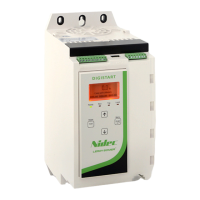
The provided document is a user guide for the Nidec Leroy-Somer Digistart D5 Digital Soft Starter.
Function Description:
The Digistart D5 is a digital soft starter designed to control the starting and stopping of motors. It offers a streamlined setup process with configuration profiles for common applications and a multi-language, easy-to-understand interface with descriptive option names and real-time performance graphs. The soft starter supports energy efficiency, being IE3 compatible and 99% energy efficient when running, and utilizes soft start technology to avoid harmonic distortion. It provides extensive input and output options, including remote control inputs (2 fixed, 2 programmable), relay outputs (2 fixed, 2 programmable), and an analog output. For advanced applications, optional features like smart cards, various communication options (DeviceNet, Ethernet/IP, Modbus RTU, Modbus TCP, Profibus, Profinet), and ground fault protection are available.
The soft starter can be started and stopped via digital inputs, a remote keypad, a communication network, a smart card, or scheduled auto-start/stop. It offers versatile starting and stopping options such as Scheduled Start/Stop, Adaptive Control, Constant Current, Current Ramp, Pump Clean, Timed Voltage Ramp Soft Stop, Coast To Stop, DC Brake, Soft Brake, and Reverse Direction. Customisable protection features include Motor Overload, Excess Start Time, Undercurrent/Overcurrent, Underpower/Overpower, Undervoltage/Overvoltage, Current Imbalance, Input Trip, and Motor Thermistor.
The soft starter can be connected to the motor in-line or inside delta (three-wire and six-wire connection). It automatically detects the motor connection type and calculates the correct inside delta current level. For models 0735C~1220C, dedicated bypass terminals allow the soft starter's protection and monitoring functions to work even when externally bypassed. Power factor correction can be controlled by connecting the PFC contactor to a programmable relay set to "Run".
Important Technical Specifications:
- Current Ratings: 24 A to 1250 A (nominal).
- Mains Voltage: V5 = 200-525 VAC (±10%), V7 = 380-690 VAC (±10%).
- Control Voltage:
- C1 = 110-120 VAC (+10%/-15%), 600 mA
- C1 = 220-240 VAC (+10%/-15%), 600 mA
- C2 = 24 VAC/VDC (±20%), 2.8 A
- Mains Frequency: 50 Hz-60 Hz (±5 Hz).
- Rated Insulation Voltage: 690 VAC.
- Rated Impulse Withstand Voltage: 6 kV.
- Form Designation: Bypassed or continuous, semiconductor motor starter form 1.
- Short Circuit Capability: Type 2 coordination with semiconductor fuses, Type 1 coordination with HRC fuses.
- EMC Immunity: IEC 60947-4-2.
- EMC Emissions: IEC 60947-4-2 Class B.
- Inputs: Active 24 VDC, 8 mA approx.
- Motor Thermistor (B4, B5): Trip >3.6 kΩ, reset <1.6 kΩ.
- Relay Outputs: 10 A @ 250 VAC resistive, 5A @ 250 VAC AC15 pf 0.3.
- Main contactor (33, 34): Normally open.
- Bypass contactor (03, 04): Normally open.
- Relay output A (41, 42, 44): Changeover.
- Relay output B (53, 54): Normally open.
- Analog Output (21, 22): Maximum load 600 Ω (12 VDC @ 20 mA), Accuracy ±5%.
- Operating Temperature: -10 ˚C to 60 ˚C (above 40 ˚C with derating).
- Storage Temperature: -25 ˚C to +60 ˚C.
- Operating Altitude: 0-1000 m (above 1000 m with derating).
- Humidity: 5%-95% Relative Humidity.
- Pollution Degree: Pollution Degree 3.
- Vibration: IEC 60068-2-6.
- Protection (IP Rating):
- 0024B~0135B: IP20
- 0184B~1250B: IP00
- 0735C~1220C: IP00
- Heat Dissipation:
- During Start: 4.5 watts per ampere.
- During Run (Bypassed): ≤ 35 watts (0024B~0052B), ≤ 50 watts (0064B~0135B), ≤ 120 watts (0184B~0250B), ≤ 140 watts (0352B~0580B), ≤ 180 watts (0835B~1250B).
- During Run (Non-bypassed): 4.5 watts per ampere (0735C~1220C).
- Operational Life (internal bypass contacts): 100,000 operations.
Usage Features:
- Quick Setup Menu: Simplifies configuration for common applications by guiding the user through parameters and suggesting typical settings.
- Command Source Selection: Allows users to choose the preferred method for starting and stopping the motor (digital inputs, remote keypad, communication network, smart card, or scheduled auto-start/stop).
- Run Simulation: A built-in tool to simulate motor starting, running, and stopping to confirm correct installation and wiring, available when the soft starter is in "Ready" state and disconnected from mains voltage.
- Load/Save Settings: Enables saving and loading parameter settings to/from an internal file or an external USB drive, as well as resetting parameters to default values.
- USB Save and Load: Supports saving parameter settings and event logs to an external USB drive (CSV or proprietary format) and loading parameter settings or custom messages from a USB drive. Compatible with FAT32 file systems.
- Auto-Start/Stop: Configurable to automatically start and/or stop the motor at specific times (Clock Mode) or run in cycles of a specified duration (Timer Mode).
- Network Address Configuration: Allows setting IP Address, Gateway Address, and Subnet Mask for Ethernet network operation.
- Digital I/O State and Analog I/O State Displays: Provide real-time feedback on input/output states and motor thermistor/analog output values.
- Serial Number and Rating Display: Shows product name, serial number, and model number.
- Software Versions Display: Reports versions of user interface, motor control, remote keypad, parameter list, bootloader, and expansion card software.
- PowerThrough: Allows the soft starter to control the motor even if one phase is damaged, using two-phase control techniques for soft start and stop. Only available for in-line installations.
- Emergency Mode: Allows the soft starter to run the motor and ignore trip conditions, activated via a programmable input.
- Auxiliary Trip: An external trip circuit can be connected to a programmable input to trip the soft starter and stop the motor based on external conditions.
- Pump Clean: A function to dislodge debris from the impeller by starting the motor in reverse, then forward, and then stopping, configurable to repeat cycles.
- Reverse Direction Operation: Controls a reversing contactor to operate the motor in reverse, performing a soft start with the opposite phase sequence.
- Jog Operation: Runs the motor at reduced speed for alignment or servicing, available via digital inputs.
- Secondary Motor Set: Allows programming two separate starting and stopping profiles for dual winding motors, multi-motor applications, or duty/standby scenarios.
Maintenance Features:
- Event Log: Stores details of recent trips, warnings, and operations for analysis. Can be exported to an external file via USB.
- Counters: Tracks hours run (lifetime and since last reset), number of starts (lifetime and since last reset), and number of thermal model resets. Counters can be reset.
- QR Code Generation: Creates a QR code that a smartphone app can read to display key information about the starter, including serial number, firmware versions, installed options, and recent trip details, useful for support.
- Thermistor Reset: Disables the thermistor input if it's no longer required, accessed via Setup Tools.
- Reset Thermal Model: Resets the soft starter's thermal modeling software, which monitors motor performance and ability to start. Should only be done in emergencies as it compromises protection and motor life.
- Finger Guard Kit: Optional accessory for personnel safety, providing IP20 protection for terminals.
- Soft Starter Management Software: PC software for real-time or offline management, monitoring, control, and programming via USB or communication cards.
- Disposal Instructions: Electrical components must be collected separately as electrical and electronic waste according to local legislation.

 Need help?
 General




 To Next Page