EasyManua.ls Logo

Nidec Leroy-Somer R180 - User Manual

Nidec Leroy-Somer R180
20 pages
Print Icon
To Next Page IconTo Next Page
Loading...
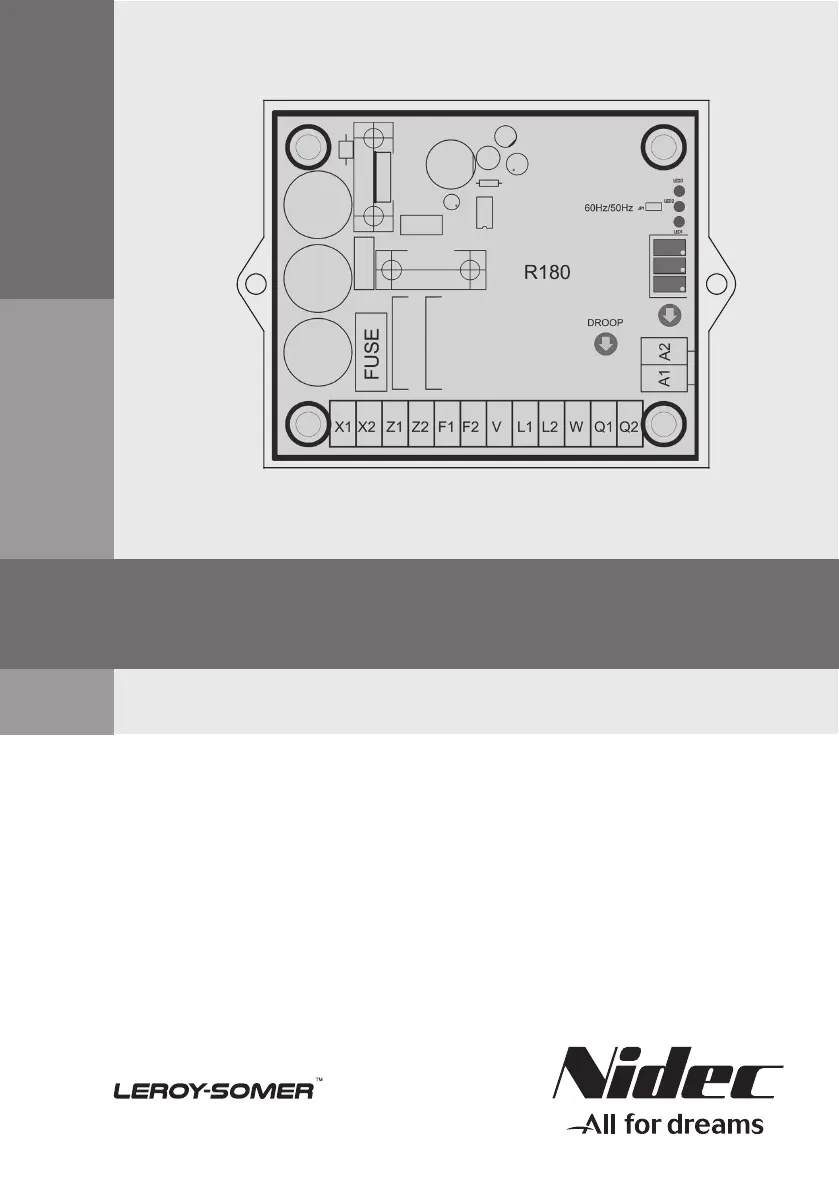
R180
AVR
Installation and maintenance

Questions and Answers

  • A
    Ashley GarciaAug 3, 2025
    How to fix Nidec Leroy-Somer R180 no voltage build-up?
    • D
      David ParkAug 3, 2025
      If your Nidec Controller isn't building up voltage, several factors could be the cause. First, check the fuse links and replace them if they're blown. Second, ensure the alternator is running at the correct RPM. If the issue continues, disconnect the AVR and briefly connect a 24 VDC battery between terminals F1 and F2 to increase residual voltage, then reconnect the AVR. Also, verify that the wiring complies with the wiring diagram and repair any discrepancies. Finally, the voltmeter or the AVR itself could be defective, requiring replacement.
  • K
    Kathleen RichardsAug 7, 2025
    Why is my Nidec Leroy-Somer R180 Controller regulation incorrect?
    • H
      Helen MartinezAug 7, 2025
      Incorrect regulation in your Nidec Controller can stem from several causes. The prime mover RPM might be falling, so ensure it is properly set. A highly distorted non-linear load could be the issue; try reducing it. If the alternator is running on very low power factor (P.F.), P.F. correction may be needed. An unbalanced load can also cause this, so redistribute the load equally over all three phases. Other potential causes include a faulty AVR (replace if necessary), failed rotating diodes (replace them), or a droop connection (remove if not needed).
  • K
    Kerry Martinez DDSAug 12, 2025
    What to do if Nidec Leroy-Somer R180 Controller voltage is too high?
    • J
      John WilsonAug 12, 2025
      If the voltage of your Nidec Controller is too high, it could be due to an incorrect voltage setting; set the voltage to the required value. Alternatively, the AVR might be faulty, in which case you should replace it.
  • J
    jonesjohnAug 18, 2025
    How to stabilize unstable voltage on Nidec Leroy-Somer R180?
    • H
      Heather RoyAug 18, 2025
      Unstable voltage in your Nidec Controller can be caused by incorrect wiring. Check and repair the wiring, ensuring all contacts are tightly screwed in. Also, the stability setting might be incorrect; try adjusting the stability potentiometer.
  • D
    Dana SpencerAug 23, 2025
    Why is the voltage low on my Nidec Controller?
    • A
      Ashley RomeroAug 23, 2025
      Low voltage on your Nidec Controller can be attributed to a few reasons. Check if the external potentiometer link is open and connect the link or potentiometer as needed. Verify that there isn't a loss of sensing voltage and connect it as per the diagram. Also, ensure that the prime mover RPM is correctly set, as a fall in RPM can cause low voltage.
  • J
    Jimmy DorseyAug 27, 2025
    What causes erratic voltage behavior in Nidec Controller?
    • E
      Eric MeltonAug 28, 2025
      Erratic voltage behavior in your Nidec Controller can be due to incorrect wiring. Check and repair the wiring, making sure all contacts are securely screwed in. Another cause could be incorrect circuit board settings; ensure they are set as per the instructions in the manual.

Summary

Safety Measures

Safety Warning Symbols

Summarizes warning symbols for equipment damage, personnel danger, and electrical danger.

AVR Parameters

UFRO Selection Link

Configures the operating mode for 50 Hz or 60 Hz.

UFRO Potentiometer

Sets the frequency range for the UFRO function.

Voltage Setting

Sets the working voltage using a potentiometer.

Technical Specification

Main Function of the AVR

AVR Settings

Start-up Procedure

Steps for starting the AVR, including voltage build-up and adjustment.

Troubleshooting Chart

Multimeter Test

Static Test Procedure

Test Procedure Steps

Covers build-up, voltage control, external potentiometer, UFRO, sensing loss, and stability tests.

Service and Support

Nidec Leroy-Somer R180 Specifications

General IconGeneral
Voltage230/400V; 400V; 230V; 460V; 690V
Frequency50/60 Hz
Efficiency ClassIE1 to IE4
Protection ClassIP23; IP55; IP56
MountingFoot; Flange

Related product manuals