1 Disabled 2 Enabled
Pgm Rcv : Wait to receive a project le as sysex.
Pgm Dump : Dump the current project as a sysex le
Intro
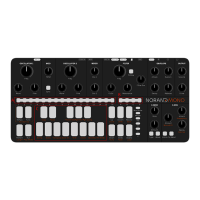
What is Norand Mono ? Well, (not so) simply put, it is an analog monophonic
synthesizer with a large set of performance-oriented digital features. At the
heart of this small synthesizer lies an all analog signal path, with uniquely
designed circuit blocks. The circuits are not cloned from anything, they are
original designs (at least to my knowledge, of course). Each of these analog
blocks are voltage-controlled by powerful Digital-to-Analog converters,
which allow for high-denition, independent audio-rate controls and
modulations. The “brain” of the synth is a last-generation microcontroller
running at a whooping 480MHz, which allows smooth computation of these
voltage source outputs.
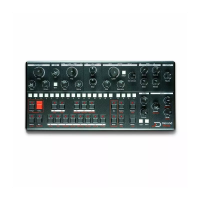
Mono’s interface is split in three distinctive blocks :
The synthesis block : where most of the sound timbre is crafted. This is the
top part of Mono - the synthesis block controls synth parameters such as
osc frequency, lter cut-o, etc, are called synth parameters.
The modulation block : where you can program modulations for synth
parameters. This is not a single LFO and Envelope - every single synthesis
parameter has its own dedicated modulation block. The modulation block
controls are called modulation parameters.
The sequencer block : where you can record, edit, and play sequences of
notes, parameters, modulations … On mono, everything is “sequencable”.
Now anyone with a decent understanding of synthesis can just power on
Mono and start making music. However, I want this manual to toroughly
explain each element. The synthesis part of this manual explains a lot of
what Mono can do that other synths can’t do, it’s pretty technical but it's an
important step to master the synth.
“So you expect me to read?!”
Well … yes ! Mono is designed to be programmed by the user from scratch.
The 303-like look is not there just because I nd it beautiful. What was
amazing with these old-school synths was the spontaneity, ease of use,
and instant fun. Now of course the more complicated and feature rich the
synth is, the less spontaneous it could be. Therefore, the boring part :
RTFM. The point of this manual is not just to give you a list of the features
and step-by-step instructions, but to highlight and demonstrate how you
can use these features in real world sound-design examples!
Synthesis Engine
Intro
By the looks of it, Mono has everything of an East Coast synthesizer. There
is a clear signal ow from left to right, starting from the oscillators, through
the lter, and nally to the amplier. But the contextual modulations (X-


 To Next Page
 Loading...