Vmax I&O Manual │Cascade Instructions
Safe Temperatures for Potable Water
Two factors used to determine safe hot water temperatures are Legionella and scalding. Potable water needs to
be stored at temperatures hot enough to limit the growth of Legionella, yet be cool enough to prevent scalding.
Since both hazards present a potential risk to the user, they must be monitored and controlled.Table 11-1
indicates how water temperature affects Legionella bacteria and contributes to scald injury. Use of a thermostatic
mixing valve in the indirect water heater plumbing system (or at point of use) can help protect against both of
these hazards. By storing potable water at higher temperatures, bacteria growth is controlled, while still
providing high temperature water for dishwasher applications and low temperature water for bathing. Before
proceeding, read the following carefully and take all necessary precautions to avoid potential illness and/or
injury that can result from Legionella or scalding hazards.
Legionella Hazard - This bacteria is naturally occurring in surface water and ponds. It
can also be found in man-made water systems around the world such as water storage
tanks, water distribution systems, fountains, hot tubs, humidification systems,
refrigeration systems and grocery produce misters. Health authorities agree that
Legionella bacteria most often enter the lungs due to aspiration when contaminated water
spray is breathed in as opposed to ingesting drinking water contaminated with the
bacteria. Typical illnesses attributed to Legionella include flue like symptoms (Pontiac
Fever) and a potentially fatal type of pneumonia (Legionnaires’ disease). Failure to
follow instructions may result in illness or death.
Contributing Factors to Legionella - Experts acknowledge that Legionella is an identified risk in most water
systems. Although eradicating Legionella is improbable, precautions can be taken to control and monitor
conditions that promote bacteria growth. According to the World Health Organization (WHO); American
Society of Heating, Refrigeration, and Air-conditioning Engineers (ASHRAE); Canada Safety Council
(CSC); and Centers for Disease Control (CDC), contributing factors to the growth of Legionella in potable
water systems include:
Minerals and nutrients present in the source water and systems materials
Stagnation or low flow characteristic of dead ends in distribution piping systems and storage tanks
Scale, corrosion, and bio film
Tepid water in cold water lines
Water storage temperatures optimal for bacteria growth
Chlorine concentration
Thermostatic Mixing Valve – due to the potentially high hot water temperature stored
in the water heater, a thermostatic mixing valve (or equivalent anti-scald device) must be
installed according to Figure 11-1, local code and the installation instructions provided
with the the thermostatic mixing valve, to reduce scald hazard potential. Anit-scald
devices such as a thermostatic mixing valve allows potable water to be stored at a higher
temperature to limit bacteria growth, and allows water at the tap to be delivered at a
lower temperature to prevent scalds. Failure to follow these instructions may result in
serious injury or death.
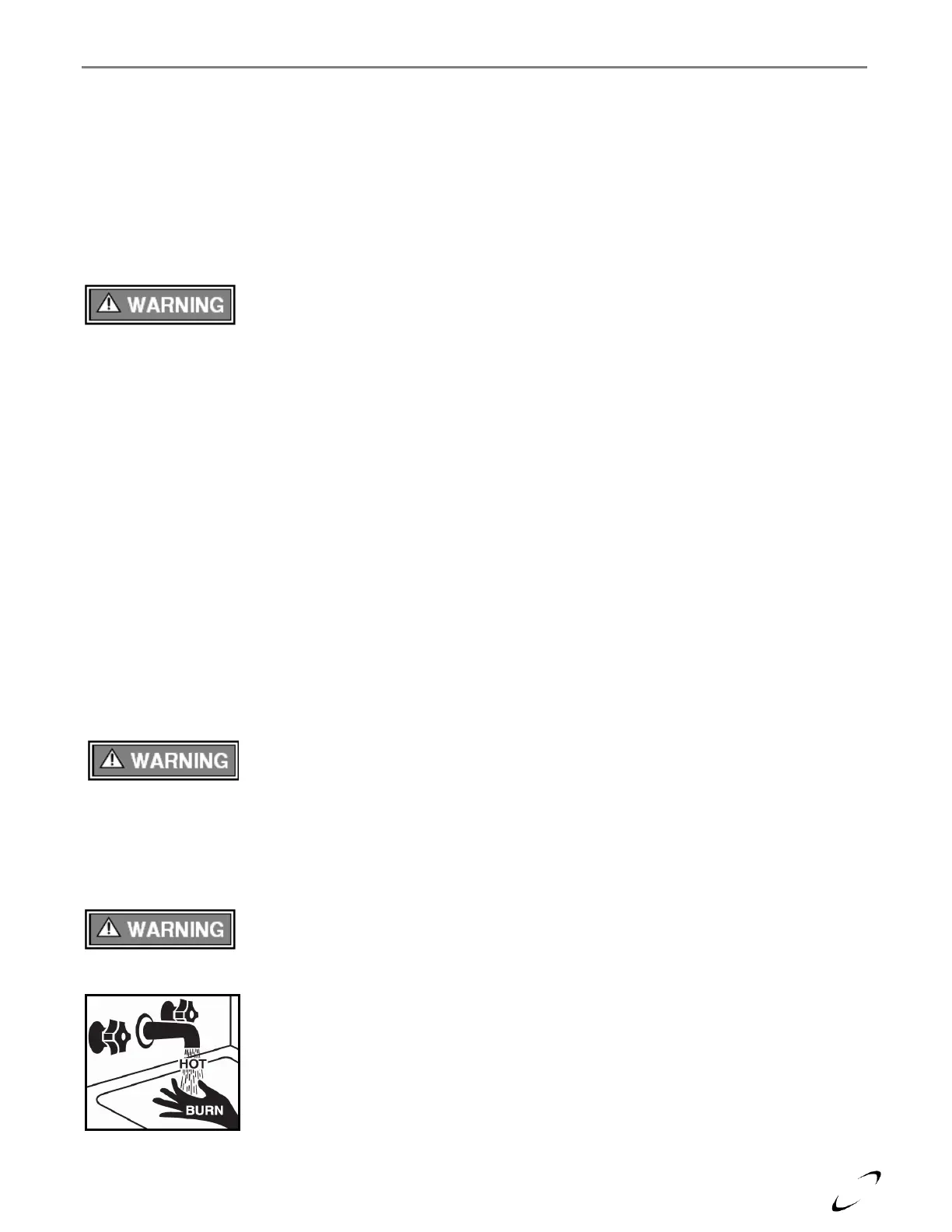
Scald Hazard - There is a hot water scald potential if the thermostatic mixing valve (or
other anit-scald device) is set too high. Refer to the installation instructions provided
with the thermostatic mixing valve, prior to attempting adjustments. Failure to follow
these instructions may result in serious injury or death.
A scald injury can occur when hot steam or liquid makes contact with one or more layers
of skin. Scald severity (degree of burn) is directly impacted by exposure time and
temperature. Refer to Table 11-1. The following basic precautions are common sense:
Young children and elderly adults burn more quickly and should use cooler water.
Never leave a child alone while drawing water in a bathtub.
Test the water temperature before bathing or showering.
Turn cold water on first and then add hot water until the temperature is comfortable.


 To Next Page