Need help?
Do you have a question about the Nu-Air Windsor NU145 and is the answer not in the manual?
Lists items included with the HRV for installation.
Outlines duties and precautions for installers.
Describes different methods for connecting the HRV.
Details outdoor duct installation and weather hood placement.
Instructions for hanging the unit and minimizing noise.
Guidelines for designing and installing duct systems.
Steps for installing the condensate drain assembly.
Explains how to interlock the HRV with the furnace.
Procedures for balancing air flow using measurement devices.
How to adjust fan speeds for balancing and system needs.
Details the ES Series controls and their functions.
Explains the ES Tx and Mx control units.
Features and functions of the ES Lumina control.
Guidance on wiring ES Series controls.
Covers Windsor Series and other 24 VAC control options.
Guidance on wiring Windsor Series and 24 VAC controls.
Wiring and operation of the DSTAT-1 control.
Wiring and operation of the Win-1 control.
Wiring and operation of the Win-20 control.
Instructions for remote 2-wire switching setup.
Explains the meaning of status LEDs and operational modes.
Electrical schematic for NU165 models.
Electrical schematic for NU145 models.
Electrical schematic for NU205 models.
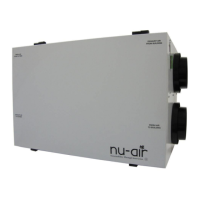
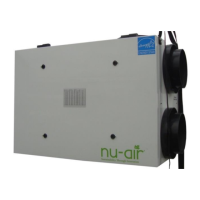
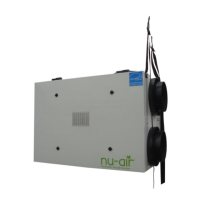
The Nu-Air Windsor Series Heat Recovery Ventilator (HRV) is a balanced central ventilation system designed to bring fresh, filtered outdoor air into your home while exhausting an equal amount of stale, humid indoor air. This process helps to maintain indoor air quality by removing odors, excessive moisture, and volatile organic compounds (VOCs) from paints, cleaners, furniture, and building materials, effectively acting as the "lungs" of your home. The system is designed for residential applications and can be installed as an independent system or integrated with a central heating/cooling system.
The HRV operates by utilizing powerful centrifugal blowers to draw fresh air from outside and exhaust stale air from inside. The incoming fresh air is filtered before passing through a heat exchange core. Simultaneously, stale, humid air from the home flows through the same cross-flow heat exchanger, transferring its energy to the incoming fresh air without the two air streams mixing. This tempered fresh air is then distributed throughout the house via an independent or shared (furnace) duct system.
The unit is capable of several operating modes, depending on the type of controls installed:
It is generally recommended to run the unit on low speed continuously to ensure a steady supply of fresh air and removal of indoor pollutants. The amount and frequency of ventilation needed can vary based on factors such as the number of inhabitants, cooking habits, hobbies, presence of pets, and whether windows are opened. Signs like moisture on windows, lingering odors, or a sensation of stuffy air indicate a need for more or increased ventilation.
Some controls include a dehumidistat (d-stat) to monitor ambient relative humidity (RH) with selectable settings (30%-80% RH). If the ambient humidity exceeds the setpoint, the ventilator will switch to high speed until the RH returns to the setpoint. While not a dehumidifier, the HRV can help reduce indoor humidity by exhausting high-RH air, especially in cooler seasons when outdoor humidity is lower. Typical dehumidistat settings are 40%-60% for winter, 50%-60% for spring/fall, and 65%-80% or OFF for summer (for non-air-conditioned homes).
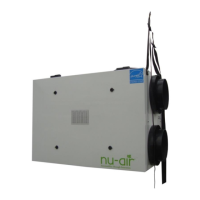
The Nu-Air HRV is designed for ease of installation and operation. It comes equipped with filters, anti-vibration straps, a heat recovery core, and a drain hose assembly. Balancing dampers are not required, as the ES Series HRVs allow installers to adjust each motor's speed for both high and low settings. The unit includes removable terminal blocks for timers, remote controls, and furnace interlock, with specific blocks for 12 VDC ES Series controls and 24 V controls.
Installation options include:
For optimal performance and energy efficiency, fully insulated ducting with an integrated vapor barrier must be used between weather hoods and the HRV, and on all runs passing through unheated areas, to prevent condensation and energy losses. Weather hoods should be located with a minimum of 6 feet separation between fresh air and exhaust hoods, and at least 18 inches above ground level for supply hoods and 4 inches for exhaust hoods. They should also be at least 3 feet away from any other appliance exhaust vent or furnace vent.
The HRV is designed to be hung from the ceiling using anti-vibration straps, which are adjustable for easy mounting and leveling. It is recommended to avoid hanging the unit directly below bedrooms or other quiet areas.
Balancing air flows is crucial for HRV performance. The Windsor Series allows quick and simple motor speed adjustments using two recessed buttons. A magnehelic gauge or differential pressure digital manometer is recommended for measuring airflow. To balance, activate high speed (e.g., via remote control or jumper wire), then press and hold either the FRESH air or EXHAUST air pushbuttons for 3 seconds to enter SPEED ADJUST MODE. Each press of the corresponding button reduces motor speed until the minimum is reached, then returns to peak speed. After adjusting, stop pressing buttons for 10 seconds to save the new speeds. Low-speed adjustment follows a similar procedure.
The unit supports various remote control options, including humidity sensing, off-on control, intermittent and continuous modes, and recirculation. Both ES Series (12 VDC) and Windsor Series (24 VAC) controls can be used, though only one type of central control should be employed per installation. ES Series controls feature a touch pad and LEDs to select modes and indicate operation. The ES Lumina control offers a backlit LCD screen, navigation keys, an intuitive interface, an on-board humidity sensor, a built-in timer, and filter alerts.
Regular maintenance is essential for the longevity and efficiency of the Nu-Air HRV. Before any servicing, the power to the unit must be disconnected.
Key maintenance tasks include:
Annual general servicing by an accredited contractor is recommended. This servicing should include all the above maintenance items, a general check for proper operation, and inspection of controls and electrical connections. It also involves verifying that intake and exhaust air flows are properly balanced and re-balancing if necessary.
Troubleshooting guidance is provided for common issues such as low or high humidity, frosting, cool supply air, water in the HRV, and poor airflow, with recommended solutions ranging from balancing airflows and adjusting controls to cleaning components and checking connections. Only qualified technicians should service controls or internal components.
 General
| Model | NU145 |
|---|---|
| Brand | Nu-Air |
| Type | Ceiling Fan |
| Power | 50 W |
| Speed Settings | 3 |
| Blade Size | 52 inches |
| Voltage | 230 V |
| Frequency | 50Hz |
| Diameter | 132 cm |

 To Next Page