Need help?
Do you have a question about the NuAire MRXBOXAB-ECO2B and is the answer not in the manual?
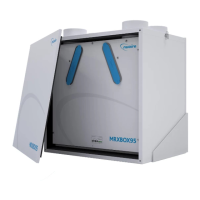
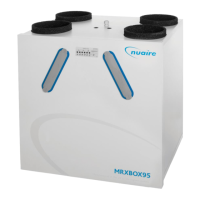
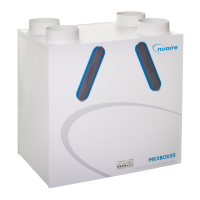
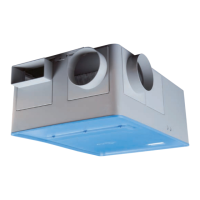
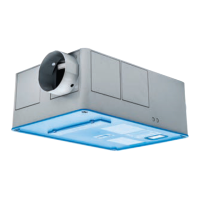
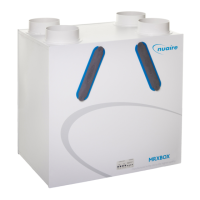
The MRXBOXAB-ECO2B is a range of mechanical ventilation units with heat recovery, designed for wall mounting in residential dwellings. These units provide continuous mechanical supply and extract ventilation, recovering heat from the extracted air to pre-warm the incoming fresh air. This process significantly reduces heat loss and improves energy efficiency, with the heat exchanger block capable of recovering up to 95% of normally wasted heat. The units are equipped with two independent fans, each offering full-speed control for both background and boost ventilation rates, ensuring optimal airflow and indoor air quality.
For safe and proper operation, the unit must be installed by a qualified electrician, with all electrical connections conforming to current IEE regulations. It is crucial to isolate the unit from the power supply before any cover removal or maintenance. All covers must be securely fitted before switching on the mains supply. The unit requires earthing, and all-pole disconnection from the mains, with a minimum contact separation of 3mm, must be incorporated into the fixed wiring. Ducting must be securely fixed to the spigots to prevent access to live parts, and duct runs terminating close to the fan should be protected by suitable guards. In case of a damaged supply cord, it must be replaced by the manufacturer, its service agent, or similarly qualified persons to avoid hazards. Precautions must also be taken to prevent the back-flow of gases into the room from open flues of gas or other fuel-burning appliances.
The MRXBOXAB-ECO2B is designed for indoor installation on a solid wall, away from direct sources of frost, heat, water spray, or moisture generation, to ensure vibration-free operation. A minimum clearance of 350mm in front of the unit is required for access during maintenance, such as filter changes. The unit must remain switched on at all times to maintain ventilation within the dwelling, as turning it off can lead to long-term damage to both the unit and the building fabric. The appliance is not intended for use by children or persons with reduced physical, sensory, or mental capabilities unless supervised or instructed on its safe use by a responsible person. Children should not play with the appliance or perform cleaning and user maintenance.
Installation on a solid wall involves fixing a mounting bracket (supplied) horizontally to the wall using screws (by others) through pre-drilled holes, ensuring the interlock side is at the top. The unit then interlocks over this wall-mounted bracket. For non-solid walls, such as stud partitions, the MVHR unit should be fixed to a minimum 25mm thick MDF panel solidly fixed behind the plasterboard. This MDF panel should ideally extend from floor to ceiling, or at least 2m high, and cover a minimum of three vertical studs with centers no more than 400mm apart, with additional vertical supports if necessary. Care must be taken to install the unit true in all three dimensions to prevent overflow from the internal condensation drip tray.
For loft mounting, two options are available. Option 1 involves positioning the MVHR unit on a tank stand using the Anti-vibration tray assembly (MRXBOX-AV2), discarding the angle brackets. Option 2 requires positioning the MVHR unit on a minimum 25mm thick MDF panel vertically fixed across the roof trusses to form a solid false wall, utilizing the Anti-vibration tray assembly (MRXBOX-AV2) including the angle brackets.
The condensate drain must discharge under a water level in a U-trap drainpipe or an alternative airlock drain method. The connection is suitable for 21.5mm overflow pipe, and solvent cement should be used for the joint. If a U-trap is used, it must be filled with water to avoid airlocks, and if the condensation pipe is in an unheated space, it should be insulated to prevent freezing. The MVHR-DRAIN is recommended as the primary condensate take-off.
The unit is designed to extract air from all wet rooms (e.g., bathroom, kitchen, en-suite, utility room with sink) and supply air to all habitable rooms (e.g., bedrooms and lounge). Adjustable extract/input grilles (not supplied) should be used, and external grilles must have a minimum free area of 12,250 sq. mm. Ducting installation should comply with building regulations, specifically the "Domestic ventilation compliance guide." Rigid ducting is recommended at all times due to its lower resistance compared to flexible ducting. If flexible ducting is used, it must be kept to a minimum (maximum 300mm per leg) and pulled taut. To prevent condensation, ducts between the MVHR unit and the atmosphere (outside air inlet and air outlet) must be insulated. Ducting should be installed to minimize airflow resistance, with bends kept to a minimum and a distance of at least 300mm between the appliance and any bends. Ideally, 150mm diameter or 204 x 60mm rectangular ducting should be used. All ducting joints must be sealed with silicone-type sealant and securely fixed to the appliance.
The MRXBOXAB-ECO2B units are intended for whole-dwelling ventilation and must not be used during site construction or clean-up periods, as cement and plaster dust can be abrasive and affect fan performance and reliability. Filters should be checked for dust or debris prior to commissioning. During the property's drying-out phase, high moisture levels are likely, so it is advisable to keep the unit running once building works are complete. If building works are not complete, air valves should be closed or covered to prevent condensation in the ductwork and the unit due to warm air migration.
Commissioning involves setting the required airflow rates according to design specifications or building regulations (ADF 2010). The unit provides independent control for normal and boost airflows. Correct commissioning is essential to ensure ventilation rates are met and to prevent excessive power consumption. Commissioning should be carried out using a calibrated moving vane anemometer and hood. Adjustment valves should be locked in place after commissioning. The homeowner/tenant must be informed not to adjust the unit, as it could negatively impact indoor air quality and lead to condensation and mold growth. The clear panel covering the control has an adhesive panel that should be exposed and sealed post-commissioning to prevent tampering. Speed 1 is limited to never exceed speed 2; when commissioning, speed 2 should always be set first.
The unit features a humidity sensor that triggers a boost to the commissioned boost speed when humidity in the extracted air from wet rooms exceeds a set point. This set point can be adjusted behind the front panel of the unit (least sensitive when turned fully clockwise). This adjustment should only be performed by a qualified person after isolating power and removing the cover.
The unit's status is indicated by LEDs on the front cover, showing Speed 1, Speed 2, Speed 3, Supply Fan Fault, Extract Fan Fault, Frost Protection, Filter Change, and HX Bypass (for AB units only). The display on the control panel will not indicate when a higher speed setting is triggered by an external source like an ES-PIR2. The unit can override both speed 1 and speed 2 to operate the fan at maximum airflow (Speed 3).
An integral automatic heat exchanger (HX) bypass monitors intake and extract temperatures. If temperatures fall within set parameters, the bypass damper opens automatically to target an indoor comfort temperature year-round. The extract temperature is an average from all wet rooms; if it exceeds 25°C, the unit may go into bypass depending on outside temperatures. Frost protection activates if the intake air temperature drops below the predetermined set point (-5°C as standard), reducing the supply fan to minimum speed. Once the temperature rises, the fan returns to its commissioned speed. Frost protection only activates after ten days of continuous run time. For -D units, a 5m pre-fitted cable is supplied for connection to the MRXBOX-VSC-B touch screen display.
Maintenance involves inspecting filters every 6 months and replacing them every 12 months (or sooner if required). Failure to do so may impair performance and energy efficiency. A flashing LED indicates a filter change is required, repeating every 12 months and turning off after 5 days. To remove filters, grip the two circular tabs on either end of the filter covers and pull them away from the unit. The filter can then be extracted by pulling the black removal loop on its front edge.
The product comes with a 5-year warranty, covering parts and labor for the first year, and replacement parts for the remaining period. The warranty is void if the equipment is modified without authorization, incorrectly applied, misused, disassembled, or not installed, commissioned, and maintained according to the manual and general good practice. Failure to maintain the unit as recommended will invalidate the warranty. Nuaire uses largely recyclable components, and at the end of its life, fans, motors, controls, cabling, sheet metal parts, aluminum extrusion, heating/cooling coils, EPP, plastic ducting, nylon corner pieces, plastic heat exchangers, and packaging materials can be segregated into appropriate recycling streams. Cardboard-framed filters should be processed in energy from waste centers, while metal/wire-framed filters should be taken to a civic amenity site. Before dismantling, the product must be made safe from any electrical/water/refrigerant supplies, and this work should only be undertaken by a qualified person.
 General
| Model | MRXBOXAB-ECO2B |
|---|---|
| Type | Mechanical Ventilation with Heat Recovery (MVHR) |
| Heat Exchanger Type | Counterflow |
| Heat Recovery Efficiency | Up to 95% |
| Mounting | Wall or Floor |
| Voltage | 230V |
| Operating Temperature | -20°C to +40°C |
| Fan Type | EC (Electronically Commutated) |
| Filter Type | G3 |
| Ducting | 125mm |
| Power Supply | 230V, 50Hz |
| Noise Level | 35 dB(A) |

 To Next Page