Need help?
Do you have a question about the nux Trident and is the answer not in the manual?
Details requirements and initial software setup for the firmware update process.
Instructions for connecting the NUX Trident to a computer and entering DFU mode.
Guide on selecting the correct firmware file and initiating the update procedure.
Steps to complete the firmware update, including disconnecting and testing.
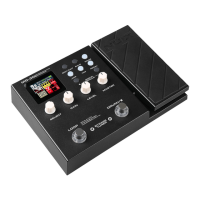
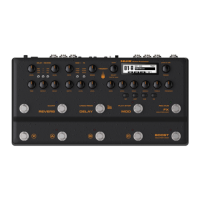
The NUX Trident is a versatile guitar processor designed to offer a comprehensive suite of effects and amplifier simulations for musicians. It integrates a range of features for both live performance and studio recording, allowing users to craft and refine their sound with precision.
The NUX Trident serves as a multi-effects unit and amplifier modeler, providing a wide array of sonic possibilities. It features dedicated sections for Delay/Reverb, Modulation (MOD FX), and Amplifier/Cabinet simulations, along with an EQ section. The Delay/Reverb section offers controls for Level, Time, Repeat, and Decay, enabling users to create ambient textures or precise echoes. The MOD FX section includes parameters for Rate, Depth, Level, and Gain, with options for Chorus (CHO), Tremolo (TREM), Compressor (COMP), and Filter effects. These modulation effects can add movement, sustain, or unique tonal characteristics to the guitar signal.
The core of the Trident's functionality lies in its AMP and CAB sections. Users can select various amplifier models, such as "VIVO" and "EUH Brown," and fine-tune their sound using traditional amplifier controls like Bass, Middle, Treble, and Presence. The device also includes a Noise Reduction (NR) feature to minimize unwanted hum and hiss, ensuring a clean signal. The CAB section allows for the selection of different cabinet simulations, further shaping the overall tone. An editable EQ section provides additional control over the frequency response, allowing for detailed sound sculpting.
Beyond its core effects and amp modeling, the NUX Trident incorporates several utility functions. It includes a built-in Looper for recording and overdubbing phrases, accessible via the REC/DUB footswitch. A TAP function allows users to set the tempo for time-based effects like delay. The device also features a BOOST function, which can be activated to provide an extra volume or gain kick, useful for solos or emphasizing certain parts of a performance. A tuner function is integrated, accessible by holding the BOOST footswitch, ensuring accurate pitch.
The Trident's interface is designed for intuitive control, featuring a combination of rotary knobs and footswitches. The display provides visual feedback on selected presets, amplifier models, and effect parameters. The device supports preset management, allowing users to save and recall their custom sounds. A "CLEAR" footswitch is available for resetting parameters or clearing loops. The "UNDO/REDO" function provides flexibility during sound design or looping.
The NUX Trident is engineered for ease of use, both in setup and operation. To begin using the device, it requires connection to a power supply (NUX ACD-006A, included) and an instrument input. Output connections can be made to an amplifier, mixer, or audio interface. The USB-C data/sync cable (included) facilitates connection to a computer for firmware updates and potentially for editor software integration, which is crucial for advanced sound editing and management.
For live performance, the footswitches are strategically placed for quick access to various functions, including preset switching, effect toggling, and looper control. The "SELECT" footswitch allows users to navigate through presets or menus, while holding it can activate the save function. The "EDIT" footswitch provides access to deeper parameter adjustments. The clear labeling of each knob and footswitch contributes to a straightforward user experience, even in low-light conditions.
The device's connectivity options extend its utility. The USB-C port not only handles data transfer for updates but also supports LOOPBACK USB Routing, which can be beneficial for recording and re-amping scenarios. This allows the Trident to act as an audio interface, sending processed guitar signals directly to a computer and receiving audio back for further processing or monitoring.
The NUX Trident is designed to be a central hub for a guitarist's sound, offering a wide range of tones from pristine cleans to heavy distortions, all within a single unit. Its ability to combine multiple effects, amplifier models, and cabinet simulations makes it a powerful tool for musicians looking to streamline their rig without compromising on sonic quality.
Maintaining the NUX Trident primarily involves keeping its software up-to-date and ensuring proper physical care. Firmware updates are a critical aspect of maintenance, as they often introduce new features, improve existing functionalities, and fix bugs. The update process is facilitated by the "NUX Device Updater" software, which runs on Windows 7 (or later) or MacOS 10.10 (or later).
To perform a firmware update, users need to download the firmware update kit from the NUX Trident product page and install the NUX Device Updater. The device must be connected to the computer via the included USB-C cable and put into DFU (Device Firmware Upgrade) mode. This is achieved by holding specific footswitches (UP and REVERB) while powering on the device. Once in DFU mode, the updater software will recognize the Trident, and users can select the new firmware file (.bin) to initiate the upgrade.
During the update process, it is crucial to ensure a stable connection and power supply. Users are advised not to disconnect or power off the NUX Trident, as this could "brick" the device. The update typically takes around 30 minutes, and the device's display will show "UPDATING..." until completion, after which it will display "COMPLETE."
After a successful firmware update, it is recommended to also download and install the corresponding new version of the editor software. This is because the firmware and editor software are designed to work in conjunction, ensuring full compatibility and access to all new features and parameters.
Physical maintenance involves keeping the device clean and protected. Regular cleaning of the exterior with a soft, dry cloth can prevent dust and grime buildup. Care should be taken to avoid spilling liquids on the unit. When transporting the Trident, using a protective case can prevent damage from impacts or scratches.
In case of any issues during the firmware upgrade, such as a failed update or problems with the included USB-C cable, NUX provides support. Users are advised to contact Cherub Technology via email for assistance. It is also recommended to disconnect all other USB MIDI and audio devices from the computer before connecting the NUX Trident for an update, to prevent potential conflicts. The emphasis on using a "quality USB-C to USB adapter" if the computer only has USB-C ports highlights the importance of reliable connectivity for successful updates.
 General
| Type | Multi-effects pedal |
|---|---|
| Inputs | 1 x 1/4" instrument input |
| Outputs | 1 x 1/4" headphone output |
| USB | Yes |
| Power Source | 9V DC |
| Amp Modeling | Yes |
| Impulse Response (IR) Loading | Yes |
| Connectivity | headphone output |
| Effects | Overdrive, Distortion, Modulation, Delay, Reverb |
| Dimensions | 280mm(L) x 160mm(W) x 55mm(H) |
| Weight | 1.6 kg |

 To Next Page