5
OPERATION
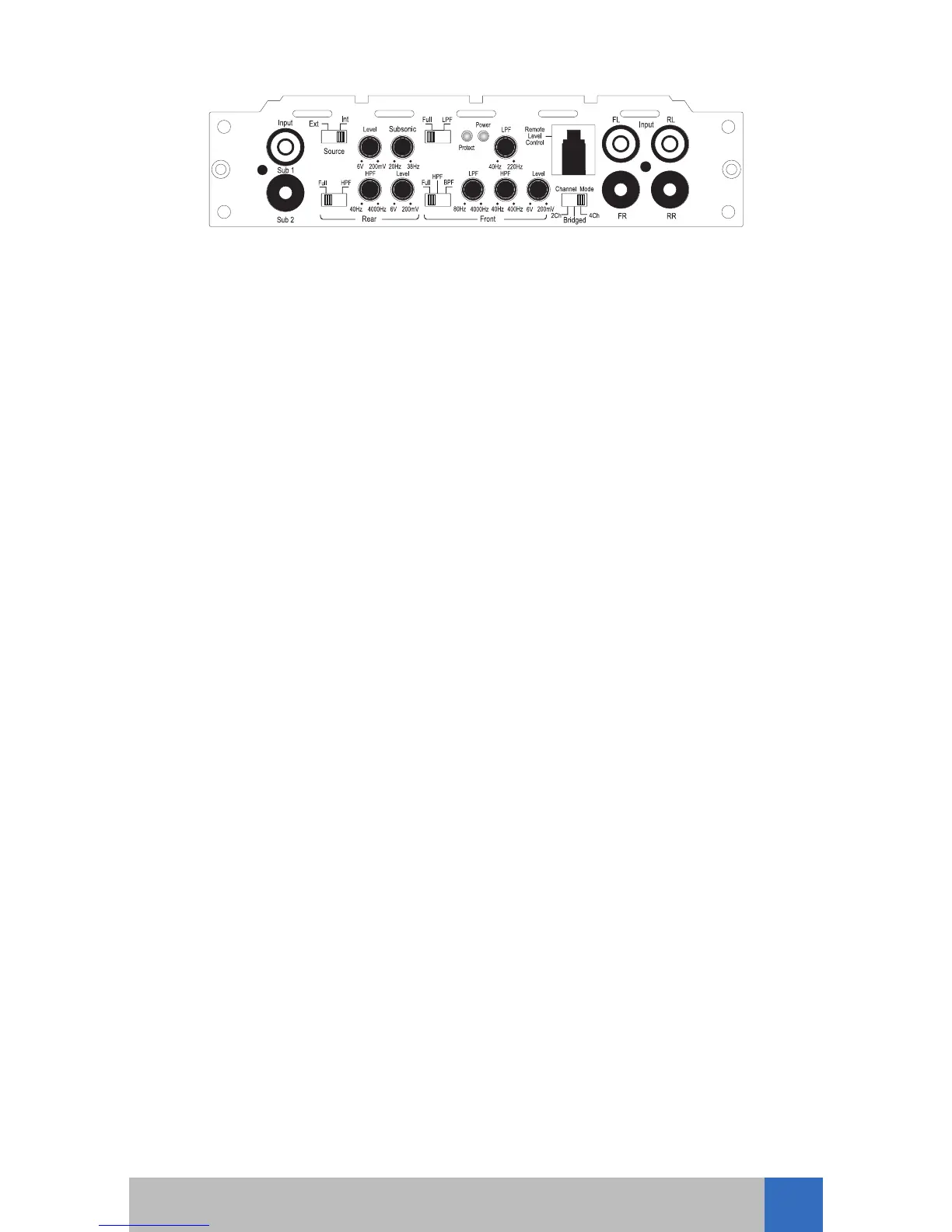
Status LEDs (Power and Protect): Power LED will illuminate when the amplier is turned on
and operating normally. Protection LED will illuminate if the amplier shuts down due to a short
circuit, DC offset, or overheating.
Remote Level Control: Input adaptor for connecting a remote bass control knob. (Included)
HPF Variable Control: This is a separate low frequency lter that can be adjusted anywhere
from 40Hz - 4kHz (front) and 40Hz - 400Hz (rear). This control function is useful for removing low
bass frequencies to prevent damage to the small full range speakers.
LPF Variable Control: The variable crossover control on the side panel of the amplier allows
you to adjust the crossover frequency from 80Hz - 4kHz (front) and 20Hz - 220Hz (subwoofer).
We recommend starting at the midpoint setting (250Hz front and 100Hz subwoofer) and turn
clockwise for greater mid-bass frequencies or counterclockwise for reduced mid-bass output.
Subsonic Filter: Crossover that restricts damaging ultra-low frequency notes from reaching
speakers incapable of reproducing notes below (20Hz - 38Hz). Clockwise turn increases the
frequency lter and counterclockwise reduces the frequency lter.
Level Control: The input gain control is not a volume control. It is possible to have maximum
power output even with the level setting at minimum. To set this level properly turn the source
unit to 80% volume. Next, slowly turn the level control clockwise on the amplier up until you can
hear audible distortion, then turn it down to preferred settings.
Line Level Inputs: The RCA inputs are capable of receiving low-level signals (200mV-6V) from
a source unit, preamplier or equalizer.
Crossover Switch: This manual switch allows you to select either the lowpass or highpass
crossovers and includes the option of deactivating both crossovers.
Source Switch: Set the switch to the SUB position if you are connecting your head unit’s
subwoofer output to the SUB 1 or SUB 2 inputs. Set the switch to the INT position if you are
sending a full range signal to the full range inputs (FL, FR, RL, RR) and not connecting anything
to the SUB inputs. In the INT position, the amplier will lter the bass frequencies from the full
range signal and send them to the subwoofer amplier channel.
Channel Mode Switch (4CH/ST): Set the switch to 4CH if you are using four channel outputs
from your head unit to the FL, FR, RL, RR inputs on the amplier. Set the switch to ST (stereo)
mode if you are using two channel outputs from your head unit. In the ST position, the amplier
will take the signal input to the FL and RR inputs and send the same signals also to the RL and
RR amplier channels.
The Band-Pass Filter (BPF) allows you to run your components in an active setup, where the
passive crossovers are eliminated and the electronic crossovers on the amplier take over. To
take advantage of this feature, move the switch on the amplier to the BPF position, and set the
LPF and HPF to your preference.


 To Next Page
 Loading...