12
To make a simple beginning at this, return the filter settings
to the positions of page five, and open the audio input from
the noise generator. Then move the switch #10 to the left. The
VCA is now under the control of ENV 1, and will allow signals
to pass through only when ENV 1 is gated on. Press a key and
hold it until the resulting event is over. Change the settings
on ENV I and do it again; continue to experiment until you can
anticipate the kind of event that will result from any arbi-
trary setting of the ENV 1 constants.
You can gate ENV 1 automatically--instead of from the key-
board--by moving the left assignments switch in the
mini-sequencer to either its middle or upper position, and
turning the CLOCK on. Do this now, and set the CLOCK tempo to
something near one beat (gate) per second. Events are now pro-
duced automatically, leaving both your hands free to manipulate
the VCF manual controls.
For an example of a practical application, reduce the noise
input to about two o'clock, set the filter resonance to maxi-
mum, and the filter mode to bandpass. The ENV 1 should be set
for minimum attack and sustain and fairly short decay. Now
slight changes in the filter frequency control in the range 12
o'clock to 3 O'clock will produce a wide range of percussive
noises. In a later section you will learn that even these
changes in the filter frequency need not be done by hand, but
can be programed from the s/h unit.
D. TWO VOICES AND THE KEYBOARD
You are now acquainted with all the controls that determine the
character of individual events from the synthesizer. All of the
remaining controls are used for producing chains of
events--i.e. melodies, repeating sequences, bass lines, random
percussive rhythms, etc.
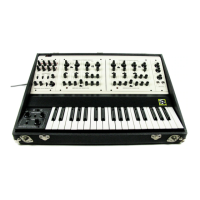
But up to this point you have used only VOICE MODULE ONE, under
the control of KEYBOARD VOLTAGE ONE. You are now ready to use
the second voice module; do so by opening the OUTPUT LEVEL CON-
TROL in the output mixer, and moving the 2ND VOICE switch at
the left of the keyboard to ON. Set the controls on the second
voice module to any of the useful patches you have already
found, and use the keyboard to play both modules simulta-
neously.
You should be able to verify the following "keyboard logic":
a) VOICE MODULE ONE always follows the pitch represented by
the leftmost key depressed. VOICE MODULE TWO always fol-
lows the rightmost key depressed. If three keys are
depressed, the middle key has no effect.


 To Next Page