16
Through all of your experiments so far with the minisequencer,
the third ASSIGNMENTS switch should have been down.
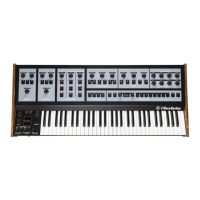
Now move it to its center position, labelled SEQ 1 By CV 1. In
this position, KEYBOARD CONTROL VOLTAGE #1 is reintroduced to
the control inputs of the VCO's in voice module one. Try it;
you will find that the keyboard can now TRANSPOSE any sequence
being produced by voice module one. All of the keyboard con-
trols themselves--portamento, pitch bend, the transpose
switch--are effective. If both modules are under sequencer con-
trol, you will find that the pitches produced from the second
voice module are, however, not affected by the keyboard.
It should not be hard to guess that in the SEQ 2 BY CV 2 posi-
tion, the sequencer output voltage to the second voice module
will be transposed by KEYBOARD CONTROL VOLTAGE #2. The first
voice will not be affected by anything you do at the keyboard.
Since, however, the 2ND VOICE switch plays a role in determin-
ing when and how a second control voltage is produced from the
keyboard, it will also affect the transpositions of SEQ 2. For
example--
a) if the switch is off, transpositions will occur with the
depression of only a single key; if one key is held down
while another is depressed to the right of it, the
sequence will transpose to the higher key only for as
long as the higher key is depressed. When the key is
released the sequence will transpose down again to the
pitch of the lower depressed key.
b) If the switch is on, one-key-at-a-time playing will not
transpose the sequence; but if one key is held down, and
another is pressed to the right of it, the sequence will
transpose and will hold the transposition after the sec-
ond key is lifted. No further transposition will occur
until the next occasion on which two keys are depressed.
NOTE: The latter setup gives you considerable performing free-
dom in controlling voice one from the keyboard. A sequence
transposition can be established for voice two by pressing two
keys; after that you have the full freedom of the keyboard for
playing voice one. But you must develop a non-legato touch; any
overlapping of keys will be interpreted INSTANTLY by the key-
board electronics as a transpose instruction for the second
voice sequence.
This use of a non-legato playing technique does not mean, of
course, that you cannot have legato phrasing; that will be
determined by the decay time on your envelope generators, not
by your keyboard touch.


 To Next Page
 Loading...