6 7
HOOKING UP THE TRAILER
When loading your trailer, store heavy gear rst, keeping it
on or close to the camper oor. Distribute items to keep the
loaded trailers tongue weight within 12-15% of the loaded
trailer weight. Only store light items on high shelves. Distribute
weight to obtain even side-to-side balance of the loaded
vehicle. Secure loose items to prevent weight shifts that could
affect the balance of your vehicle. When the trailer is loaded,
drive to a scale and weigh tow each vehicle and trailer axle
separately to determine axle loads.
The trailer axle load should not exceed its gross axle weight
rating (GAWR). The total tow vehicle and trailer load should
not exceed the gross combined weight rating (GCWR) of the
tow vehicle and/or not exceed the tongue weight rating of
the tow vehicle. These weight ratings are given on the trailer
certication label that is located on the left side of the trailer
on the A-frame/tongue.
Ensure your vehicle has hitch and receiver capacities that
meet or exceed the trailer weight; only use a hitch ball
that matches the coupler provided with your trailer. For
trailers equipped with the optional Max Coupler, refer to the
manufacturer’s manual for proper hook up and use. Ensure the
coupler is properly seated with the locking latch fully closed
and locking pin inserted to the latch prior to towing your
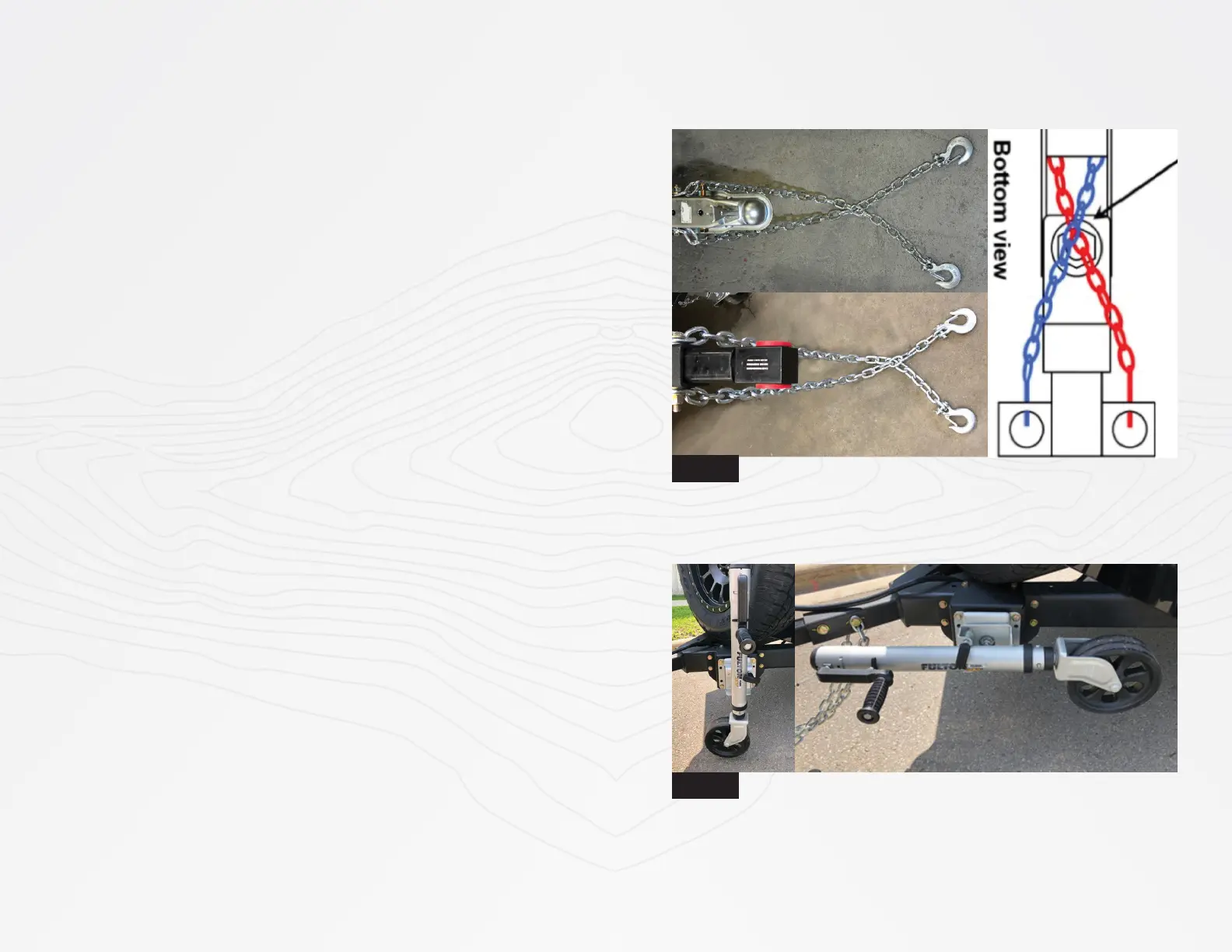
trailer. Always use safety chains when towing your trailer, and
cross over the chains as illustrated in Fig 1.1.
Your trailer us equipped with a manual trailer jack; turn the
handle clockwise to raise the trailer, and counter clockwise to
lower the trailer. Remove jack locking pin to rotate the jack as
illustrated in Fig 1.2. If a wheel(s) is supplied with your trailer
jack it is only intended for delivery assistance. Jack options
are subject to change.
Fig 1.1
Fig 1.2


 To Next Page