OFITE, 11302 Steeplecrest Dr., Houston, TX 77065 USA / Tel: 832-320-7300 / Fax: 713-880-9886 / www.ote.com 7
Shear Stress Conversions
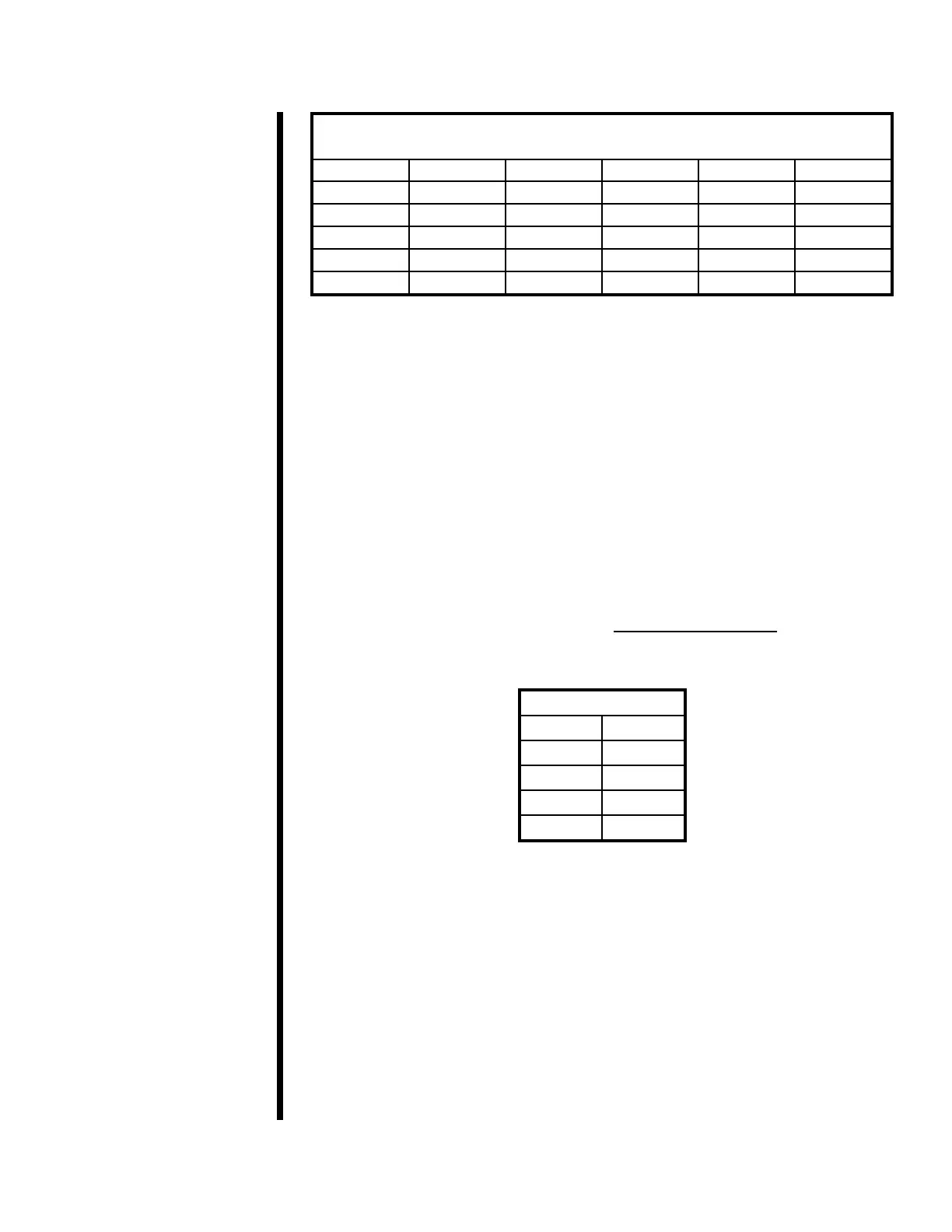
To convert from units on left side to units on top, multiply by factor @ intercept.
Dyne/cm
2
Pa lb/100ft
2
lb/ft
2
DR
Dyne/cm
2
1 0.1 0.2084 0.002084 0.1957
Pa 10 1 2.084 0.02084 1.957
lb/100ft
2
4.788 0.4788 1 0.01 0.939
lb/ft
2
478.8 47.88 100 1 93.9
DR 5.107 0.5107 1.065 0.01065 1
What Bob & Spring Should I Use?
There is often confusion or misunderstanding about what a viscometer can
actually measure. For example, a viscometer with an R1 B1 F1 combination
can measure water fairly well at 100 RPM and higher, but at 3 RPM, the
readings would be shaky at best. While on the other hand, a linear uid with a
viscosity of 15,000, could not get past 6 RPM with the same combination.
To estimate which spring might be best, use the formula below to calculate a
Minimum Spring factor, where one establishes the maximum RPM the uid
is going to be tested at, as well as what the expected “Apparent Viscosity”
of the uid at that RPM. If the Factor comes out as .87, then an F 1.0 spring
should be used. If it comes out as .16, then an F 0.2 spring would be best. To
cover all ranges, it may be necessary to use more than one spring.
Minimum Spring Factor (F) =
RPM(max) * AV(max)
BOB(F)*90,000
Bob (F)
R1B1 1.0
R1B2 8.9
R1B3 25.4
R1B4 50.7
R1B5 2.4


 To Next Page