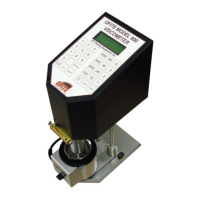
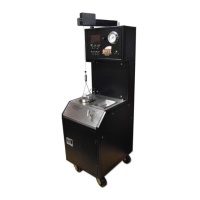
The OFITE Model 800 8-Speed Electronic Viscometer is a precision instrument designed and manufactured by OFI Testing Equipment, Inc. It is widely used in both field and laboratory settings for the accurate measurement of rheological properties of fluids, specifically determining flow characteristics of oils and drilling fluids in terms of shear rate and shear stress across various time and temperature ranges at atmospheric pressure.
Function Description:
The viscometer's core function is to measure shear stress at precisely regulated shear rates. Its motor RPM is continuously monitored and automatically adjusted by the OFITE Pulse-Power electronic speed regulator. This ensures a constant shear rate is maintained even under varying input power and drilling fluid shear conditions. The instrument features eight precisely regulated test speeds (shear rates in RPM): 3 (Gel), 6, 30, 60, 100, 200, 300, and 600. A higher stirring speed is also provided for sample preparation. Speeds can be changed easily with a control knob without needing to stop the motor. Shear stress values are displayed on a lighted, magnified dial for enhanced readability. The Model 800 operates from a 13–16 VDC power source, with the electronic regulator continuously monitoring and adjusting rotational speed to maintain constant shear rates despite fluid shear conditions and input power variations common in on-site environments.
Important Technical Specifications:
- Instrument Geometry: True Couette Coaxial Cylinder
- Speed Accuracy (RPM): 0.1
- Motor Speeds (RPM): 8 Fixed Speeds (600, 300, 200, 100, 60, 30, 6, and 3)
- Readout: Direct Dial
- Power Requirements: 13–16 VDC (for Model #130-10) or 24 VDC (for Model #130-11)
- Weight: 6.0 kg
- Dimensions: 15.2 x 17.8 x 40.6 cm
- Shipping Weight: 20.4 kg
- Shipping Dimensions: 55.9 x 25.4 x 40.6 cm
- Rotor - Bob Configuration (R1B1):
- Rotor Radius, RR: 1.8415 cm
- Bob Radius, RB: 1.7245 cm
- Bob Height, L: 3.8 cm
- Shear Gap: 0.117 cm
- R Ratio, RB/RR: 0.9365
- Shear Rate Constant k (sec⁻¹ per RPM): 1.7023
- Shear Stress Constant for Effective Bob Surface k (cm³): 0.01323
- Overall Instrument Constant, K, with Standard F1.0 Spring, η=KfO/N: 300
- Environmental Conditions:
- Indoors use
- Altitude: At or below 2,000 m (6,562 ft)
- Temperature: 5° to 40°C (41°–104°F)
- Relative Humidity: Maximum 80% for temperatures up to 31°C (88°F), decreasing linearly to 50% relative humidity at 40°C (104°F)
- Fuse: User-replaceable, 250-volt, 4-amp, time-delayed fuse.
Usage Features:
- Ease of Operation: Speeds are easily changed with a control knob without stopping the motor. Shear stress values are displayed on a lighted, magnified dial for ease of reading.
- Versatility: Suitable for both field and laboratory use.
- Precision: The electronic speed regulator ensures constant shear rates, providing accurate measurements of rheological properties.
- Sample Preparation: The instrument includes a "STIR" setting for mixing samples, allowing users to heat or cool fluids to a target temperature while monitoring with a thermometer.
- Viscosity Measurement: Users are instructed to start with higher RPMs and work down to lower RPMs for accurate readings.
- Gel Strength Measurement: The viscometer can measure both 10-second and 10-minute gel strengths. This involves mixing the sample, rotating to "GEL" speed, immediately shutting off power, waiting for the sleeve to stop, and then turning power back on to record the maximum dial deflection before the gel breaks. For 10-minute gel strength, the fluid is re-stirred, and a 10-minute wait precedes recording the maximum dial deflection.
- API Testing Procedures: The manual outlines specific steps for API testing, including mixing, setting speeds (600 RPM, 300 RPM), recording readings and temperatures, and measuring 10-second and 10-minute gel strengths.
- Calculations: The manual provides formulas for calculating Plastic Viscosity (PV), Yield Point (YP), Apparent Viscosity (AV), and Gel Strength based on dial readings and RPM. Machine constants for various bob and rotor combinations (R1B1, R1B2, R1B3, R1B4, R1B5) are also provided.
- Optional Components: The device supports various optional bobs, sleeves, and torsion springs (F0.2 to F10.0) to extend its measurement range and suitability for different fluid types. A "What Bob & Spring Should I Use?" section helps users select the appropriate spring based on maximum RPM and expected apparent viscosity.
Maintenance Features:
- Calibration: The viscometer should be calibrated quarterly (for well cement testing) or monthly (for drilling fluids) according to API Recommended Practice 10B-2 and 13B-1/13B-2. OFITE offers a Calibrating Instrument (#130-45-1) and a Calibration Check Kit (#132-49) for this purpose. Certified calibration fluids of various centipoise values are available.
- Calibration Procedure: A detailed procedure is provided for fluid-based calibration, including selecting the correct calibration fluid, equilibrating the instrument and fluid, operating the viscometer in air to loosen bearings, filling the cup to the fill line, stabilizing temperature, and recording dial readings at 600 RPM and 300 RPM. Deviations exceeding 1.5 dial units require professional adjustment or calibration.
- Cleaning: After each test, the viscometer should be cleaned by removing the sleeve and bob, wiping down the bob shaft, and cleaning all removed parts with soap and water. The instrument must be kept upright during cleaning to prevent water from entering the bearings.
- Bearing and Torsion Spring Replacement: The manual provides a comprehensive guide for replacing the bob shaft bearing and torsion spring. This involves disassembling the outer housing, removing the speed control knob, loosening set screws, carefully lifting the torsion spring, and replacing bearings using surgical gloves to prevent contamination. Specific tools required for this procedure are listed.
- Troubleshooting: The manual outlines tests to determine if bearings need replacement (zero dial reading in upright position, dial reading in air at 600 RPM, dial reading in water at 600 RPM and 300 RPM). Failure to pass these tests indicates worn bearings requiring replacement by a qualified technician.
- Safety Warnings: The manual includes symbols and explanations for various safety warnings, such as risk of danger (consult manual), fuse replacement, direct current, polarity, important notes, tips, and cautions regarding potential damage during service or maintenance. It also addresses risks related to sound pressure, emergency disconnect, potentially poisonous gases, flammable substances, and improper operation.

 Need help?
 General

 To Next Page