
 Need help?
Do you have a question about the OHAUS Adventurer AR3130 and is the answer not in the manual?
Allows selection of up to 16 measuring units plus parts counting.
Allows balance calibration using linearity methods, requiring two masses.
Enables an audible tone signal with each keystroke.
Allows setting communication and print parameters like Baud rate, Parity, Data, and Stop bits.
Select a suitable indoor environment free from drafts, corrosives, vibration, and extreme temperatures or humidity.
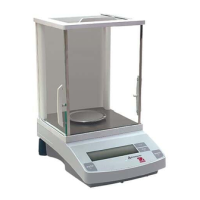
Level the balance using the built-in bubble level and two leveling feet for exact horizontal positioning.
Place the pan support and pan on the balance. Draft shield balances omit the pan support.
Use the built-in hook for weighing below the balance, ensuring the balance is elevated and releveled.
A bracket is provided at the rear to secure the balance with an optional cable and lock accessory.
Press >0/T< to turn on. Allow 20 minutes warm-up time for optimal performance.
Press and hold Mode Off until OFF is displayed to turn the balance off.
Place item on pan, read weight. Stability indicator appears when reading is stable.
Press >0/T< with an empty container to subtract its weight from the total weight on the pan.
Details the process for activating measuring units and parts counting (PCS) via the menu system.
Explains how to enable or disable the keystroke tone signal through the SYS menu.
Describes how to reset communication and printing parameters back to their original factory default settings.
Guides the user through setting Baud Rate, Parity, Data, and Stop Bit parameters for communication.
Explains options for manually printing or automatically printing stable readings.
Details the process for using the balance for parts counting after activation in the menu.
Resets the balance's weighing range using zero and a single weight value at or near capacity.
Minimizes weight deviation using zero, an intermediate, and a near-capacity weight value.


 To Next Page
 General