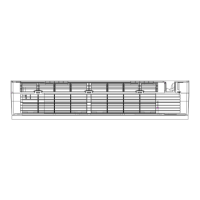
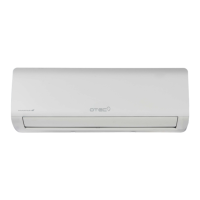
This document is a service manual for the OMEGA OTEC IEWB/ICHB Series 19 SEER Hygienic Mini Split, designed for both residential and commercial applications. The manual provides comprehensive information on safety precautions, troubleshooting, specifications, and maintenance procedures for these inverter-driven mini-split systems.
Function Description:
The OMEGA OTEC IEWB/ICHB Series are 19 SEER (Seasonal Energy Efficiency Ratio) hygienic mini-split air conditioning and heating systems. These units are designed to provide efficient cooling and heating, with a focus on hygienic operation. The "Hygienic Mini Split" designation suggests features aimed at improving indoor air quality, potentially through advanced filtration or self-cleaning functions, although specific details are not provided in the introductory pages. As inverter systems, they utilize variable-speed compressors to precisely control refrigerant flow, leading to improved energy efficiency, quieter operation, and more consistent indoor temperatures compared to traditional on/off systems. The systems are available in various capacities, ranging from 9,000 BTU/h to 24,000 BTU/h, catering to different room sizes and cooling/heating demands.
Important Technical Specifications:
The manual lists several models with their corresponding indoor and outdoor unit model numbers, capacity, and power supply requirements.
The manual also includes an error code list for both indoor (IDU) and outdoor (ODU) units, which are crucial for diagnosing malfunctions. These codes cover a wide range of issues, including communication failures, temperature sensor faults, EEPROM errors, fan motor stall protection, zero-crossing detection faults, AC over/under-voltage protection, IPM module faults, compressor faults, and various temperature and current protection mechanisms.
Usage Features:
The manual highlights several operational characteristics that users might perceive as errors but are normal functions of the unit:
- Restart Delay: The unit cannot be restarted immediately after shutdown due to a 3-minute protection timer incorporated in the microcomputer. This protects the compressor from short cycling.
- Delayed Air Blow in Heating Mode: Air is not blown out immediately at the start of heating operation (2 to 5 minutes) to prevent cold air from being discharged before the indoor heat exchanger is sufficiently warmed.
- Defrosting Mode: In low outdoor temperature and high humidity conditions, the unit may automatically enter defrosting mode (6 to 12 minutes), during which water or steam may rise from the outdoor unit. This is a normal operation to maintain heating efficiency.
- Delayed Air Stop in Cooling Mode (Drying Function): The unit may continue blowing air for up to 30 seconds after shutdown in cooling operation if the drying function is activated. This helps prevent mold growth by drying the evaporator coil.
- Delayed Air Blow in Dehumidification Mode: The indoor fan may stop intermittently during dehumidification to prevent moisture evaporation and save energy.
- Mist from Air Outlet: Mist may be blown out from the air outlet when room humidity is high, or at the end of cooling/heating/defrosting operations. This is a normal physical phenomenon.
- Water Droplets on Grilles: High ambient humidity or long-term cooling in an open space can cause water droplets on the air outlet, panel, and other parts. Ensuring doors and windows are closed and the panel is securely closed can mitigate this.
- Strange Sounds:
- Indoor Unit: Frictional sounds from plastic parts expanding/contracting with heat, loud wind noise when "TURBO" function is on, or sounds due to obstructed air inlet/loose panel.
- Outdoor Unit: Sound of refrigerant flowing (normal during operation or after stopping) and a "puff" sound when the four-way valve reverses during defrosting mode.
Maintenance Features:
The manual emphasizes safety precautions for installation, product use, electrical connections, cleaning, and maintenance.
- Professional Installation and Repair: Installation, repairs, maintenance, and relocation must be performed by authorized dealers or service technicians to prevent electric shock, fire, or injury.
- Electrical Safety:
- Use only the specified power cord.
- Keep the power plug clean and free of dust.
- Unplug by holding the plug, not pulling the cord.
- Avoid extension cords or connecting other appliances to the same outlet.
- Ensure capacitors are fully discharged (voltage below 36V) before troubleshooting PCBs.
- Cleaning and Maintenance:
- Turn off the device and unplug it before cleaning to prevent electrical shock.
- Do not use excessive water or combustible cleaning agents, which can cause fire or deformation.
- Clean the dust filter regularly to prevent accumulation, which can cause strange sounds and reduce efficiency.
- Spot Check Function: The unit includes a "spot check" function to read various parameters, aiding in diagnosis. This can be accessed by:
- Method 1: Long-pressing a button on the indoor unit PCB for 5 seconds after powering on for 5 seconds.
- Method 2: Alternately pressing "up & down swing" and "left & right swing" buttons 5 times within 10 seconds after powering on.
- Parameters available for spot check include setting temperature, indoor temperature (T1), indoor unit evaporator temperature (T2 or T2B), EEPROM code, software code, outdoor unit error code, outdoor unit running frequency, outdoor unit condenser temperature (T3), outdoor ambient temperature (T4), and indoor unit fan speed.
- Troubleshooting Guides: Detailed troubleshooting steps are provided for each error code, including checking wiring connections, power supply, sensor resistance, fan motor operation, and replacing faulty PCBs or components. For example, for E8 (IDU PG fan motor stall protection), steps include checking for blocks in the fan blade, wiring, and measuring fan motor voltage. For P7 (IDU anti-frosting protection), cleaning the filter/evaporator and checking the fan motor are recommended.
- Component Checks: The manual advises checking specific components like temperature sensors (resistance measurement), fan motors (smooth rotation, voltage), and PCBs (DC voltage between P and N).
- Refrigerant System Checks: For issues like P4 (High discharge temperature protection) and P11 (High evaporator temperature protection), checking refrigerant charging records, leakage points, and refrigerant volume is crucial.
- Ventilation Checks: Ensuring good ventilation for both indoor and outdoor units is mentioned for issues like P5 (High condenser temperature protection).


 To Next Page
 General