4
OREGON® Cordless Tool System
CHAIN SAW MODEL CS300
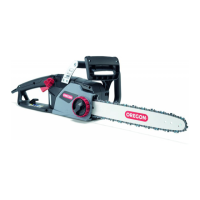
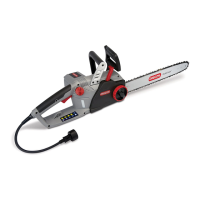
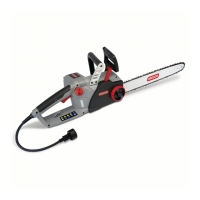
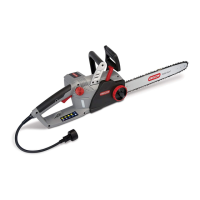
CHAIN SAW NAMES AND TERMS
AA 1214 - F/N 573259
CHAIN SAW NAMES AND TERMS
Alignment flange: The protrusion on the bar
pad that fits into the bar slot.
Automatic oiler: The system that automatically
lubricates the guide bar and saw chain.
Bar pad: The mounting pad on the powerhead
that helps ensure proper alignment of the
guide bar.
Bar slot: The cutout portion of the guide
bar that fits on to the alignment flange and
mounting stud.
Bystander safety zone: A ft ( m) circle
around the operator that must remain free
from bystanders, children and pets.
Chain brake: A device for stopping or locking
the saw chain, activated manually or non-
manually when kickback occurs.
Chain catcher: A device for retaining the saw
chain if it breaks or derails.
Chain gauge: The thickness of the saw chain
drive link, where it fits into the bar groove,
indicated by the part number stamped on the
drive links.
Chain pitch: The distance between any three
consecutive rivets on the saw chain divided by
two, indicated by the part number stamped
on the drive links.
Chain saw powerhead: A chain saw without the
saw chain or guide bar.
Chain tensioning gear: A gear mounted on the
guide bar that adjusts saw chain tension when
rotated.
Chain tensioning ring: The ring around the side
cover release knob that when turned, adjusts
the saw chain tension.
Drive link: The fin-shaped link of the saw chain
that fits into the groove on the guide bar.
Drive sprocket: The toothed part that drives the
saw chain.
Effective cutting length: The approximate
distance from the root of the spiked bumper
to the outside edge of the cutting link with the
tensioner set to the middle position.
Felling back cut: The final cut in a tree felling
operation made on the opposite side of the
tree from the notching undercut.
Front handle: The support handle located at or
toward the front of the chain saw intended to
be gripped by the left hand.
Front hand guard: A structural barrier between
the front handle of a chain saw and the
guide bar, which also serves as an activating
mechanism for the chain brake.
Guide bar: A railed structure that supports and
guides the saw chain. Sometimes simply called
the “bar”.
Guide bar cover: The plastic cover that protects
the guide bar and saw chain when the chain
saw is not in use.
Kickback: The rapid backward and/or upward
motion of the guide bar, occurring when the
saw chain near the top area of the nose of the
guide bar contacts any object (such as a log
or branch), or when the wood closes in and
pinches the saw chain in the cut.
Low-kickback chain: A chain that complies with
the low kickback performance requirements of
ANSI B. and CSA Z..
Mounting stud: The threaded protrusion on the
alignment flange that extends through the
bar slot.
Notching undercut: A notch cut in a tree to
direct the tree’s fall.
Rear handle: The support handle located at
or toward the rear of the saw intended to be
gripped by the right hand.
Rear hand guard: A structural barrier at the
bottom right side of the rear handle to protect
the operator in case of rupture or derailing of
the saw chain.
Reduced kickback guide bar: A guide bar with
a maximum nose radius as specified in ANSI
B. and CSA Z. and which has been
demonstrated to reduce kickback significantly.
Saw chain: A loop of chain having cutting
teeth, that cuts the wood, that is driven by the
powerhead and is supported by the guide bar.
Sometimes simply called the “chain”.
Side cover: The plastic cover on the powerhead
that covers the drive sprocket and chain
tensioning gear which is removed and
installed with the side cover release knob.
Spiked bumper: A device fitted to the front
of the saw acting as a pivot point when in
contact with a tree or log to make cutting
easier. Also known as “bucking spikes”.
Trigger lock-out: A movable stop that prevents
the unintentional operation of the trigger
switch until manually actuated.
Trigger switch: A device that turns the chain
saw on and off.
Wear parts: Parts such as the saw chain and
guide bar that can wear during use and can be
replaced by the user.


 To Next Page