advanced into the workpiece is sufficient to do
the job.
1. Mount a ¼” diameter drill bit in the tailstock
chuck. Twist the drill slowly while tightening
the chuck jaws to ensure that the drill bit
seats evenly between all three jaws, then
tighten the jaws firmly.
2. Loosen the tailstock cam lock and slide the
tailstock towards the headstock until the tip
of the drill bit is close to the end of the
workpiece. Lock the tailstock in place.
3. Apply a few drops of cutting fluid to the tip
of the drill bit.
4. Check to make sure that the tailstock ram
lock lever (located near the front of the
tailstock) is not in the locked (tightened)
position. Unlock it if necessary by turning it
counterclockwise about ½ turn.
5. Check to make sure that the area around
the chuck is free from any hazards, then
press the green Start button.
6. Set the speed to about 800 RPM. Make
sure that the chuck is rotating in the
Forward (counterclockwise) direction.
7. Use the tailstock handwheel to advance the
tip of the drill bit into the workpiece. Turn
the handle at a slow, steady pace, allowing
metal shards to exit the hole.
8. Continue advancing the drill tip into the
workpiece for a depth of about four
rotations of the tailstock handwheel.
9. Rotate the tailstock handwheel
counterclockwise (as viewed from the end
of the lathe) to withdraw the drill bit
completely from the hole.
10. Use a small (1”) chip brush to clear the
chips or strands of aluminum from the drill
bit. If the strands adhere to the drill bit,
posing a safety hazard, stop the lathe and
use a pair of needle-nose pliers to remove
the strands.
Warning: metal strands from drilling can be
extremely hot and sharp and can cause deep
cuts on fingers. Always turn off the lathe and
use leather gloves or pliers to remove sharp
metal shards.
11. Apply a few drops of cutting fluid to the tip
of the drill bit.
12. Advance the drill bit back into the
workpiece until it begins drilling again.
Continue advancing the drill bit for another
four turns of the tailstock handle.
13. Press the Stop button
14. Disengage the tailstock cam lock lever,
then slide the tailstock away towards the
right end of the lathe.
15. Remove the drill bit from the chuck and
return it to its storage location.
Depending on the required depth of the hole,
and whether or not the hole will be drilled all
the way through the workpiece, the above
steps are repeated as necessary to complete
the drilling operation.
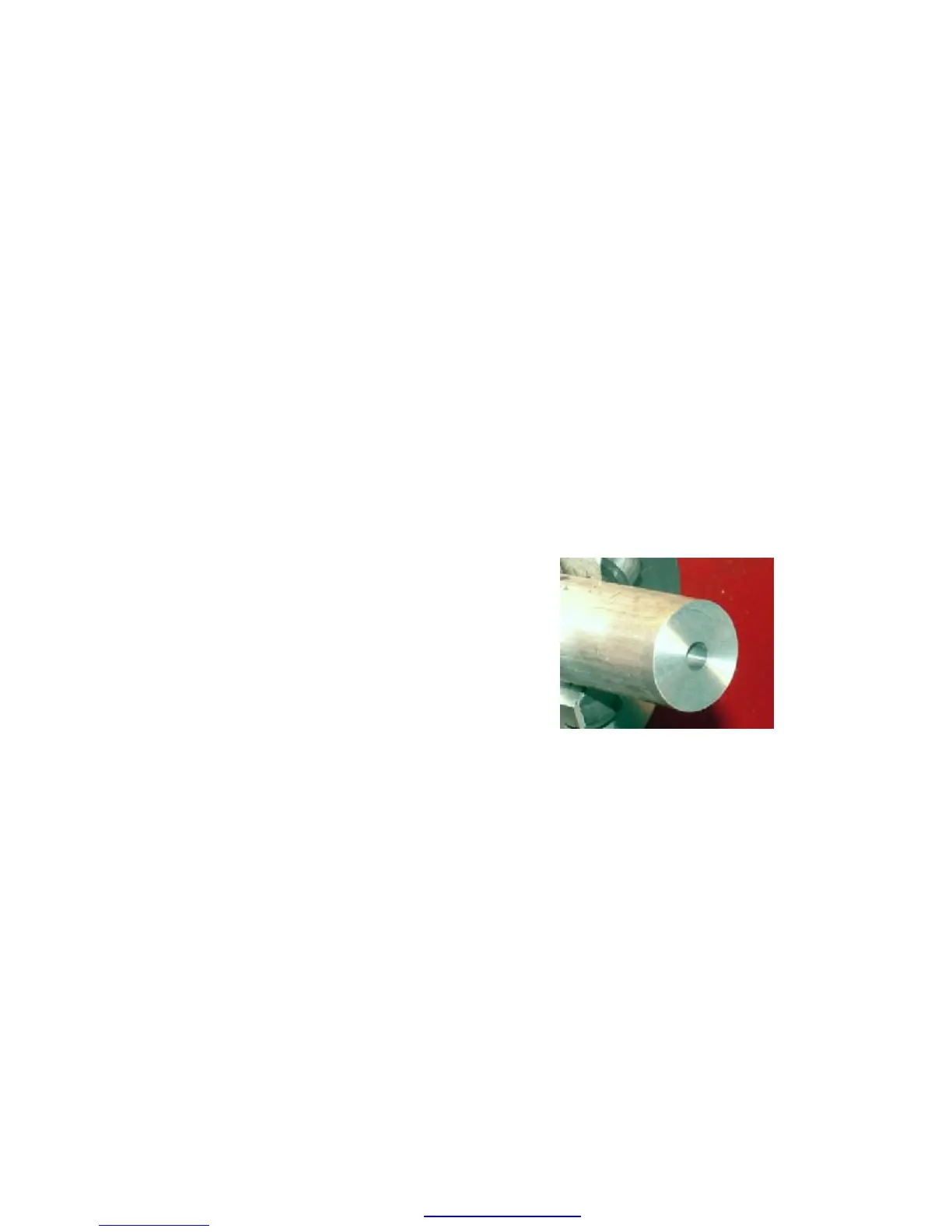
Completed drilled hole
When drilling holes larger than about 5/16”
diameter, or whenever maximum hole-size
accuracy and alignment is required, it is good
practice to drill the hole using a sequence of
two or more drill bits of increasing diameter.
This technique reduces the amount of metal
that must be removed during a single drilling
pass, thus creating a more accurately sized
hole with a smoother internal bore.
For maximum accuracy of the hole diameter
and concentricity, it is good practice to drill the
hole about 1/64” undersize and then finish the
hole using a chucking reamer of the required
final hole size. Chucking reamers are available
in sets, much like drill bits.
PDF created with pdfFactory Pro trial version www.pdffactory.com


 To Next Page