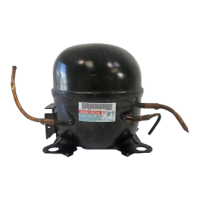
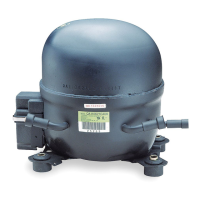
This document is an application manual for Panasonic Horizontal Scroll Compressors, specifically the C-SW series, designed for mobile air conditioning applications. It provides comprehensive guidelines for the installation, operation, and maintenance of these compressors, ensuring safe and trouble-free performance.
Function Description:
Panasonic C-SW series scroll compressors are hermetic, horizontal-type compressors that utilize a scroll compression process. This process involves a fixed eccentric and a floating orbit scroll sealing mechanism, which contributes to low sound levels, minimal gas leakage, and high efficiency. The compression process is a three-step simultaneous operation of suction, compression, and discharge, with two gas pockets 180 degrees apart, resulting in a balanced and smooth compression cycle. The motor, cooled by discharge gas, is rigidly attached to the shell, and the crankshaft is supported by main and sub-frames welded to the shell. The pump assembly comprises a fixed scroll, an orbiting scroll, and an Oldham ring, with the orbiting scroll rotating on the main frame's surface. These compressors are designed for variable speed operation and can be equipped with either a three-phase induction motor or a brushless permanent magnet (BLDC) motor.
Usage Features:
The manual emphasizes several critical aspects for proper usage. For instance, the compressor's design pressure must not be exceeded by the system's operating pressure. Specific refrigerant oils (FV68S, Polyvinyl Ether (PVE)) are recommended, as they are designed for particular refrigerants (R407C, R410A, R134a, R513A) and operating conditions, ensuring lubrication, heat absorption, prevention of refrigerant leakage, and rust proofing.
Refrigerating circuit design considerations are crucial. The condensing and evaporating pressures should align with recommended values to avoid deviations that could impact performance. Maintaining a minimum suction superheating degree of 5K [10F] is essential to prevent liquid refrigerant flood back, which can cause liquid compression, knocking noise, current surge, and undesirable vibration. Countermeasures for flood back include adding a suction accumulator, decreasing refrigerant charge, changing operation mode, or installing an internal heat exchanger. A suction accumulator is necessary to prevent uncontrolled liquid flooding back and ensure proper oil return, with specific requirements for its size and orifice.
A check valve in the discharge line is recommended to prevent refrigerant migration to the compressor during off-cycle, and its leak rate should be tested. A suction line strainer with a mesh size of 100 is advised to prevent foreign particles from entering the compressor, unless an accumulator with a screen is already in place. A suitable filter dryer (molecular sieves type) is also recommended to maintain low residual moisture. An oil separator, preferably a centrifugal type, is suggested for inverter compressors to manage oil flow, improve system performance, and ensure proper oil return to the crankcase, especially at high rotation speeds.
The system charge limit is defined by an oil-to-refrigerant ratio (Oil (kg)/Refrigerant (kg) ≥ 0.35) to prevent oil dilution and lubrication issues. The compressor's oil level must meet specifications to ensure reliability, with different levels defined for transition and stable operations. The operating envelope, which varies with running speed, must be adhered to, considering limits for discharge temperature, compression ratio, lubrication, and power.
Electrical considerations are paramount. Proper electrical wiring selection is necessary to prevent voltage drop during compressor starting, which can lead to starting failure if the voltage falls below 85% of the rated voltage. DC Inverter models must never be supplied with AC power to prevent demagnetization of the brushless motor. The rotation direction of three-phase compressors must be correct, verified by observing suction and discharge pressures, and corrected by switching any two power leads at the unit contactor. A phase monitor can also be used.
The manual provides specific instructions for inverter compressor operation, including the rate of revolution speed change (1~3rps) to prevent damage to bearing parts. It also cautions against continuous low or high-speed operation without periodic adjustments to 50-60rps for at least 3 minutes to ensure proper oil retention and lubrication. Low compression ratio conditions should be avoided, especially at lower speeds, as they can affect internal oil supply. The on/off cycle should not exceed 6 cycles per hour, with a minimum continuous operation of 5 minutes after startup and a 3-minute shut-off time before restarting. Deep vacuum operation is strictly prohibited as it can cause internal arcing and compressor damage.
Protection devices are required, including a reverse phase protector for three-phase motors, a discharge gas thermostat to prevent overheating, low-pressure switches to protect against refrigerant loss, crankcase heaters to prevent liquid refrigerant migration and ensure proper lubrication after long off-cycles, and high-pressure switches to protect against blocked fan or fan failure conditions.
Maintenance Features:
The manual details assembly and manufacturing process considerations to ensure safe installation and trouble-free operation. Before installation, compressors are shipped with a dry Nitrogen holding charge and sealed with rubber plugs. When removing plugs, the compressor should be kept horizontal, and the suction plug removed first to avoid oil loss. Installation into the system should occur within 15 minutes of plug removal.
Compressor mounting requires specific accessories (grommets and sleeves) to minimize motion and vibration, especially in mobile applications. Vibration eliminators may be needed on discharge and suction lines in severe cases. Residual moisture levels in the system must be kept below 200ppm, typically achieved through proper evacuation.
Tube brazing procedures are outlined to maintain cleanliness, prevent contamination, and avoid piping stress. Recommended brazing materials (silver-phosphorus, copper-phosphorus) and specific brazing temperatures are provided. Nitrogen purging with high purity (99.8% min.) is essential during brazing to prevent oxidation contamination, continuing until piping temperature is below 200°C. Clearances and insertion lengths for brazing parts are also specified.
After assembly, a leakage test using pressurized nitrogen is required, with specific pressure holding times and checks for pressure decrease. Evacuation of the system using a vacuum pump is critical to remove residual moisture and non-condensable gases, ensuring a vacuum degree below 1.0Torr after 30 seconds and below 7.6Torr after 24 hours.
Refrigerant charging should be done using the weighted charge method, adding liquid refrigerant to the condenser outlet side or gas refrigerant to the compressor suction tube. Simultaneous charging at high and low pressure sides with gas at a controlled rate is also acceptable. Liquid charging at the suction side is strictly prohibited, as excessive refrigerant can lead to oil dilution, lubrication issues, and compressor failure.
Preliminary running of the compressor for at least 3 seconds within 15 minutes after refrigerant charge is recommended to lubricate moving parts, followed by checks for abnormal sound, tube vibration, refrigerant leaks, and cooling effect. Starting the compressor with balanced pressure is crucial, especially for single-phase models, requiring at least a 3-minute OFF cycle.
Servicing scroll compressors involves functional checks, including verifying voltage, electrical system integrity (continuity and short to ground testing), fan operation, refrigerant charge levels, and compressor current. If a motor burn-out occurs, specific procedures for system evacuation, compressor removal, and replacement of filter dryers are provided. When returning a failed compressor, it should be sealed, and detailed information about the failure recorded for accurate analysis.
General precautions include completing installation within 15 minutes of plug removal, never using the compressor to compress air, not energizing it under vacuumed conditions, avoiding tilting during transport, not removing paint, and ensuring phase voltage difference is below 2% of the rated voltage during operation.
The manual also includes a troubleshooting section, listing common problems, check points, and probable causes, such as power source issues, wiring disconnections, control device trips, internal compressor failures, refrigerant circuit blockages, and abnormal running noise.



 To Next Page
 General