
 Need help?
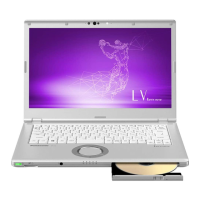
Do you have a question about the Panasonic CF-LX6 Series and is the answer not in the manual?
Explains crucial safety measures to prevent injury, fire, and equipment damage.
Details regulations and compliance information related to the product's operation and disposal.
Guides users through the initial setup and first use of the computer.
Provides step-by-step instructions for installing and removing the battery pack.
Details how to connect the computer to a power source for charging and operation.
Guides through the initial Windows operating system setup process.
Covers restarting the computer and updating the on-screen manual.
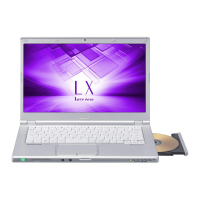
This document serves as the Operating Instructions for the Panasonic CF-LX6 series Personal Computer, providing essential information for its safe and effective use, from initial setup to ongoing maintenance.
The Panasonic CF-LX6 series Personal Computer is designed for general computing tasks, offering a portable solution for users. It operates on Windows 10 Pro 64-bit, referred to simply as "Windows" or "Windows 10" throughout the manual. The device is equipped with a lithium-ion battery for mobile operation and can be powered via an AC adaptor. It includes wireless LAN and Bluetooth capabilities, enabling connectivity to networks and other devices. The computer is designed to minimize shock to its LCD and hard disk drive, and to prevent liquid leakage onto the keyboard, making it a robust precision instrument.
The manual guides users through the first-time operation, starting with checking supplied accessories such as the AC Adaptor (Model No: CF-AA6413C), AC Cord, and Battery Pack (Model No: CF-VZSU90M). It provides clear instructions on how to insert and remove the battery pack, emphasizing the importance of securely locking it to prevent accidental falls. The display can be opened by holding the side of the computer and lifting the designated part, with a caution against opening it wider than 180 degrees or applying excessive pressure to the LCD.
Connecting the computer to a power outlet initiates battery charging automatically. Users are advised not to disconnect the AC adaptor or switch on the wireless function until the first-time operation is complete. When using the computer for the first time, no peripheral devices other than the battery pack and AC adaptor should be connected. The manual highlights the importance of using the specified AC adaptor to avoid error notifications. It also recommends using an uninterruptible power source (UPS) during periods of thunder and lightning if running from AC power alone, to protect the computer from sudden voltage drops.
Turning on the computer involves sliding and holding the power switch until the power indicator lights up. Users are cautioned against repeatedly sliding the power switch or holding it for too long (4 seconds or more), as this will forcibly turn off the computer. After turning off the computer, a waiting period of 10 seconds or more is recommended before turning it on again. During the initial setup, users should avoid connecting/disconnecting the AC adaptor, sliding the power switch, touching the keyboard/touchpad/external mouse, closing the display, or turning on/off the wireless switch until the drive indicator turns off.
The Windows setup process involves selecting the language, following on-screen instructions, and waiting for the computer to restart several times. The setup is estimated to take approximately 20 minutes. Users can use the touchpad for navigation and clicking during this process. Wireless network setup can be performed after Windows setup is complete, and setting a password is recommended at this stage. The manual provides guidelines for choosing a computer name, advising against certain words and characters.
After initial setup, the computer can be restarted by clicking the Start button, then Power, and selecting Restart. This enables a portion of the Panasonic PC Settings Utility functions. The on-screen manual can be updated by connecting to the internet, signing in as an administrator, and accessing the manual selector through the Panasonic PC Settings Utility.
A crucial usage feature is the creation of a recovery disc. This disc allows users to reinstall the OS and restore the factory default condition if the recovery partition of the HDD becomes damaged. Creating this disc before extensive use of the computer is strongly recommended.
Safety precautions are extensively covered, forming a significant part of the maintenance guidelines. The manual categorizes hazards into DANGER, WARNING, CAUTION, and NOTICE, each with specific instructions.
For the battery pack, DANGER warnings include not throwing it into fire, exposing it to excessive heat, deforming, disassembling, modifying, or shorting its contacts. Users are advised not to apply shocks to the product and to stop using it immediately if damaged or deformed. Charging methods other than those specified should be avoided, and only the specified battery pack should be used with the product. Extreme heat exposure (near fire, direct sunlight) should be avoided. If the battery pack deteriorates, it should be replaced with a new one. In case of malfunction (damage, deformation, smoke, abnormal odor, excessive heat), the battery pack should be removed immediately.
WARNINGs related to fire or electric shock include not damaging the AC cord, AC plug, or AC adaptor by bending, twisting, pulling forcefully, or placing heavy objects on them. Damaged AC cords, plugs, or adaptors should not be used, and technical support should be contacted for repair. The AC adaptor should only be connected to a standard household AC outlet, not to DC/AC converters. Users should avoid pulling or inserting the AC plug with wet hands. Disassembling the product is prohibited as it contains no user-serviceable parts. The product should not be touched in a thunderstorm if connected to AC or other cables, and liquid or metal objects should not be placed on top of it. If foreign matter enters the product, it should be immediately powered off, unplugged, and technical support contacted.
If a malfunction occurs (damaged product, foreign object inside, smoke, unusual smell, unusually hot), the AC plug and battery pack should be immediately unplugged/removed, and technical support contacted. Regular cleaning of dust and debris from the AC plug is recommended to prevent insulation defects. The AC plug should always be inserted completely.
Further WARNINGs address burns or low-temperature burns, advising against using the product in close contact with the body for long periods, as heat-emitting parts can cause burns. Users should not expose themselves or others to hot wind from the ventilation hole for extended periods, and covering the ventilation hole can lead to overheating and burns. The AC adaptor surface should not be touched continuously while using/charging. The product should not be placed in a bag or case while turned on, as this can cause overheating and burns.
Detrimental health effects are also addressed. Users are warned not to turn the volume up too loud when using headphones, as prolonged listening at high volumes can result in hearing loss. Taking a break of 10-15 minutes every hour is recommended to prevent detrimental health effects on the eyes or hands from prolonged use.
CAUTIONs related to fire or electric shock include holding the plug when unplugging the AC plug and using only the specified AC adaptor. The product should not be placed on unstable surfaces or stacked to prevent it from falling and causing injury.
General NOTICEs include keeping the computer away from televisions, radio receivers, and magnets to prevent data loss. The computer is not intended for medical diagnosis or connection to medical equipment. Panasonic disclaims liability for data loss or incidental/consequential damages. The battery pack terminals should not be touched to prevent dirt or damage. The battery pack should not be exposed to water. For long-term storage (a month or more), the battery pack should be charged/discharged to 30-40% and stored in a cool, dry place. The computer prevents overcharging by recharging only when the remaining power is less than approximately 95%. The battery pack is not charged when first purchased and must be charged before first use. If battery fluid gets into the eyes, they should be flushed with clear water and medical attention sought immediately. Users must comply with local laws and regulations regarding product use.
The manual notes that the battery pack may become warm during recharging or normal use, which is normal. Recharging will not start if the internal temperature of the battery pack is outside the 0°C to 50°C range. The computer has a high-temperature mode function to prevent battery degradation in high-temperature environments, where a 100% charge in this mode is equivalent to an 80% charge in normal temperature mode. The battery pack is a consumable item and should be replaced if its performance significantly degrades. When transporting a spare battery, it should be placed in a plastic bag to protect its contacts. The computer should always be powered off when not in use to conserve battery capacity.
For models with wireless LAN/Bluetooth, the product emits radio frequency electromagnetic energy, but at levels significantly lower than mobile phones, making it safe for consumers. However, use may be restricted in certain environments (e.g., airplanes, areas with interference risk), and authorization should be sought before use. Panasonic is not responsible for interference caused by unauthorized modifications.
The computer contains a lithium battery for storing date, time, and other data, which should only be exchanged by authorized service personnel to avoid explosion risk. The product also contains a Coin Cell Lithium Battery with Perchlorate Material, requiring special handling, and users are directed to www.dtsc.ca.gov/hazardouswaste/perchlorate/ for more information.
The product is an ENERGY STAR® Partner, meeting guidelines for energy efficiency by entering a low-power sleep mode after inactivity. Information on power management and the ENERGY STAR® program is provided, with links to the energystar.gov website.
For U.S.A. users, the Federal Communications Commission Radio Frequency Interference Statement outlines compliance with Part 15 of the FCC Rules for Class B digital devices. It provides guidance on correcting interference and warns against unauthorized modifications. FCC RF Exposure Warnings are included for models with wireless LAN/Bluetooth, stating compliance with radiation exposure limits and advising against colocation with other antennas or transmitters. The Specific Absorption Rate (SAR) limit is 1.6 W/kg, and tests are conducted at the highest certified power level, though actual operating SAR is typically lower.
For Canada, the product complies with Canadian ICES-003 and Industry Canada's licence-exempt RSSs, with specific conditions for operation. The manual also includes information for users on the collection and disposal of old equipment and used batteries, indicating that these symbols are valid in the European Union and directing users to local authorities or dealers for correct disposal methods.
 General
| Processor | Intel Core i5 |
|---|---|
| Graphics | Intel HD Graphics 620 |
| Operating System | Windows 10 Pro |
| RAM | 8GB |
| Storage | 256GB SSD |
| Display | 1920x1080 |


 To Next Page