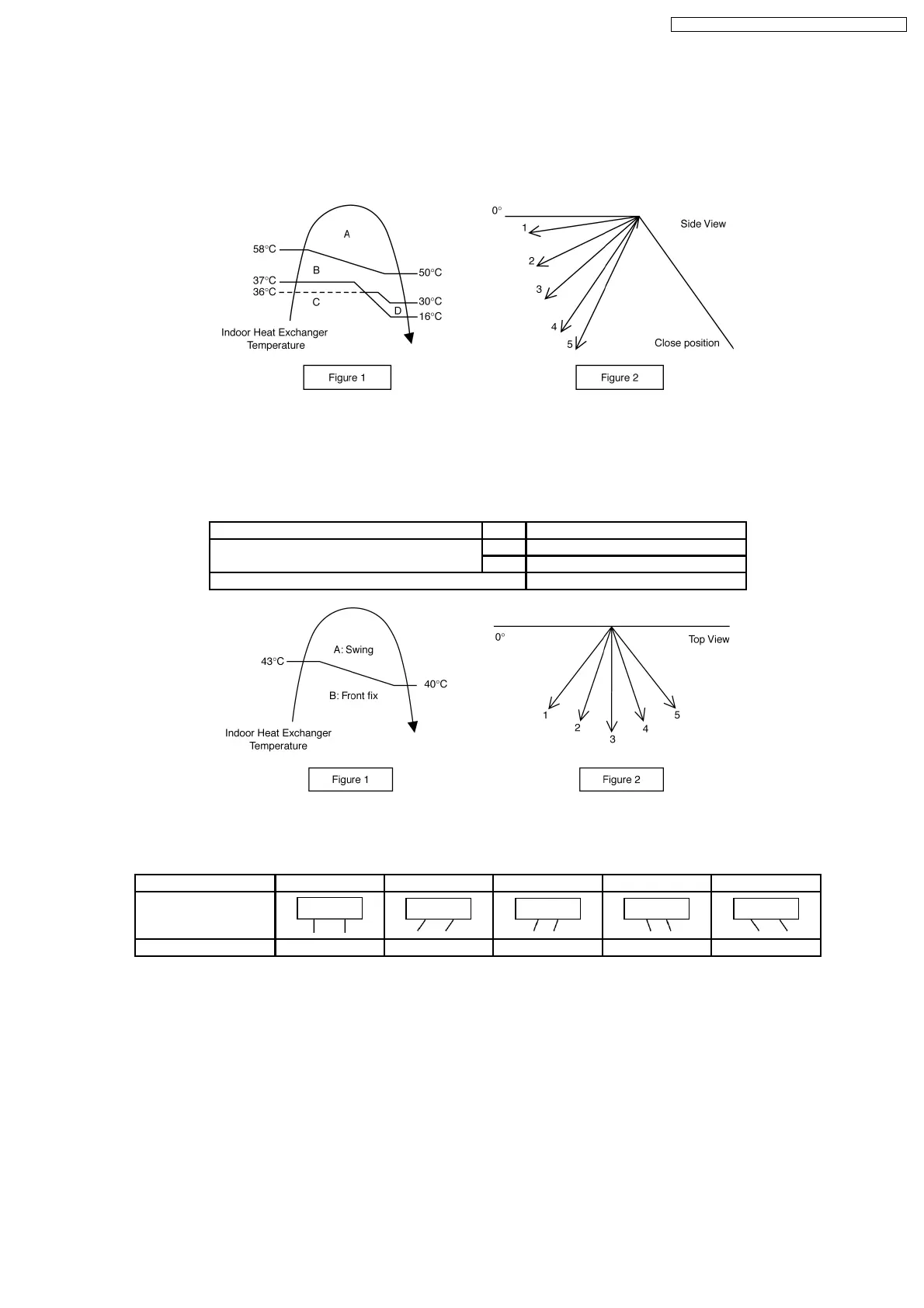
1. Automatic vertical airflow direction can be set using remote control; the vane swings up and down within the angles as stated
above. For heating mode operation, the angle of the vane depends on the indoor heat exchanger temperature as Figure 1
below. When the air conditioner is stopped using remote control, the vane will shift to close position.
2. Manual vertical airflow direction can be set using remote control; the angles of the vane are as stated above and the positions
of the vane are as Figure 2 below. When the air conditioner is stopped using remote control, the vane will shift to close position.
10.1.2.2. Horizontal Airflow
1. Automatic horizontal airflow direction can be set using remote control; the vane swings left and right within the angles as stated
below. For heating mode operation, the angle of the vane depends on the indoor heat exchanger temperature as Figure 1
below.
Operation Mode Vane Angle (°)
Heating, with heat exchanger temperature A 68 ~ 112
B 90
Cooling, Soft Dry 68 ~ 112
2. Manual horizontal airflow direction can be set using remote control; the angles of the vane are as stated below and the positions
of the vane are as Figure 2 above.
Pattern 1 2 3 4 5
Airflow Direction
Patterns at Remote
Control
Vane Angle (°) 90 68 79 101 112
10.1.3. Quiet operation (Cooling Mode/Cooling area of Soft Dry Mode)
A. Purpose
To provide quiet cooling operation compare to normal operation.
B. Control condition
a. Quiet operation start condition
• When “quiet” button at remote control is pressed.
Quiet LED illuminates.
27
CS-E18EKK CU-E18EKK / CS-E21EKK CU-E21EKK



 To Next Page