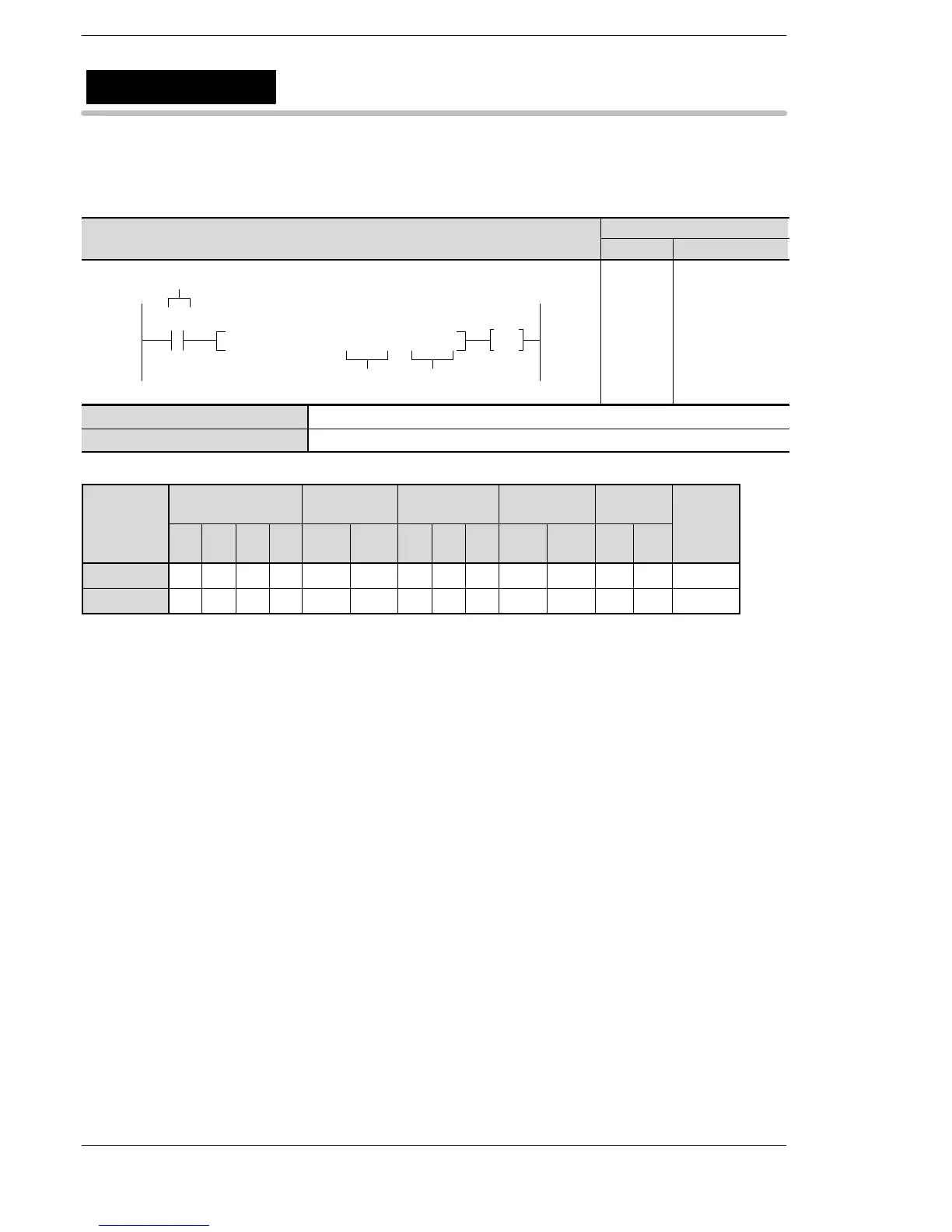
modifier
S A A A A A A A A A A A A A N/A
D N/A A A A A A A A A N/A N/A N/A N/A N/A
(*1) This cannot be used with the FP0 and FP−e.
(*2) This cannot be used with the FP0, FP−e, FP0R, FPΣ, FP−X.
(*3) With the FP0R, FPΣ,FP−X, FP2, FP2SH, and FP10SH, this is I0 to IC.
(*4) With the FP0R, FPΣ,FP−X, FP2, FP2SH, and FP10SH, this is ID.
Explanation of example
When the execution condition (trigger) has been fulfilled, the auxiliary timer is activated, and when the value
stored in DT10 x 0.01 seconds has elapsed, R5 goes on.
Description
This functions as a 0.01−second unit on delay timer. When the execution condition (trigger) is on, subtraction
is carried out for the specified time, and when the elapsed value D reaches 0, the special internal relay R900D
turns on. (The special internal relay R900D turns off when the execution condition (trigger) is off, and while
subtraction is being carried out.)
With FP2/FP2SH/FP10SH, the OT instruction can be stated immediately following the auxiliary timer. When
the execution condition (trigger) goes on, the set time is subtracted, and when the elapsed value D reaches 0,
the relay being used with the OT instruction goes on at the same time that the special internal relay R900D
goes on.
When the execution condition (trigger) is off, the elapsed value area is cleared to 0, and relays being used are
turned off by the OT instruction.
Auxiliary timer (16−bit)
F137
(STMR)
A: Available
N/A: Not Available





 To Next Page