The Panasonic LS-400 series is an amplifier-separated digital laser sensor designed for high-precision laser sensing in industrial applications. It offers a user-friendly interface and a variety of sensor heads to suit diverse sensing needs.
Function Description:
The LS-400 series operates as an amplifier-separated digital laser sensor, meaning the sensor head and amplifier are distinct units. This design allows for flexible installation and specialized sensor heads for different applications. The amplifier processes signals from the sensor head, providing digital outputs and various control functions. It features a digital display for easy monitoring of incident light intensity and settings. The sensor is capable of detecting objects with complex shapes, measuring the remaining amount of sheet rolls, and detecting electronic component pins with high precision. It offers multiple sensing modes, including U-LG, STD, FAST, and H-SP, to optimize performance for different target characteristics and distances. The amplifier also includes functions such as response time adjustment, M.G.S. (Minutest Variations Sensing) function, data bank load, emission halt, and D-CODE display for comprehensive control and monitoring.
Important Technical Specifications:
Sensor Heads:
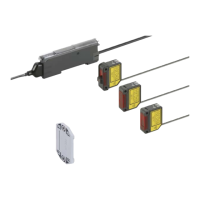
The LS-400 series offers six types of laser sensor heads:
- Coaxial Retroreflective Type (LS-H91, LS-H92 series): These sensors are designed for retroreflective sensing, where the laser beam is reflected back to the sensor by a reflector. They are available in Class 1 and Class 2 laser classifications, conforming to IEC/JIS/GB and FDA standards.
- LS-H92 (Class 2): Sensing range from 0.2 to 30 m (0.656 to 98.425 ft) with RF-330 reflector.
- LS-H92F (Class 2, FDA/IEC/JIS): Sensing range from 0.2 to 20 m (0.656 to 65.617 ft) with RF-230 reflector.
- LS-H91 (Class 1): Sensing range from 0.1 to 7 m (0.328 to 22.966 ft) with RF-330 reflector.
- LS-H91F (Class 1, FDA/IEC/JIS): Sensing range from 0.1 to 5 m (0.328 to 16.404 ft) with RF-330 reflector.
- LS-H91-A (Class 1): Sensing range from 0.1 to 5 m (0.328 to 16.404 ft) with RF-330 reflector.
- LS-H91F-A (Class 1, FDA/IEC/JIS): Sensing range from 0.1 to 3 m (0.328 to 9.843 ft) with RF-330 reflector.
- Spot diameter for LS-H91 series is approx. Ø1 mm (Ø0.039 in) at 1 m (3.281 ft) sensing distance.
- Line width for LS-H92 series is approx. 240 mm (9.449 in) at 1,000 mm (39.370 in) sensing distance.
- Long Sensing Range Spot Reflective Type (LS-H21 series): These sensors are designed for diffuse reflective sensing with a small spot size. They are available in Class 1 and Class 2 laser classifications.
- LS-H21 (Class 2): Sensing range from 30 to 1,000 mm (1.181 to 39.370 in).
- LS-H21F (Class 2, FDA/IEC/JIS): Sensing range from 30 to 500 mm (1.181 to 19.685 in).
- LS-H21-A (Class 1): Sensing range from 30 to 500 mm (1.181 to 19.685 in).
- LS-H21F-A (Class 1, FDA/IEC/JIS): Sensing range from 30 to 250 mm (1.181 to 9.843 in).
- Spot diameter for LS-H21 series is approx. Ø1 mm (Ø0.039 in) at 1 m (3.281 ft) sensing distance, and approx. Ø0.2 mm (Ø0.008 in) at 50 mm (1.969 in) sensing distance.
- Long Sensing Range Line Reflective Type (LS-H22 series): These sensors provide a line-shaped laser beam for diffuse reflective sensing. They are available in Class 2 laser classification.
- LS-H22 (Class 2): Sensing range from 30 to 1,000 mm (1.181 to 39.370 in).
- LS-H22F (Class 2, FDA/IEC/JIS): Sensing range from 30 to 500 mm (1.181 to 19.685 in).
- Line width for LS-H22 series is approx. 115 mm (4.528 in) at 500 mm (19.685 in) sensing distance.
- Laser Emission: Red semiconductor laser, peak emission wavelength 655 nm (0.026 mil). Max. output 3 mW (Class 2) or 1 mW (Class 1).
- Environmental Resistance: IP40 protection, ambient temperature -10 to +55 °C (+14 to +131 °F), ambient humidity 35 to 85% RH.
- Cable: 0.1 mm² single core two parallel shielded cables, 2 m (6.562 ft) long (connector for amplifier attached). Cable cannot be extended for sensor heads.
Amplifiers (LS-401, LS-401P, LS-403, LS-401-C2, LS-401P-C2):
- Output: NPN or PNP open-collector transistor, two outputs.
- Max. sink current: 100 mA (LS-401/401P), 50 mA (LS-403).
- Applied voltage: 30 V DC or less.
- Residual voltage: 1.5 V or less.
- Power Supply: 12 to 24 V DC ±10%, ripple P-P 10% or less.
- Power Consumption: Normal operation: 950 mW or less; ECO mode: 780 mW or less.
- Response Time: Selectable from 80 µs (H-SP), 150 µs (FAST), 500 µs (STD), 4 ms (U-LG).
- External Input: NPN or PNP non-contact input for laser emission halt, full-auto teaching, or limit teaching.
- Indicators: Orange LED for output, Green LED for laser emission, Yellow LED for select indicator, Green/Red digital display.
- Sensitivity Setting: Normal mode (2-level teaching, limit teaching, full-auto teaching, manual adjustment), Window comparator mode (1-level, 2-level, 3-level teaching, manual adjustment), Hysteresis mode (1-level, 2-level, 3-level teaching, manual adjustment), Differential mode (5-level settings, LS-403: 8-level settings).
- Timer Function: Variable ON-delay/OFF-delay/one-shot timer, switchable effective or ineffective. Timer period 1 to 9,999 ms approx.
- Automatic Interference Prevention: Incorporated, allows up to four sensor heads to be mounted close together (LS-401 disabled in H-SP mode, up to two LS-403 in H-SP mode).
- Environmental Resistance: Ambient temperature -10 to +55 °C (+14 to +131 °F) (derating for multiple units), ambient humidity 35 to 85% RH.
- Cable (LS-401-C2/LS-401P-C2): 0.15 mm² 5-core cabtyre cable, 2 m (6.562 ft) long. Cable extension up to total 100 m (328.084 ft) with 0.3 mm² or more cable.
Usage Features:
- User-Friendly Interface: The amplifier features a 4-digit digital display (green and red) for easy monitoring of current incident light intensity and threshold values. Two jog switches and a MODE key simplify operation and setting changes.
- Multiple Sensing Modes: Offers U-LG, STD, FAST, and H-SP modes to adapt to various sensing requirements, from high sensitivity to high speed.
- MODE NAVI Customized Function: Allows users to store frequently used functions (response time, M.G.S. function, data bank load, emission halt, D-CODE values) in CUSTOM mode for quick access.
- M.G.S. (Minutest Variations Sensing) Function: Enables accurate sensing of minute variations, especially for close-range, transparent, or minute target objects, by adjusting receiving sensitivity to three (or four for U-LG mode) levels without affecting response time.
- Hysteresis Mode: Adjustable hysteresis allows for stable sensing by canceling out convexo-concave parts of uneven objects.
- Window Comparator Mode: Judges objects based on whether their incident light intensity falls within two set threshold values (OK, NG: Under range, NG: Over range).
- 2 Independent Output Modes: Provides two independent outputs, enabling complex control scenarios, such as detecting meandering objects.
- Differential Sensing Mode: Detects only rapid changes in received light, ideal for accurately sensing edges of glass or for positioning.
- Emission Halt Function: Allows stopping laser radiation via an external input signal, useful for preventing laser spots in image processor visual ranges.
- D-CODE Display: Shows amplifier settings as an 8-digit code, convenient for remote indications and follow-ups.
- Class 1 Laser Type: Visible light spot for easier beam axis alignment, particularly with LS-H91(F)-A and LS-H21(F)-A models.
- Industry Standard Mounting Pitch: Sensor heads have a 25.4 mm (1.000 in) mounting pitch, compatible with existing CX-400 series Ver.2 general-purpose photoelectric sensor mounting brackets.
- Spot-Shape Adjuster: Built into the back of LS-H21 and LS-H22 sensor heads, allowing easy adjustment of the spot shape with a screwdriver while viewing the spot.
- Sensor Mounting Bracket for Beam Axis Alignment (MS-CX-11): Enables fine adjustment of the sensor by 4 degrees up, down, right, or left, even after initial setup. Can be mounted in longitudinal and lateral directions.
- External Input Cable Type (LS-401-C2/LS-401P-C2): Equipped with a 5-core cable for external teaching or laser light emission halting.
- Network Communication: LS-403 amplifier supports open network communication via a communication unit (SC-GU3 series), allowing settings to be changed for up to 16 laser sensors at once.
- Threshold Tracking Function: Automatically adjusts threshold values over long periods to compensate for changes in incident light intensity due to environmental factors, reducing maintenance.
Maintenance Features:
- Easy and Accurate Adjustments: The spot-shape adjuster allows for precise adjustment of the laser spot, which can be performed while viewing the spot.
- Mounting Brackets: Various optional mounting brackets (MS-CX series) are available for secure and precise sensor head installation, including options for fine beam axis alignment and protection against shocks.
- Reflectors and Reflective Tape: RF-330 and RF-230 reflectors, as well as RF-31 reflective tape, are available for retroreflective sensing.
- Amplifier Protection Seal (FX-MB1): Prevents malfunction due to transmission signals from other amplifiers and protects connector pins from contact with metal.
- Bank Selection Unit (FX-CH/-P): Allows changing settings for up to 16 laser sensors simultaneously via external signals.
- Lens Attachment for Line Reflective Type (LS-MR1): Removable lens attachment for LS-H22, providing equivalent performance to LS-H21 when removed. Can also be attached to LS-H21 to achieve LS-H22 performance. Keep the lens clean to avoid performance degradation.
- Wiring: Ensure proper wiring and power supply conditions to prevent damage. Avoid running wires with high-voltage lines to prevent malfunction due to induction. Use an isolation transformer for DC power supply.
- Environmental Considerations: Avoid use during initial transient time (0.5 sec. approx.) after power-on. Operate in indoor environments, avoiding dust, dirt, steam, water, oil, grease, or organic solvents. Do not use in inflammable or explosive gas environments.
- Safety Standards: Products comply with IEC/JIS/GB Class 2 (or Class 1 for LS-H(F)-A) and FDA regulations. Do not look directly at the laser beam or through optical systems. Warning labels are provided.

 Need help?
 General


 To Next Page