
 Need help?
Do you have a question about the Panasonic KX-NT546 and is the answer not in the manual?
Displays information, line counts vary by model.
Programmable buttons below the display, used for menu navigation and functions.
Controls volume and display contrast, used for item selection.
Confirms selected items or actions.
Indicates incoming calls and new messages with different colors and flashing patterns.
Secures the handset when the unit is mounted on a wall.
Port for connecting compatible electronic headsets.
Standard port for connecting a headset.
Manages message waiting indications and callbacks.
Inserts pauses in numbers or used for programming.
Disconnects current call to make a new one without hanging up.
Redials the last dialed number.
Answers calls hands-free or mutes the microphone.
Establishes or joins multi-party conference calls.
Transfers an active call to another party.
Used for speed dialing and storing program changes.
Activates Call Forwarding or Do Not Disturb features.
Places an active call on hold.
Cancels the current operation or selection.
Makes or receives internal calls between extensions.
Activates the speakerphone for hands-free operation.
Built-in microphone for hands-free conversations.
Seize outside lines or perform assigned features.
Switches pages for the Self Labelling feature (KX-NT560 only).
Adjusts audio level during hands-free conversations.
Adjusts audio level when using the handset or headset.
Adjusts the loudness of incoming call alerts.
Adjusts screen contrast for better readability.
Selects and sets custom ring tones for calls.
Controls the screen's backlight mode, e.g., automatic, always on/off.
Guides pairing and connecting a Bluetooth headset to the KX-NT560.
Manages Bluetooth headset identification and removal.
Instructions for initiating calls to extensions and outside parties.
Redials the last number that was dialed.
Dialing a number using a pre-assigned quick dial code.
How to initiate a call to a doorphone unit.
Using system-wide speed dial codes to call numbers.
Storing and dialing personal speed dial numbers.
Storing and using one-touch dialing buttons for frequent contacts.
Operations available while actively engaged in a call.
Placing an active call on hold and retrieving it.
Transferring an active call to another extension or outside line.
Customizing phone settings like Do Not Disturb and Timed Reminders.
Enabling or disabling call forwarding and blocking incoming calls.
Setting timed reminders or alarms on the telephone.
Advanced call handling and feature utilization.
Adding parties to an ongoing call to create a conference.
Setting up call management features before stepping away.
Configuring the phone to forward incoming calls to another number.
Managing flexible buttons and their labels on the LCD screen.
Assigning numbers and custom text to one-touch buttons for the LCD display.
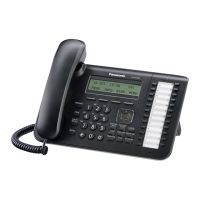
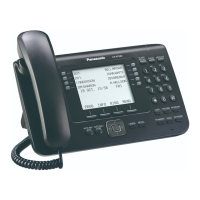
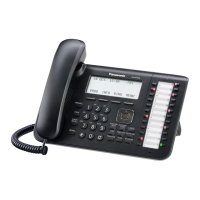
The provided manual describes the Panasonic KX-NT543, KX-NT546, and KX-NT560 IP-PT telephones, focusing on their physical controls, operational features, and basic maintenance functions.
These Panasonic IP-PT telephones are designed for business communication, offering a range of features for making and receiving calls, managing conversations, and customizing settings. The core function revolves around voice communication, enhanced by features like call hold, transfer, and multi-party conversations. The KX-NT560 model, in particular, includes advanced features such as Bluetooth headset registration and a self-labelling LCD display for flexible CO buttons, indicating a more sophisticated user experience for managing multiple lines and features.
The telephones are equipped with several user-friendly features to facilitate daily communication:
Display and Navigation:
Call Management:
Customization and Settings:
The manual primarily focuses on operational features rather than explicit maintenance. However, some aspects can be inferred as user-level maintenance or configuration:
Overall, the Panasonic KX-NT543, KX-NT546, and KX-NT560 IP-PT telephones are designed to be robust communication tools with extensive customization options to suit various business needs, emphasizing ease of use and efficient call management.
 General
| Speakerphone | Yes |
|---|---|
| Mounting | Desk/Wall |
| Handset type | Wired handset |
| Product type | IP Phone |
| Product color | Black |
| Lines quantity | 6 lines |
| Phonebook capacity | - entries |
| Number of VoIP accounts | - |
| Ethernet LAN (RJ-45) ports | 2 |
| Number of handles included | 1 pc(s) |
 Weight and Dimensions
| Depth | 170 mm |
|---|---|
| Width | 267 mm |
| Height | 180 mm |
| Weight | 1130 g |


 To Next Page
