EasyManua.ls Logo

Panasonic Technics SL-1900 - Operating Principle

Panasonic Technics SL-1900
15 pages
Print Icon
To Next Page IconTo Next Page
To Previous Page IconTo Previous Page
Loading...
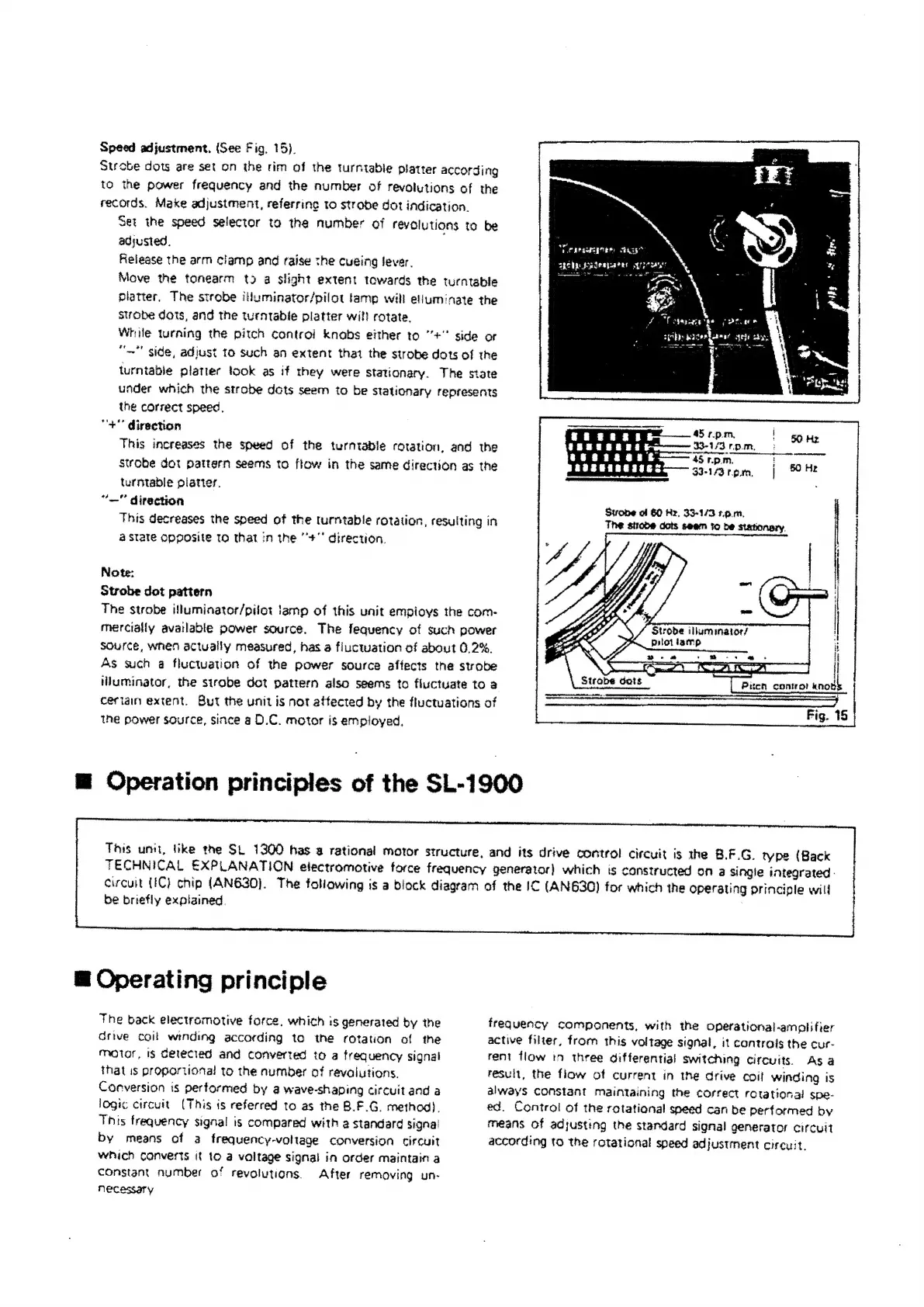
Speed
adjustment,
(See
Fig,
15).
Strobe
dots
are
set
on
the
rim
of
the
turntable
platter
according
to
the
power
frequency
and
the
number
of
revolutions
of
the
records.
Make
adjustment,
referrins
to
strobe
dot
indication.
Set
the
speed
selector
ta
the
number
of
revolutions
to
be
adjusted.
Release
the
arm
clamp
and
raise
the
cueing
fever.
Mave
the
tonearm
to
a
slight
extent
towards
the
turntable
platter,
The
strobe
iHuminator/pilot
tamp
will
efluminate
the
|
:
Sn
|
strobe
dots,
and
the
turntable
platter
wil!
rotate.
2
“E
opegcare
pDtaee
i
While
turning
the
pitch
control
knobs
either
to
’+"
side
or
act.
Jilbebaceryaey’
ani
ae
“~""
side,
adjust
to
such
an
extent
that
the
strobe
dots
of
the
q
{
oN
turntable
platier
took
as
if
they
were
stationary.
The
state
under
which
the
strobe
dots
seem
to
be
stationary
represents
the
correct
speed,
"+"
direction
This
increases
the
speed
of
the
turntable
rotation,
and
the
Strobe
dot
patrern
seems
to
flow
in
the
same
direction
as
the
turntable
platter.
**m"
direction
This
decreases
the
speed
of
the
turntable
rotation,
resulting
in
a
State
opposite
tO
that
in
the
"+"
direction,
|
Vleepaageynee:
stage’
SPOMa
Ba
dreparkt
sprpeseyt
\
ane
Neen
a
Strobe
of
$0
Rr,
39-1/3
rom,
Note:
strobe
dot
pattern
The
strobe
i!luminator/pilot
lamp
of
this
unit
empioys
the
com-
|
s
mercially
avatlable
power
source.
The
fequency
of
such
power
j
/
Strobe
iliuminator?
source,
when
actually
measured,
has
a
fluctuation
of
about
0.2%.
~
pilot
iamp
As
such
@
fluctuation
of
the
power
source
aftects
the
strobe
iiluminator,
the
strobe
dot
pattern
also
seems
to
fluctuate
to
a
certain
extent.
But
the
unit
is
not
attected
by
the
fluctuations
of
ihe
power
source,
since
a
D.C.
motor
i$
employed,
Strobe
Gots
Piten
contro:
kno
m@
Operation
principles
of
the
SL-1900
This
uni,
tike
the
SL
1300
has
a
rational
motor
structure,
and
its
drive
control
circuit
is
the
B.F.G.
rype
(Back
TECHNICAL
EXPLANATION
electromotive
force
frequency
generator)
which
is
constructed
on
a
single
integrated.
circuit
(IC)
chip
(AN630).
The
following
is
a
block
diagram
of
the
IC
LANG30)
for
which
the
operating
principle
will
be
briefly
explained.
@
Operating
principle
The
back
electromotive
force,
which
is
generated
by
the
drive
coil
wrnding
accarding
to
the
rotation
of
the
motor,
is
Ceteclad
and
converted
to
a
frequency
signal
that
is
proportional
to
the
number
of
ravalutions.
Conversion
is
performed
by
a
wave-shaping
circuit
and
a
logic
circuit
(This
ts
referred
to
as
the
B.F.G.
method).
This
frequency
signal
is
compared
with
a
standard
signa’
by
means
of
3
frequency-voltage
conversion
circuit
which
converts
i{
to
a
voltage
signal
in
order
maintain
a
constant
number
of
revolutions.
After
removing
un-
necessary
frequency
components,
with
the
operational-amopli
fier
active
filter,
from
this
voltage
signal,
it
controls
the
cur-
rent
flow
ta
three
differential
switching
circuits.
Asa
result,
the
flow
of
current
in
the
drive
coil
winding
is
always
COMStant
maintaining
the
correct
rotational
spe-
ed.
Control
of
the
rotational
speed
can
be
performed
by
means
of
adjusting
the
standard
signal
generator
circuit
according
to
the
rotational
speed
adjustment
circuit.

Related product manuals