
 Need help?
Do you have a question about the Panasonic TX-21AP2D and is the answer not in the manual?
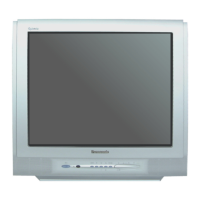
This document serves as a comprehensive service manual for the Panasonic Colour Television models TX-21AP2D, TX-21AP2F, TX-21AP2P, TX-21AP2D/B, and TX-21AP2P/B, all built on the GP3L Chassis. It provides essential information for technicians to safely and effectively service and maintain these television sets.
The primary function of these televisions is to display colour video and reproduce audio from various input sources. They are designed to operate within a 220-240V a.c., 50Hz power environment. The televisions are equipped with a 51cm picture tube and deliver audio output through two 5W RMS speakers, with a maximum power output of 10W, at an 8Ω impedance. They also feature an 8Ω impedance headphone jack for private listening.
For connectivity, the televisions offer a range of options. An AV1 21-pin SCART terminal provides comprehensive video and audio input/output capabilities, supporting 1V p-p 75Ω for video and 500mV rms 10kΩ for audio. This SCART connection also supports RGB input at 0.7V p-p 75Ω. Additionally, an AV2 front terminal includes RCA connectors for both audio (500mV rms 10kΩ) and video (1V p-p 75Ω) inputs, offering convenient access for temporary device connections. Aerial impedance is set at 75Ω.
The televisions are designed to receive a wide array of broadcast signals. This includes VHF channels E2-E12, A-H (ITALY), and R3-R5, as well as UHF channels E21-E69. They also support CATV channels S1-S10, S01-S05, S11-S20 (U1-U10), and HYPERBAND. The receiving system is multi-standard, accommodating PAL-I, B/G, D/K, SECAM B/G, M.NTSC (AV only), PAL 525/60 (AV only), and NTSC (AV only).
The internal signal processing involves several key intermediate frequencies. For video, these include 38.9MHz and 33.9MHz. Audio intermediate frequencies vary depending on the standard: 33.4MHz (B/G), 33.16MHz (A2), 33.05MHz (NICAM B/G, D/K,L), and 32.4MHz (D/K), 32.66MHz (CZ STEREO). For L' standards, 40.4MHz and 39.75MHz (L'NICAM) are used. Colour processing utilizes 34.47MHz (PAL), 34.5MHz, 34.65MHz (SECAM), and 38.3MHz, 38.15MHz (SECAM L').
Usage features for the end-user include basic controls for brightness and contrast, which are adjustable to minimum settings during specific service procedures. The television can be put into a "Service Mode" for advanced adjustments, accessible via a combination of remote control and front panel buttons. A "Self-Check" mode is also available, allowing for automatic verification of bus lines and hexadecimal codes. This mode is activated by setting Bass to maximum, Treble to minimum, and simultaneously pressing the "STATUS +" button on the remote control and the down (-/v) button on the front panel controls. Exiting Self-Check mode is done by switching off the TV at the power button.
Maintenance features are extensively covered in the manual, emphasizing safety and proper adjustment procedures. Technicians are advised to use an isolation transformer when servicing a "hot chassis" and to ensure all protective devices are correctly installed after repairs. High voltage potentials, up to 27kV, are present during operation, necessitating caution and proper discharge of the picture tube anode.
Leakage current checks, both "cold" and "hot," are critical maintenance steps to prevent shock hazards. The "cold check" involves measuring resistance between a jumpered a.c. plug and exposed metallic parts, with readings expected between 4M ohm and 20M ohm, or infinite if no return path to chassis exists. The "hot check" involves measuring potential across a 2kΩ 10W resistor in series with an exposed metallic part and earth, with potentials not exceeding 1.4 Vrms.
X-Radiation warnings are also provided, highlighting the high voltage section and picture tube as potential sources. Accurate, periodically calibrated high voltage meters are recommended for measuring high voltage, which should be 26kV ± 1kV with brightness set to minimum. Immediate service is required if this tolerance is exceeded, and only the specified picture tube should be used to prevent X-Radiation.
The manual details how to remove the rear cover by unscrewing five specific screws. It also identifies the locations of key internal components like the D-Board, L-Board, Focus, and Screen controls. Adjustment procedures for various parameters, such as +B SET-UP, UG2/CUT OFF, Vertical Slope, Vertical Position, Vertical Amplitude, Horizontal Shift, R-CUT, G-CUT, R-Drive, G-Drive, B-Drive, AGC, Sub Colour, and Sub Brightness, are outlined. These adjustments are performed in Service Mode 1, using the remote control and front panel buttons to navigate and alter values, with a "STR" button on the customer controls used to store adjustments.
Waveform pattern tables are included to aid in troubleshooting, providing reference waveforms for various test points under specific conditions (Contrast: MAX, Brightness: MID, Colour: MID, Sharpness: MID). Schematic diagrams and conductor views are provided for both the D-Board and L-Board, with important safety notices regarding components identified by a mark, which must be replaced with manufacturer-specified parts. The diagrams also use specific symbols for test points, earth connections (Chassis Earth and Line Earth), and signal paths (Video and Audio). Voltage measurements are specified to be taken with a d.c. voltmeter under conditions of a.c. 220V-240V, 50Hz power, Colour Bar signal (RF), and all customer controls at maximum position.
Remarks on safety during servicing include warnings against touching hot and cold parts simultaneously, short-circuiting circuits, and connecting instruments incorrectly. The Power Supply Circuit is highlighted as a separate circuit area with its own power supply, isolated from the earth connection, with HOT and COLD indications in the schematic diagram.
 General
| Screen Size | 21 inches |
|---|---|
| Display Technology | CRT |
| Aspect Ratio | 4:3 |
| TV Standard | PAL/SECAM |
| Inputs | Composite, RF |


 To Next Page