
 Need help?
Do you have a question about the Panasonic TX-P50UT30 and is the answer not in the manual?
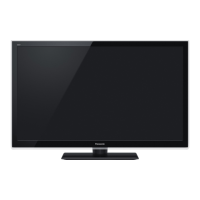
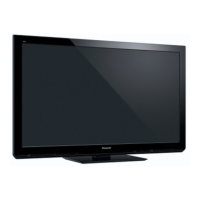
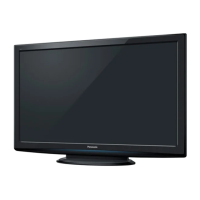
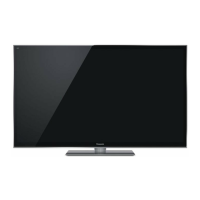
This document provides service and maintenance information for the Panasonic Plasma Television models TX-P50UT30E and TX-P50UT30J, which utilize the GPF14D-E Chassis.
The Panasonic Plasma Television is designed for home entertainment, offering a large display for viewing various content. It supports multiple input sources, including analog and digital terrestrial/cable broadcasts, as well as external devices via component, HDMI, and AV inputs. The television is equipped with sound output capabilities, including integrated speakers and a headphone jack. Advanced features include 3D eyewear compatibility and network connectivity via Ethernet for accessing online services.
Power Source: AC 220-240 V, 50 / 60 Hz Rated Power Consumption: 315 W On mode Average Power Consumption: 167 W (based on IEC 62087 Ed.2 measurement method) Standby Power Consumption: 0.40 W (16.00 W with monitor out recording)
Display Panel:
Sound:
Receiving Systems / Band Name:
Aerial Input: VHF / UHF
Operating Conditions:
Connection Terminals:
Dimensions (W × H × D):
Mass:
Service Mode: The television includes a service mode for diagnostics and adjustments. This mode allows technicians to check and modify various settings, including picture adjustments (contrast, color, tint, brightness, position, amplitude), white balance, and option settings. It also provides access to the SOS History, which records the number of LED blinks indicating past errors, and displays cumulative power-on time and on/off cycles.
Hotel Mode: A "Hotel Mode" is available to restrict certain functions, making the television suitable for hospitality environments. This mode allows setting initial input, program number, and volume level upon power-on, as well as locking local control buttons and remote control functions. It also includes features for managing private information for VIERA Cast, allowing it to be kept or reset.
Data Copy by SD Card: The television supports data copying via an SD card, which is useful for board replacement or for configuring multiple units in a hotel or facility. This feature allows copying user settings, hotel mode settings, channel scan data, and adjustment/factory preset data from an existing A-board to a new one, or from a master TV to other TVs. A startup file (boardreplace.pwd or hotel.pwd) is required on the SD card, and a password must be entered to initiate the copy process.
Applicable Signals: The television is compatible with a wide range of component (Y, PB, PR) and HDMI signals, including various interlaced and progressive scan formats (e.g., 525i/p, 625i/p, 750p, 1125i/p). For PC input via HDMI, it supports standard timings such as 640x480 @60 Hz, 1280x720 @60 Hz, and 1920x1080 @60 Hz.
Safety Precautions: The manual emphasizes general safety guidelines for repairs, including not modifying equipment, replacing entire wiring units if damaged, proper handling of connectors, observing original lead dress, replacing overheated/damaged parts, and ensuring protective devices are properly installed.
Touch-Current Check: A detailed procedure for performing a touch-current check is provided to prevent shock hazards. This involves measuring potential across a measuring network connected between exposed metallic parts and earth ground, ensuring it does not exceed specified limits.
Electrostatic Discharge (ESD) Prevention: Specific techniques are outlined to prevent ESD damage to sensitive components (ES Devices) during servicing. These include draining body ESD, placing assemblies on conductive surfaces, using grounded soldering irons and anti-static solder removal devices, avoiding freon-propelled chemicals, and handling replacement ES devices carefully in their protective packaging.
Lead-Free Solder (PbF) Information: The document notes that the television is manufactured using lead-free solder (Sn+Ag+Cu) for environmental reasons. It provides guidance for service and repair work, recommending the use of PbF solder and highlighting its higher melting point (50-70°F / 30-40°C higher than standard solder) and tendency to splash if overheated. Instructions are given for completely removing old solder before applying new, and for checking for excess solder on double-layered boards.
Troubleshooting Guide: A self-check function is integrated into the television to aid in troubleshooting. This includes checking IIC bus lines and interpreting power LED blinking patterns, which indicate specific defective blocks or protection circuit activations. For instance, 7 blinks of the power LED indicate a failure in the SC or SU/SD board, for which a specialized SC jig (TZSC09187) is provided to isolate the faulty board.
Local Screen Failure Diagnosis: A diagram is included to help diagnose local screen failures (e.g., vertical bars) by correlating the affected screen area with potential defective PCB components (SU, SD, SC, SS, C1, C2, C3, and A boards).
Disassembly and Assembly Instructions: Comprehensive step-by-step instructions are provided for disassembling and assembling various components, including the rear cover, AC inlet, P-Board, side terminal cover, tuner unit, A-Board, speakers, SU-Board, SD-Board, SC-Board, SS-Board, stand bracket, hanger metals, plasma panel section, radiator plate, C1/C2/C3-Boards, attachment metal bottom/top, glass holders, K-Board, and V-Board. Specific cautions are given, such as waiting for capacitors to discharge before handling certain boards and handling the plasma panel carefully due to its fragility.
Measurements and Adjustments: The manual details procedures for critical adjustments, such as Vsus selection (setting Vsus to LOW when replacing the plasma panel or A-board) and sub-contrast adjustment for RF, AV, and HD inputs. For white balance adjustment, two methods are described: "copy adjustment" and "differential and copy adjustment," depending on the PEAKS EEPROM version. These procedures involve using a color analyzer and adjusting specific parameters in service mode to achieve desired color temperature settings (COOL, NORMAL, WARM).


 To Next Page
 General