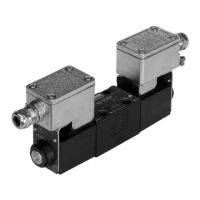
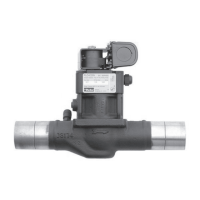
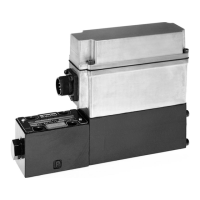
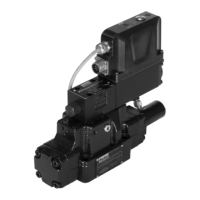
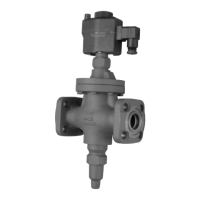
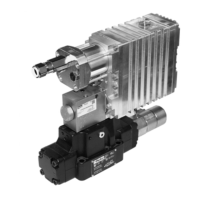
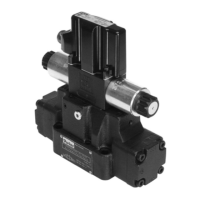
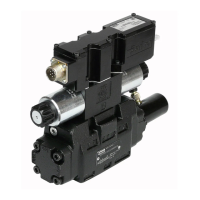
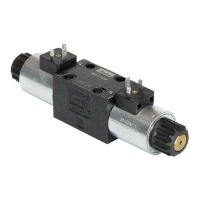
This document provides operating instructions for Parker Hannifin's series of directly operated and pilot-operated directional control valves, including the D1VW*-SC / D1DW*-SC (NG6), D3W*-SC / D3DW*-SC (NG10), D31DW*-SC (NG10), D41VW*-SC (NG16), and D81VW*-SC / D91VW*-SC (NG25) series. These valves are subplate-mounted and feature a slider-type design.
Function Description
The DCV valves are devices designed to influence the direction of fluid flow within a hydraulic system by making or breaking connections between various ports. Activation of a solenoid or hydraulic pilot causes the piston within the valve to move to an end position. When the electrical signal is removed, an installed spring returns the piston to its starting position. The integrated position control system detects when the piston is in the starting position.
For pilot-operated directional control valves (Series D31DW, D41VW, D81VW, D91VW), a minimum pilot pressure must be provided to ensure reliable operation of the main piston. This requires a suitable combination of flow and return arrangements for the pilot oil. With piston 030, there is a brief connection from P to T in the transitional position, necessitating an external pilot oil supply or an integrated precharge valve to guarantee reliable valve operation even at low flows.
Important Technical Specifications
The valves are designed for mould closing devices in injection moulding machines. They comply with essential health and safety requirements of Annex I of the Machinery Directive 2006/42/EC.
General Specifications (common across series, with variations):
- Design: Directional spool valve
- Actuation: Solenoid
- Mounting Position: As desired, horizontal mounting preferred
- Ambient Temperature: -20°C to +60°C
- Max. Operating Pressure:
- Directly operated (D1VW/D1DW, D3W/D3DW): P, A, B: 350 bar; T: 210 bar
- Pilot operated (D31DW, D41VW, D81VW/D91VW): Pilot drain internal: P, A, B, X: 350 bar; T, Y: 140 bar. Pilot drain external: P, A, B, T, X: 350 bar; Y: 140 bar.
- Fluid: Hydraulic oil according to DIN 51524
- Fluid Temperature: -20°C to +70°C
- Viscosity Permitted: 2.8 to 400 cSt / mm²/s
- Viscosity Recommended: 30 to 80 cSt / mm²/s
- Max. Contamination: ISO 4406; 18/16/13
- Duty Cycle: 100% ED; CAUTION: coil temperature up to 150°C possible
- Protection Class: IP 65 to EN 60529 (plugged and mounted)
- Solenoid Connection: Connector to EN 175301-803, solenoid identification to ISO 9461
- Wiring Min.: 3 x 1.5 mm² recommended
- Wiring Length Max.: 50 m recommended
Series-Specific Nominal Sizes and Weights:
- D1VW/D1DW: NG06 / CETOP 03 / NFPA D03; Weight (1 solenoid): 1.8 kg
- D3W/D3DW: NG10 / CETOP 05 / NFPA D05; Weight (1 solenoid): 5.2 kg
- D31DW: NG10 / CETOP 05 / NFPA D05; Weight (1/2 solenoids): 6.0 / 6.6 kg
- D41VW: NG16 / CETOP RP 121-H / NFPA D07; Weight (1/2 solenoids): 9.7 / 10.3 kg
- D81VW/D91VW: NG25 / CETOP RP 121-H / NFPA D08; Weight (1/2 solenoids): 17.9 / 18.6 kg
Flow Max. and Leakage:
- D1VW/D1DW: Flow max. 80 l/min; Leakage at 50 bar: Up to 10 ml/min per flow path.
- D3W/D3DW: Flow max. 150 l/min; Leakage at 50 bar: Up to 20 ml/min per flow path.
- D31DW: Flow max. 150 l/min; Leakage at 350 bar: Up to 100 ml/min.
- D41VW: Flow max. 300 l/min; Leakage at 350 bar: Up to 200 ml/min.
- D81VW/D91VW: Flow max. 700 l/min; Leakage at 350 bar: Up to 800 ml/min.
Position Control Switch (Type 118368-01):
- Supply Voltage: 24 VDC (±20% tolerance, ≤10% ripple)
- Polarity Protection: 300 V
- Current Consumption (without load): ≤20 mA
- Switching Hysteresis: <0.06 mm
- Max. Output Current per Channel (ohmic): 250 mA
- Ambient Temperature: -20°C to +85°C
- Protection: IP65 acc. EN 60529
- CE Conformity: EN 61000-4-2/EN 61000-4-4/EN 61000-4-6 (guaranteed with screened cable and female connector)/ENV 50140/ENV 50204
- Min. Distance to next AC Solenoid: 0.1 m
- Interface: M12x1 to IEC 61076-2-101
- Function: Supervises one trip point. When reached, pin 4 is non-conducting (normally closed), and pin 2 becomes conducting (normally open).
- Outputs: Open collector
Usage Features
Installation:
- The valve must be operated with a suitable control system.
- Separate wires are used for solenoid and position control connections.
- Each solenoid connection requires a plug 2 + PE as specified in EN 175301-803 (plugs must be ordered separately).
- The sealing surface of the valve must be properly connected to the earthed frame of the machine.
- Fastening bolts must be tightened diagonally and evenly to the manufacturer's specified torques (e.g., 7.6 Nm ±15% for D1VW/D1DW, 13.2 Nm ±15% for D3W/D3DW and D31DW, 63 Nm ±15% and 13.2 Nm ±15% for D41VW, 108 Nm ±15% for D81VW/D91VW).
- The DCV valves must only be installed as indicated in ISO 4401.
- Connections to the limit switch must be laid separately from mains connections to prevent inductive voltage peaks.
- A suitable DC power supply with ripple not exceeding 10% is required for the switch.
- Voltage spikes from inductive loads should be eliminated using protection circuits (e.g., flyback diodes).
- The limit switch should not be installed close to AC consumers; a minimum distance of 0.1 m must be observed.
- The product may only be operated within the specified technical data conditions.
Pressure Fluids:
- Mineral oil: No restrictions.
- HFA (oil in water emulsions), HFB (water in oil emulsions): Mandatory check.
- HFC (water glycols), HFD (anhydrous fluids/phosphate ester): Possible restrictions, recommended check.
- Special sealing materials are supplied depending on the fluid used.
Safety:
- The product is a safety component and may only be repaired by the manufacturer if it malfunctions. User repairs invalidate the warranty.
- Observe ambient conditions; unauthorized temperatures, shocks, aggressive chemicals, radiation, or electromagnetic emissions can cause malfunctions.
- DCV valves with position control are not suitable for use in Ex areas (gas/dust).
- In a power failure, the valve piston returns to the spring-centred starting position; potential hazards must be checked.
- The service temperatures may exceed 70°C, causing burn injury; personal protective equipment is required.
- If integrated electronics are exposed to temperatures above 80°C, they may malfunction.
- Leaking plugs can cause malfunctions and safety hazards; valves with leaking plugs must be returned for repair.
- If electronic components are exposed to electromagnetic fields from lightning, they must be checked for perfect operation; malfunctioning products must be returned for repair.
- If any safety features are not operational, the system/machine must be shut down immediately.
Maintenance Features
Storage:
- Protect from dirt, weather, and damage.
- Internal components are protected from corrosion by hydraulic oil from the factory.
- Storage conditions:
- 12 months: Stable air humidity 60% and temperature >5°C - <25°C.
- 6 months: Fluctuating air humidity and temperature >5°C - <35°C.
- Store securely to prevent tipping or falling.
Commissioning:
- Before installation, check for damage and missing parts (e.g., seals), especially on sealing surfaces and safety devices. Do not use damaged products.
- Remove all transport securing devices, protective covers, and packaging.
- Check for foreign objects in hydraulic passages.
- Ensure the hydraulic system/machine is unpressurized before installation.
- Ensure sealing rings are seated correctly.
- Before commissioning, verify correct hydraulic system installation and consider all safety regulations.
- After placing the valve on the mating surface, tighten all bolts diagonally and evenly.
- Check the sealing surface for leaks when the valve is first pressurized.
Regular Maintenance:
- Essential for prolonging service life and safeguarding plant safety.
- Adhere to user-established maintenance intervals.
- Minimum maintenance requirements: visual inspections to check seal integrity at position control, check for leaks, and ensure plugs are properly secured.
- If the product is removed for maintenance, the system/machine must be disabled to prevent unexpected switch-on.
- Before checking or removing electrical connections, ensure power supply is disconnected and cannot be reconnected unintentionally.
- Replaceable parts with original Parker replacement parts: accessible O-rings (sealing surfaces), solenoid coils, and plugs (if included with original product).
- Hydraulic fluid must be replaced periodically based on type, grade, filtration, operating temperature, and ambient conditions.
- The hydraulic system must be air bled during initial startup, after oil changes, and after opening lines or valves.
- Regularly actuate the valve to prevent oil particles from causing the piston to seize.
Decommissioning and Disposal:
- Ensure the hydraulic system/machine is unpressurized before product removal.
- At the end of service life, all escaping pressure fluids must be removed and disposed of properly.
- Any significant fluids remaining in the product must be removed and disposed of properly.
- All materials must be segregated for recycling and taken to a suitable recycling centre.
- Segregate packaging material properly (paper, plastic).
- None of the components contain hazardous materials.
- Comply with normal local environmental protection laws for disposal.


 To Next Page
 General